Vista previa
 Compartir
 Compartir
 Ver detalles

 Descargar
 Ver artículos similares
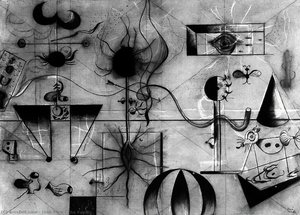
 Radiografía
 Presentación de diapositivas
 Estadísticas
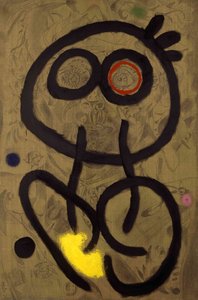
Retrato de muchacha


 Leer más
Giclée / Impresión de arte
Impresiones giclée o en lienzo de calidad de museo con producción rápida y opciones de acabado flexibles. ( Encargar reproducción pintada a mano Ver versión en imagen digital)




P118B $10

P118H $10

P118W $10

P438Z $10

P508JH $12

P508YH $12

P805H $10

P805Z $10

P919BZ $10

P919G $10

P919XJ $10

P959ZH $10

P968JZ $12

W106C $8

W218G $10

W218JH $8

W218Y $10

W307PJ $10

W316G $10

W316PJ $8

W316Y $10

W398PJ $8

W4111J $10

W500HY $15

W500JH $15

W692G $12

W849H $8

W940BG $15

W953PJ $8




Elija entre nuestros tamaños predefinidos que respetan las proporciones originales de la obra.

Puede introducir sus propias dimensiones para adaptarse a un marco o espacio específico. Si el tamaño seleccionado no coincide con las proporciones de la imagen original, recortaremos la obra de arte o extenderemos la imagen con un borde con efecto espejo o de color sólido. Se enviará una maqueta digital para su aprobación antes de que comience la producción.
Tenga en cuenta que la vista previa en pantalla no refleja el recorte o la extensión real. Solo la maqueta mostrará con precisión la composición final.
Aunque existen tamaños personalizados, recomendamos seleccionar una dimensión de la lista predefinida para preservar las proporciones originales.
Envío a todo el mundo () en 2 semanas en lugar de las 4/5 semanas estándar. (16 septiembre)

Envío exprés gratuito a todo el mundo

Lienzo de lino de alta calidad

Seguro de envío completo

Garantía de reembolso de impuestos aduaneros

Garantía de fidelidad cromática exacta

Política de devolución de 100 días (solo por defectos)

Garantía de devolución del 100% del dinero

Oferta por volumen
 La opción de vidrio solo está disponible en tamaños inferiores a 110 cm.

Retrato de muchacha
Giclée / Impresión de arte
Tamaño de la reproducción
-


Precio total
$ 62
A Dreamscape in Color: The Soul of Joan Miró’s Retrato de Muchacha
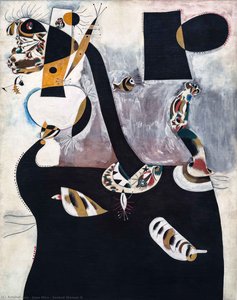
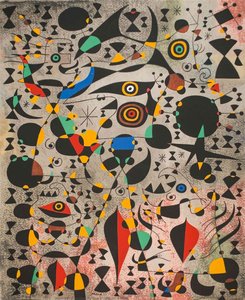
In the vast, swirling cosmos of 20th-century modernism, few works capture the delicate tension between vulnerability and cosmic whimsy as poignantly as Joan Miró’s “Retrato de Muchacha”. Created in 1967, this masterpiece serves as a profound window into the artist's subconscious, where the boundaries between reality and dream dissolve into a symphony of organic abstraction. At first glance, the viewer is met with the figure of a young woman, her expression etched with a quiet, melancholic beauty. She holds a black umbrella aloft, an element that transcends mere utility to become a powerful symbol of protection and resilience against the unpredictable storms of existence. Through Miró’s eyes, this portrait is not merely a depiction of a person, but an exploration of the human spirit navigating a landscape of myth and memory.
The technique employed in this work is a masterclass in organic abstraction, eschewing the rigid constraints of traditional realism to prioritize raw emotional resonance. Miró utilizes bold, irregular brushstrokes—often applied with the tactile energy of a palette knife—to build a textured surface that feels alive and breathing. The colors are a captivating paradox; they are vibrant enough to dance across the eye, yet muted by a certain atmospheric gravity that evokes the misty, dreamlike quality of Catalan landscapes. This deliberate avoidance of geometric precision allows for a sense of spontaneity, where curving lines and amorphous shapes evoke the fluid rhythms of nature itself, reminiscent of the architectural organicism found in the works of Gaudí.
Symbolism and the Spirit of Catalonia
Beyond its aesthetic allure, “Retrato de Muchacha” is deeply embedded in the cultural fabric of Catalan identity. Miró’s work has always been a dialogue with his roots, and here, the elements of folklore and Modernisme converge. The inclusion of small, wandering birds—one drifting near the upper periphery and another nestled toward the base—adds a layer of kinetic energy and life to the composition, suggesting a world in constant, subtle motion. These creatures act as messengers between the earthly realm of the woman and the celestial realm of the abstract, mirroring the Surrealist preoccupation with liberating the imagination from the shackles of conscious control.
For the discerning collector or interior designer, this painting offers more than just visual splendor; it provides a focal point of profound emotional depth. The interplay between the dark, protective silhouette of the umbrella and the whimsical, floating elements creates a balanced tension that can anchor a sophisticated room. Whether placed in a contemporary gallery setting or a curated residential space, the artwork invites contemplation, prompting viewers to find their own meaning within its layers of color and shape. It is a piece that does not merely decorate a wall but transforms an environment, infusing it with the timeless, poetic vision of one of history's greatest dreamers.
Obras relacionadas
Biografía del artista
**vida temprana y carrera**
joan miró, un renombrado pintor, escultor y ceramista español, nació el 20 de abril de 1893 en Barcelona, España. Su familia, de raíces judías (marrano o converso), tuvo una influencia significativa en su vida temprana. El padre de Miró, Miquel Miró Adzerias, era orfebre y relojero, lo que pudo haber inspirado el interés del artista por los detalles intrincados.**desarrollo artístico**
Miró comenzó clases de dibujo a los siete años en una escuela privada en Barcelona. Posteriormente, se matriculó en la Academia de Bellas Artes La Llotja, a pesar de la desaprobación de su padre. Esto marcó el comienzo del viaje artístico de Miró, que eventualmente lo llevaría a convertirse en pionero del surrealismo y el arte abstracto.**obras notables y colaboraciones**
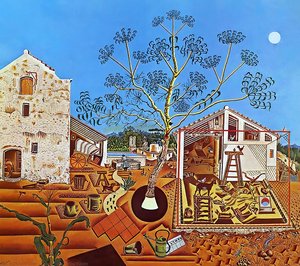
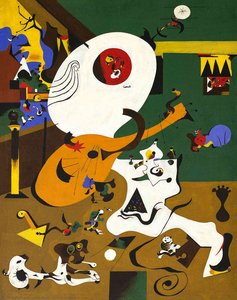
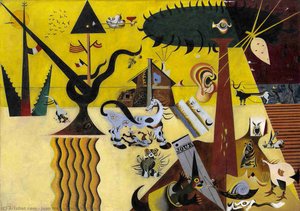
* la granja (1922), una pintura que muestra la transición de Miró a un estilo más individual, con cualidades nacionalistas. * Colaboración con Max Ernst en diseños para el ballet de Sergei Diaghilev en 1926, pionero en la técnica del grattage. * los interiores holandeses (1928), una serie de pinturas inspiradas en Hendrik Martenszoon Sorsh y Jan Steen, que muestra el estilo único de Miró.**museos y legado**
* La Fundación Joan Miró en Barcelona, establecida en 1975, dedicada a mostrar las obras de Miró. * La Fundación Pilar i Joan Miró en Palma de Mallorca, establecida en 1981, que consolida aún más el legado de Miró.**obras clave y su significado**
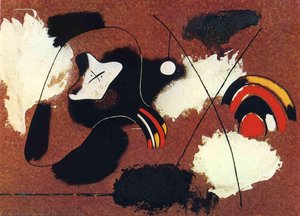
- pintura (1933), una pintura al óleo abstracta, ejemplificando la visión surrealista de Miró.
- pintura 11, otra obra notable y abstracta, que muestra el estilo único de Miró.
- la mazorca (37 x 46 cm), una obra surrealista, que presenta detalles intrincados.
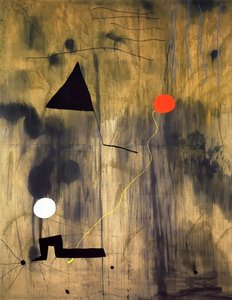
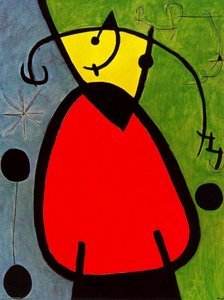
- el nacimiento del día, una obra de arte abstracta, que consolida aún más las contribuciones de Miró al arte abstracto.
**conclusión**
El legado de Joan Miró como pionero del surrealismo y el arte abstracto es innegable. Sus obras, exhibidas en varios museos, incluida la Fundación Joan Miró, continúan inspirando a artistas y entusiastas del arte por igual. Para obtener más información sobre las obras de Miró, visite [https://ArtsDot.com/@/joan-miro](https://ArtsDot.com/@/joan-miro) o explore sus notables obras en [https://ArtsDot.com/@@/8ewky5-joan-miro-painting](https://ArtsDot.com/@@/8ewky5-joan-miro-painting).- ver más obras de Joan Miró en ArtsDot.com
- descubra el museo Fundación Joan Miró en Barcelona, España
- explore la biografía del artista y sus obras notables en [https://en.wikipedia.org/wiki/joan_mir%c3%b3](https://en.wikipedia.org/wiki/joan_mir%c3%b3)
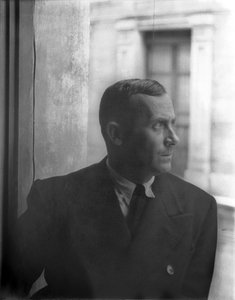
Joan Miró
1893 - 1983 , España
Datos clave
- Artistas Que Influyeron:
- Vincent van Gogh
- Paul Cézanne
- Estilo Artístico: Surrealismo, Arte Abstracto
- Fecha De Muerte: 1983
- Fecha De Nacimiento: 20 de abril de 1893
- Lugar De Nacimiento: Barcelona, España
- Nacionalidad: Española
- Nombre Completo: Joan Miró i Ferrà
- Obras Notables:
- La Granja
- Interiores Holandeses
- Pintura (1933)
- El Nacimiento del Mundo
Artículos relacionados
Kandinsky: Las 25 Obras Maestras del Pionero de la Abstracción | ArtsDot
Descubre las 25 obras maestras de Wassily Kandinsky, pionero del arte abstracto. Explora su expresionismo, composiciones únicas y la historia detrás de cada cuadro. Reproducciones de alta calidad para decorar tu hogar con arte moderno en ArtsDot.com.

Abstracción Geométrica: 10 Obras Maestras que Transformaron el Arte Moderno | ArtsDot
Descubre las 10 obras maestras de la abstracción geométrica que revolucionaron el arte moderno. Explora a Mondrian, Malevich y Kandinsky en ArtsDot.com. Reproducciones de alta calidad para tu hogar.
Joan Miró: Las 25 Obras Maestras del Genio Catalán | Arte y Decoración
Descubre las 25 obras maestras de Joan Miró, el genio del surrealismo catalán. Explora su arte abstracto, colores vibrantes y la historia detrás de cada cuadro. Reproducciones de alta calidad en ArtsDot.com para transformar tu hogar con arte original.
Expresionismo Abstracto: 10 Obras Maestras que Transformaron el Arte |
Descubre las 10 obras maestras del Expresionismo Abstracto: Pollock, Rothko y más. Explora la historia, técnica y significado de estos lienzos icónicos. Reproducciones de arte exclusivas en .
Surrealismo: 10 Obras Maestras que Transformaron el Arte y la Decoración
Descubre las 10 obras maestras del Surrealismo con Dalí, Magritte y Miró. Explora la historia, el simbolismo y la técnica de estos íconos del arte moderno. Encuentra reproducciones de alta calidad para tu hogar en .