

 Ver en contexto
 Enviar
 Compartir
 Detalles

 Descargar
 Similares
 Radiografía
 Presentación de diapositivas
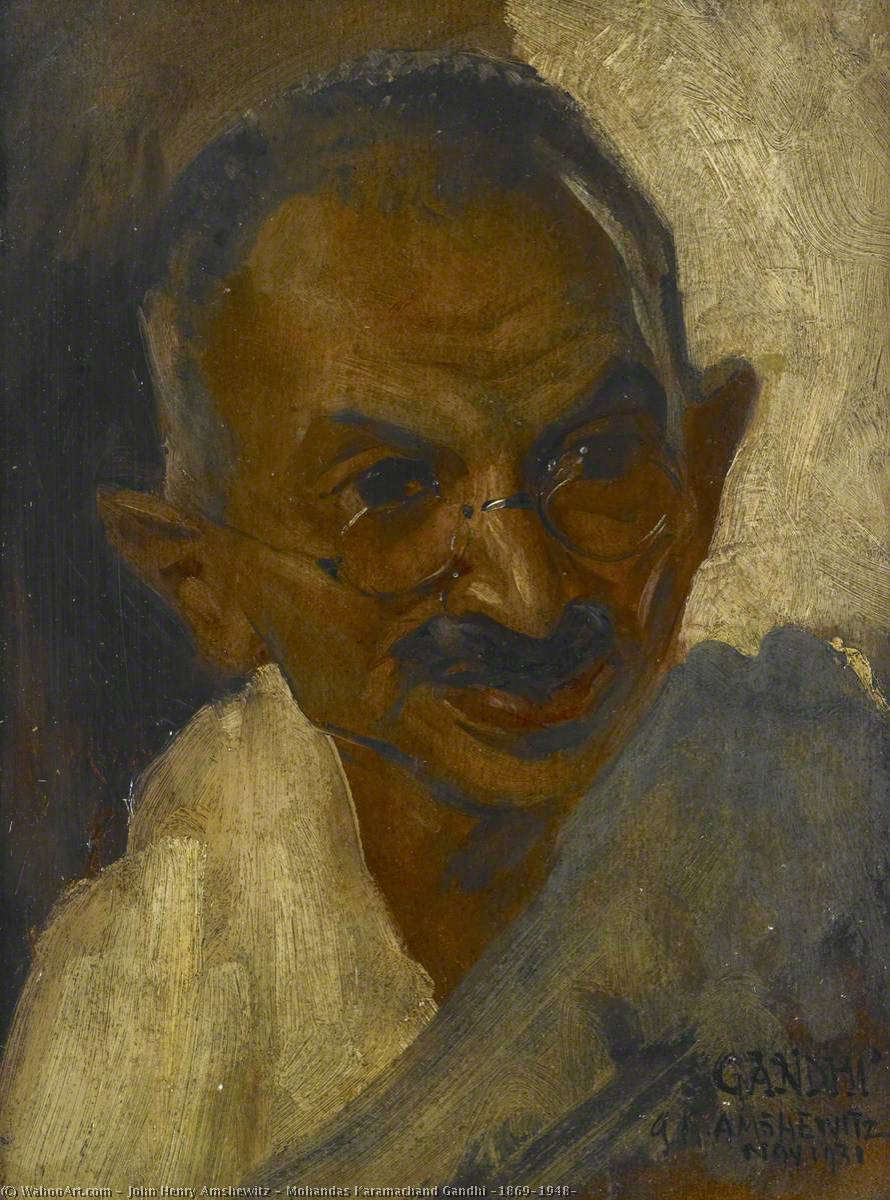
Mohandas Karamachand Gandhi (1869–1948)
 1931
1931 27.0 x 21.0 cm
 Biblioteca Británica
 Ver más
Reproducción al óleo hecha a mano
Óleo sobre lienzo pintado a mano en el tamaño y marco de su elección, realizado por encargo por nuestros artistas. ( Comprar impresión Comprar imagen)




































Elija entre nuestros tamaños predefinidos que respetan las proporciones originales de la obra.

Puede ingresar sus propias dimensiones para adaptarse a un marco o espacio específico. Si el tamaño seleccionado no coincide con las proporciones de la imagen original, recortaremos la obra o extenderemos la pintura con elementos adicionales pintados a mano. Se le enviará una maqueta digital para su aprobación antes de comenzar la producción.
Tenga en cuenta que la vista previa en pantalla no refleja el recorte o la extensión reales. Solo la maqueta mostrará con precisión la composición final.
Si bien existen tamaños personalizados, recomendamos seleccionar una dimensión de la lista predefinida para preservar las proporciones originales.
Tras realizar el pedido, el equipo de ArtsDot.com enviará un correo electrónico al cliente para solicitar instrucciones y proporcionarle una vista previa del boceto.
Envío a todo el mundo () en 3-4 semanas en lugar de las 5 semanas estándar. (2 septiembre). Sin comprometer la calidad.

Envío exprés gratuito a todo el mundo

Lienzo de lino de alta calidad

Seguro de envío total

Garantía de reembolso de impuestos aduaneros

Garantía de fidelidad cromática exacta

Política de devolución de 60 días (solo por defectos)

Garantía de devolución del 100% del dinero

Descuento por cantidad
 La opción de vidrio solo está disponible en tamaños inferiores a 110 cm.

Mohandas Karamachand Gandhi (1869–1948)
Técnica de reproducción
Dimensiones de la reproducción
-


Precio total final
$ 263
Obras relacionadas









Biografía del artista
John Henry Amshewitz: Bridging Tradition & Modernity
John Henry Amshewitz (1882 – 1942) was born into a Jewish family in Ramsgate, England, the son of Asher Amschejewitz, an Orthodox rabbi and scholar who had emigrated from Vilna to England in 1867 as a scholar in residence. His father’s erudition profoundly shaped his own intellectual pursuits and instilled within him a deep appreciation for Jewish tradition and scholarship—a legacy that would permeate throughout his life's work. From a young age, Amshewitz demonstrated exceptional artistic talent, securing a prestigious art scholarship to the Royal Academy School from 1902–07, where he honed his skills under the tutelage of luminaries like John Singer Sargent and Sir George Clausen. This formative period cemented his commitment to painting as a vocation and established him amongst the vanguard of British artists grappling with the challenges and opportunities presented by the burgeoning modernist movement.Early Artistic Development & Royal Academy Years
Amshewitz’s artistic journey commenced in earnest at the Royal Academy School, where he immersed himself in studying classical techniques alongside fellow contemporaries. Sargent's influence was particularly significant, fostering Amshewitz’s fascination with capturing fleeting moments of beauty and conveying emotion through nuanced brushstrokes—a stylistic hallmark that would characterize much of his subsequent oeuvre. The school’s emphasis on anatomical precision and compositional balance instilled within him a foundational understanding of artistic principles that served as bedrock for his explorations into diverse subjects and mediums. His fellow instructors, Clausen and Solomon J Solomon, broadened his horizons by introducing him to Impressionistic influences, encouraging experimentation with color palettes and capturing the atmospheric effects of natural landscapes—a stylistic divergence that would ultimately enrich his artistic repertoire. He diligently studied the works of Rembrandt and Rubens, absorbing their mastery of chiaroscuro and mastering techniques for conveying psychological depth through tonal modulation.Notable Commissions & Mural Projects
Amshewitz’s burgeoning reputation as a painter swiftly garnered him commissions from prominent civic institutions across England and South Africa, reflecting both his artistic prowess and his engagement with social responsibility. The Liverpool Town Hall murals—a monumental undertaking commemorating the 700th anniversary of the city's charter—stand as testament to his ambition and technical mastery. These expansive canvases demanded meticulous planning and execution, showcasing Amshewitz’s ability to synthesize classical influences with Impressionistic sensibilities into a cohesive visual narrative. Similarly, his work on the Royal Exchange in London demonstrated his versatility and willingness to embrace ambitious projects that pushed the boundaries of artistic expression. Beyond these grand commissions, he produced numerous portraits capturing the likenesses of influential figures—from Frederick Halford to Sir George Cory—demonstrating his sensitivity to character and conveying psychological depth through subtle tonal variations and expressive brushwork. His meticulous attention to detail ensured that each portrait conveyed not merely physical resemblance but also an understanding of the sitter’s inner life.South African Influence & Artistic Legacy
Amshewitz’s relocation to Johannesburg in 1916 marked a pivotal moment in his artistic life, fostering an enduring connection with the vibrant cultural landscape of South Africa. He established the Johannesburg Sketch Club—a pioneering initiative aimed at nurturing young talent and promoting artistic dialogue—and served as its president for many years, shaping the trajectory of Johannesburg’s art scene. His prolific output during this period encompassed depictions of gold mining activities, portraits of local residents, and evocative landscapes reflecting the region's distinctive topography and atmosphere. Among his most celebrated works are “The Fortune Hunter” and “The Voortrekker,” which exemplify Amshewitz’s ability to imbue his paintings with narrative richness and emotional resonance—qualities that continue to captivate audiences today. He skillfully blended Impressionistic techniques with Symbolist aesthetics, creating images imbued with spiritual significance and conveying complex emotions through carefully orchestrated color harmonies. His artistic legacy extends beyond individual masterpieces, encompassing a broader contribution to the development of British Primitivism and fostering a distinctive aesthetic sensibility characterized by unsettling portraits and poignant explorations of human experience.Recognition & Artistic Achievements
Throughout his career, Amshewitz received widespread acclaim for his artistic achievements—a testament to his unwavering dedication to craft and his profound engagement with the visual arts. His paintings were exhibited at prestigious venues across England and America, securing prominent positions in major collections and cementing his place amongst the foremost artists of his generation. The Royal Society of British Artists recognized his talent by electing him as a member in 1914—a distinction honoring his artistic excellence and intellectual curiosity. Furthermore, he garnered recognition for his etchings and dry points—mediums that allowed him to explore textural nuances and convey subtle emotional undertones—demonstrating his versatility as an artist and expanding the scope of his creative expression. His work was showcased at exhibitions in London and New York, securing critical acclaim and establishing him as a celebrated figure within the international art community. He remained steadfast in his pursuit of artistic excellence until his untimely death in 1942, leaving behind a rich body of work that continues to inspire admiration and scholarly inquiry.
Datos clave
- Artistic Movement Or Style: Impressionism
- Artists Who Influenced This Artist:
- Henry Lamb
- John Singer Sargent
- Date Of Birth: December 19th, 1882
- Full Name: John Henry AMSHEWITZ
- Nationality: British
- Notable Artworks:
- The Castilian
- Elephantasia
- Place Of Birth: Ramsgate, England

