 Ver en contexto
 Enviar
 Compartir
 Detalles

 Descargar
 Similares
 Radiografía
 Presentación de diapositivas
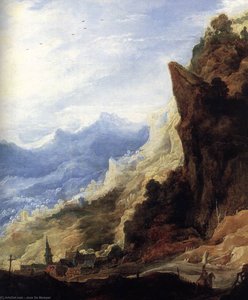
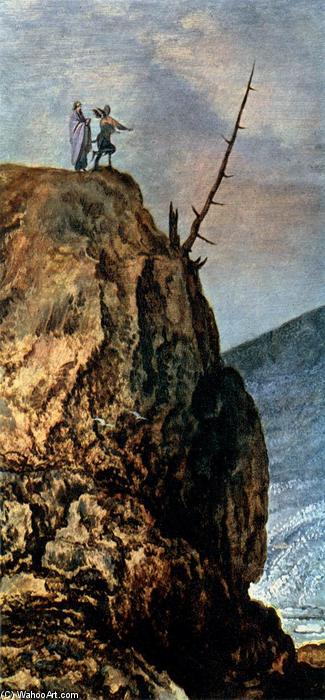
Landscape with the Temptation of Christ (detail)


 Ver más
Giclée / Impresión de arte
Impresiones giclée o en lienzo de calidad de museo con producción rápida y opciones de acabado flexibles. ( Comprar pintura hecha a mano Comprar imagen)




P118B $10

P118H $10

P118W $10

P438Z $10

P508JH $12

P508YH $12

P805H $10

P805Z $10

P919BZ $10

P919G $10

P919XJ $10

P959ZH $10

P968JZ $12

W106C $8

W218G $10

W218JH $8

W218Y $10

W307PJ $10

W316G $10

W316PJ $8

W316Y $10

W398PJ $8

W4111J $10

W500HY $15

W500JH $15

W692G $12

W849H $8

W940BG $15

W953PJ $8




Elija entre nuestros tamaños predefinidos que respetan las proporciones originales de la obra.

Puede introducir sus propias dimensiones para adaptarse a un marco o espacio específico. Si el tamaño seleccionado no coincide con las proporciones de la imagen original, recortaremos la obra de arte o extenderemos la imagen con un borde con efecto espejo o de color sólido. Se enviará una maqueta digital para su aprobación antes de que comience la producción.
Tenga en cuenta que la vista previa en pantalla no refleja el recorte o la extensión real. Solo la maqueta mostrará con precisión la composición final.
Aunque existen tamaños personalizados, recomendamos seleccionar una dimensión de la lista predefinida para preservar las proporciones originales.
Envío a todo el mundo () en 2 semanas en lugar de las 4/5 semanas estándar. (29 agosto)

Envío exprés gratuito a todo el mundo

Lienzo de lino de alta calidad

Seguro de envío total

Garantía de reembolso de impuestos aduaneros

Garantía de fidelidad cromática exacta

Política de devolución de 60 días (solo por defectos)

Garantía de devolución del 100% del dinero

Descuento por cantidad
 La opción de vidrio solo está disponible en tamaños inferiores a 110 cm.

Landscape with the Temptation of Christ (detail)
Giclée / Impresión de arte
Dimensiones de la reproducción
-


Precio total final
$ 62
A Moment Frozen in Time: Deconstructing ‘Landscape with the Temptation of Christ’
Joos de Momper the Younger's “Landscape with the Temptation of Christ” – a detail from a larger composition – isn’t merely a depiction of a serene vista; it’s a carefully constructed tableau brimming with symbolic weight and reflecting the anxieties and spiritual inquiries of 17th-century Flanders. The painting, likely executed around 1605, offers a glimpse into a world grappling with religious reformation, political instability, and the enduring tension between earthly desires and divine judgment. The scene unfolds on a rugged cliffside, overlooking what appears to be a vast expanse of water – perhaps the Scheldt or another significant waterway of the region – its surface reflecting the muted tones of the sky above. The composition immediately draws the eye to two figures engaged in a hushed conversation; one gesturing emphatically towards the other who sits pensively on a rock, their postures suggesting a weighty exchange.
De Momper’s mastery lies not just in his technical skill but in his ability to evoke atmosphere and imbue the landscape with profound meaning. The artist was deeply influenced by the Dutch Golden Age painters of the time, particularly those who specialized in topographical views – paintings that aimed to accurately represent specific locations. However, de Momper transcends mere realism; he employs a subtle, almost melancholic palette dominated by earthy browns, ochres, and muted greens, creating a sense of quiet contemplation. The dramatic interplay of light and shadow, skillfully rendered through meticulous brushwork, adds depth and volume to the scene, highlighting the textures of the rocks, foliage, and even the figures’ clothing. Notice how the sunlight catches the edges of the cliff face, casting long shadows that emphasize its imposing presence – a visual metaphor for the challenges and temptations faced by humanity.
The Weight of Symbolism: Temptation and Redemption
The title itself, “Landscape with the Temptation of Christ,” immediately establishes a theological framework. While the full narrative is contained within the larger composition, this detail powerfully suggests the moment of temptation – not necessarily in a dramatic, overtly confrontational way, but rather through a subtle exchange between two individuals. The gesture of the figure on the left could represent the allure of worldly pleasures or sinful desires, while the seated figure embodies contemplation and perhaps even regret. The rocky terrain beneath them reinforces this sense of precariousness; it’s a landscape fraught with danger and uncertainty. The inclusion of a solitary tree branch extending horizontally across the composition acts as a visual anchor, providing balance to the scene and subtly hinting at the enduring presence of nature – a constant reminder of God's creation and his ultimate authority.
Furthermore, the setting itself carries symbolic weight. Cliffsides often represent thresholds or transitions—the boundary between the earthly realm and the divine. The water, frequently associated with both life and death, adds another layer of complexity to the scene. The muted colors and subdued light contribute to a sense of solemnity, inviting viewers to reflect on themes of morality, faith, and the struggle between good and evil. De Momper’s skill lies in his ability to convey these complex ideas through deceptively simple imagery.
A Master of Flemish Detail: Technique and Legacy
Joos de Momper the Younger was a pivotal figure in the development of Flemish landscape painting, building upon the traditions established by his father and grandfather. He was renowned for his meticulous attention to detail, particularly in rendering naturalistic elements – trees, rocks, water, and foliage – with astonishing accuracy. His work demonstrates a deep understanding of perspective and atmospheric effects, creating a sense of depth and realism that was highly valued during the 17th century. De Momper’s technique involved layering thin glazes of oil paint to achieve luminous colors and subtle gradations of tone. He also employed a dry brush technique to create textural variations in the rocks and foliage, adding visual interest and complexity to the composition.
Despite his considerable talent, de Momper's name has often been overshadowed by that of his more famous contemporaries. However, his contributions to the development of Flemish landscape painting are undeniable. His “Landscape with the Temptation of Christ” – this intimate detail – stands as a testament to his artistic skill and his ability to imbue a seemingly simple landscape with profound symbolic meaning. Reproductions of this piece offer a captivating glimpse into the world of 17th-century Flanders, inviting viewers to contemplate the timeless themes of temptation, redemption, and the enduring beauty of nature.
Obras relacionadas
Biografía del artista
Joos de Momper - Un Pionero del Paisaje Flamenco
Joos de Momper el Joven (Amberes, 1564-5 de febrero de 1635), también conocido como Josse de Momper, fue uno de los más importantes paisajistas flamencos entre Pieter Brueghel el Viejo y Pedro Pablo Rubens. La influencia de Brueghel es evidente en muchos cuadros de Momper. Su nombre también se escribe como Joost, Joes o Jodocus.Joos de Momper el Joven fue aprendiz primero con su padre, el pintor Bartholomäus de Momper. Entró a formar parte de la guilda de san Lucas o gremio de pintores en 1581, formando parte de la junta directiva en 1611. En los años 1580, viajó a Italia a estudiar arte, conociendo, entre otros, a Lodewijk Toeput (Pozzoserrato en Treviso). Para el año 1594 ya estaba de vuelta en Amberes, donde se le documenta como partícipe en la decoración para el recibimiento del archiduque Ernesto.
Se asumió que en los años 1580 viajó a Italia para estudiar arte. La evidencia de este viaje fue proporcionada cuando paisajes impresionistas en la iglesia de S. Vitale en Roma, anteriormente atribuidos a Paul Bril, fueron dados a Joos de Momper el Joven.
En 1590 se casó con Elisabeth Gobijn. La pareja tuvo 10 hijos de los cuales Philippe de Momper fue pintor.
Estilo y Influencias
Como Abraham Bloemaert en Utrecht, de Momper simboliza el paso del manierismo al barroco en Amberes. De Momper pintó principalmente paisajes, el género por el que fue bien considerado en vida. Pintó tanto paisajes de fantasía como realistas. Los primeros siguen una gradación de color manierista convencional: marrón en el primer plano, verde grisáceo después y azul en el fondo; adopta en estos paisajes un punto de vista más bien alto. En cambio, en sus paisajes más realistas el punto de vista adoptado es más bajo y los colores más naturales.
Su influencia fue proporcionada por Pieter Brueghel el Viejo, cuyo estilo panorámico tuvo un impacto profundo en la obra de Momper. De Momper no sólo copiaba Brueghel; él absorbía su espíritu, adaptándolo a su propia visión y forjando un estilo que conectaba los principios manieristas del siglo XVI con el creciente realismo del siglo XVII.
Obras Destacadas
Paisaje fluvial con cacería de jabalíes, h. 1600 - Rijksmuseum, Ámsterdam
Helicón o Visita de Minerva a las Musas - Museo Real de Bellas Artes de Amberes, en Bélgica
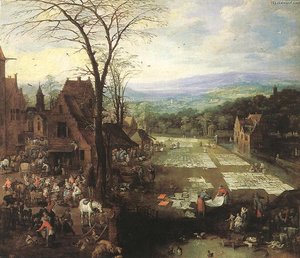
Mercado flamenco y lavadero - Museo del Prado, Madrid
Paisaje con la tentación de Cristo - Galería Nacional de Praga
Escena de montaña con puentes - Museo Wallraf-Richartz, Colonia
Legado Histórico
Joos de Momper fue reconocido por Karel van Mander en su influyente Schilder-boeck (Book of Painters), un libro clave para comprender el arte flamenco del siglo XVII. Su retrato fue incluso grabado por Anthony van Dyck—un honor raro que destaca su posición dentro de la comunidad artística.
Además, Joos de Momper fue nombrado miembro de la junta directiva de la guilda de san Lucas en 1611, lo que demuestra el reconocimiento público y prestigio que disfrutaba durante su vida. También entrenó varios alumnos, incluyendo Louis de Caullery y su hijo Philippe de Momper, asegurando así la continuación de su legado artístico.
Hoy en día, las obras de Joos de Momper pueden encontrarse en museos y colecciones privadas alrededor del mundo, ofreciendo una visión fascinante de la rica cultura visual flamenca del siglo XVII. Él fue un maestro artesano que dio vida a paisajes impresionistas, invitando al espectador a perderse en su belleza y contemplar las maravillas del mundo natural.

Joos de Momper
1564 - 1635 , Bélgica
Datos clave
- Artistic Movement Or Style: Paisaje barroco
- Artists Or Movements Influenced By This Artist: ['Leonardo da Vinci']
- Artists Who Influenced This Artist:
- Pieter Brueghel el Viejo
- Lodewijk Toeput
- Date Of Birth: 1564
- Date Of Death: 1635
- Full Name: Joos de Momper el Joven
- Nationality: Flamenco
- Notable Artworks:
- Paisaje fluvial con cacería de jabalíes
- Helicón o Visita de Minerva a las Musas
- Place Of Birth: Amberes, Bélgica
Artículos relacionados

Goya: Las 25 Obras Maestras del Genio Español | Reproducciones de Arte en ArtsDot
Descubre las 25 obras maestras de Goya, el genio español. Explora retratos icónicos, 'Los Caprichos' y 'Las Pinturas Negras'. Reproducciones de arte en lienzo de alta calidad para decorar tu hogar con estilo. ¡Encuentra tu obra favorita en ArtsDot.com!

Paisajes Románticos: 10 Obras Maestras que Definieron un Movimiento Artístico
Descubre los 10 paisajes románticos más influyentes de artistas como Caspar David Friedrich y Turner. Explora la belleza, el simbolismo y las técnicas del movimiento romántico. Reproducciones de arte exclusivas en ArtsDot.com.

Acerca de nosotros
Descubre nuestra historia! Llevamos el arte de clase mundial a tu vida gracias a una selección experta, creaciones personalizadas y vistas previas gratuitas. Aprobado por particulares y empresas desde el año 2000.

Evocations of Place: A Historical Journey Through Landscape Art
Explore the rich history of landscape art with ArtsDot. Discover renowned artists, movements like Impressionism & Romanticism, and expert guidance for collecting timeless pieces. Find your perfect serene escape today!

John Constable: Las 25 Obras Maestras del Paisaje Inglés | ArtsDot
Descubre las 25 obras maestras de John Constable, el pintor romántico inglés que capturó la belleza del paisaje. Explora su técnica, historia y significado en ArtsDot.com. Reproducciones de arte de alta calidad para tu hogar.