 Ver en contexto
 Enviar
 Compartir
 Detalles

 Descargar
 Similares
 Radiografía
 Presentación de diapositivas
Study for Homage to the Square Departing in Yellow


 Ver más
Reproducción al óleo hecha a mano
Óleo sobre lienzo pintado a mano en el tamaño y marco de su elección, realizado por encargo por nuestros artistas. ( Comprar impresión Comprar imagen)




P118B $10

P118H $10

P118W $10

P438Z $10

P508JH $12

P508YH $12

P805H $10

P805Z $10

P919BZ $10

P919G $10

P919XJ $10

P959ZH $10

P968JZ $12

W106C $8

W218G $10

W218JH $8

W218Y $10

W307PJ $10

W316G $10

W316PJ $8

W316Y $10

W398PJ $8

W4111J $10

W500HY $15

W500JH $15

W692G $12

W849H $8

W940BG $15

W953PJ $8




Elija entre nuestros tamaños predefinidos que respetan las proporciones originales de la obra.

Puede ingresar sus propias dimensiones para adaptarse a un marco o espacio específico. Si el tamaño seleccionado no coincide con las proporciones de la imagen original, recortaremos la obra o extenderemos la pintura con elementos adicionales pintados a mano. Se le enviará una maqueta digital para su aprobación antes de comenzar la producción.
Tenga en cuenta que la vista previa en pantalla no refleja el recorte o la extensión reales. Solo la maqueta mostrará con precisión la composición final.
Si bien existen tamaños personalizados, recomendamos seleccionar una dimensión de la lista predefinida para preservar las proporciones originales.
Tras realizar el pedido, el equipo de ArtsDot.com enviará un correo electrónico al cliente para solicitar instrucciones y proporcionarle una vista previa del boceto.
Envío a todo el mundo () en 3-4 semanas en lugar de las 5 semanas estándar. (26 agosto). Sin comprometer la calidad.

Envío exprés gratuito a todo el mundo

Lienzo de lino de alta calidad

Seguro de envío total

Garantía de reembolso de impuestos aduaneros

Garantía de fidelidad cromática exacta

Política de devolución de 60 días (solo por defectos)

Garantía de devolución del 100% del dinero

Descuento por cantidad
 La opción de vidrio solo está disponible en tamaños inferiores a 110 cm.

Study for Homage to the Square Departing in Yellow
Técnica de reproducción
Dimensiones de la reproducción
-


Precio total final
$ 263
Descripción de la obra
The Geometry of Perception: Exploring Josef Albers's Study
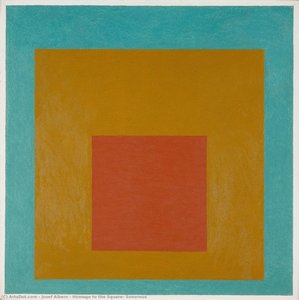
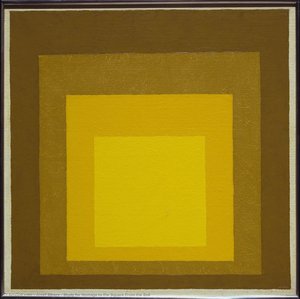
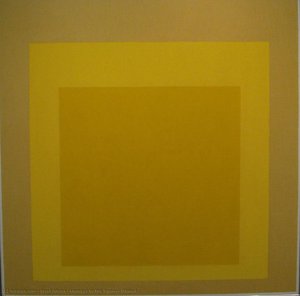
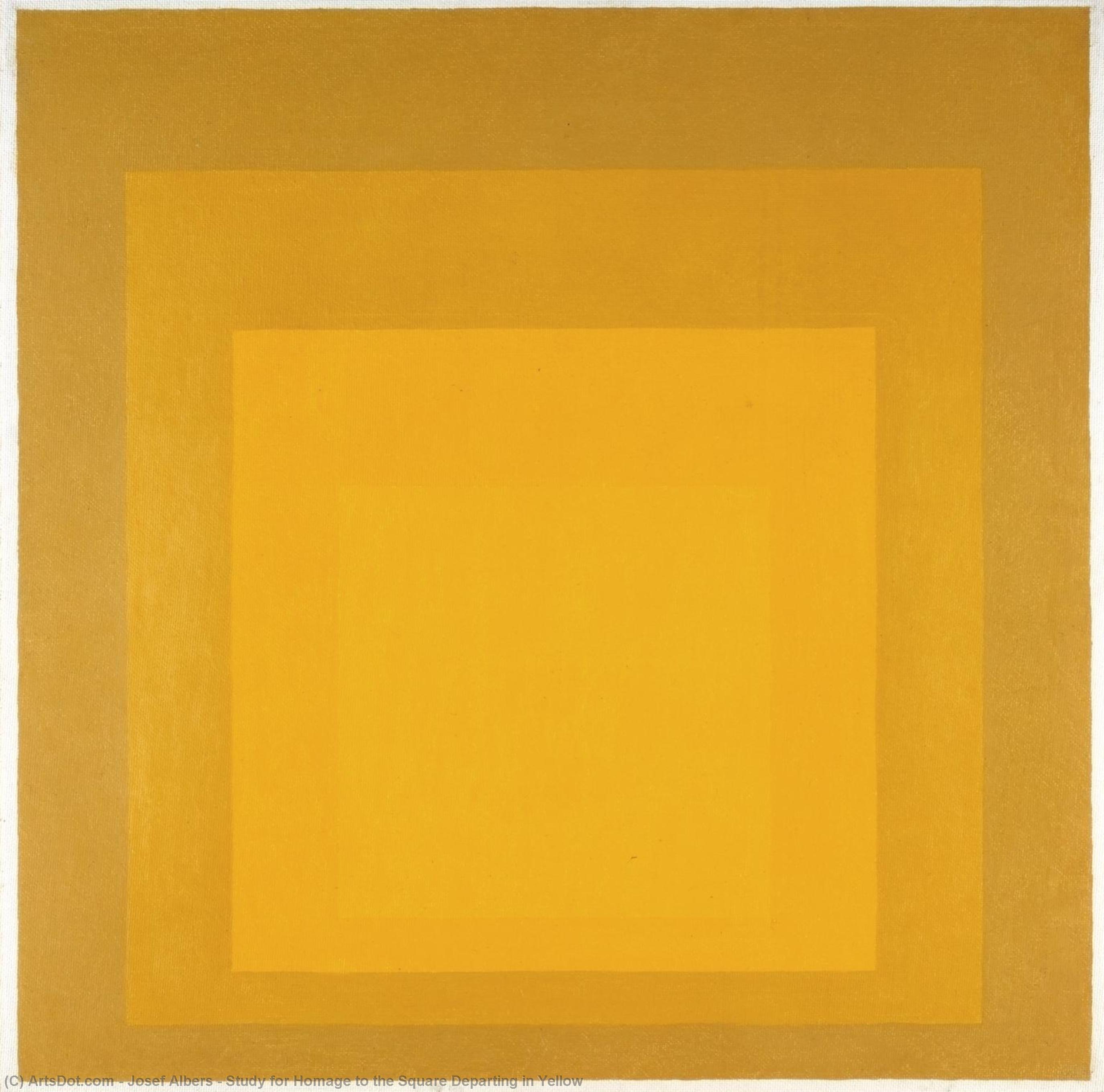
To stand before a work like Study for Homage to the Square Departing in Yellow is not merely to observe paint on canvas; it is to engage in a quiet, almost meditative dialogue with color itself. This piece by Josef Albers, dating from 1964, strips away the clutter of narrative and representation, leaving behind an architecture built solely from hue and form. The composition is breathtakingly simple: two nested squares, one enveloping the other, rendered in variations of yellow and yellow-orange. There are no dramatic gestures, no visible struggle of the brush—only the pure, unwavering declaration of boundaries. It forces the viewer to slow down, to look past what they think they know about art, and instead, simply *see*.
A Masterclass in Color Theory and Minimalism
Albers’s genius lay in his ability to elevate the most fundamental elements—color and shape—into profound subjects of study. This work is a quintessential example of Minimalism, a movement that championed reduction, urging artists to pare down their subject matter until only the essential remained. The relationship between the outer, saturated yellow field and the slightly deeper, inner square becomes the entire universe of the painting. It speaks volumes about how adjacent colors interact, how one shade modifies the perceived value of another. For those drawn to contemporary design or interior aesthetics, this piece offers a sophisticated anchor—a visual palate cleanser that adds intellectual depth without overwhelming a space.
Technique and Materiality: The Illusion of Depth
The technical execution is remarkably controlled. The surface appears flawlessly smooth, suggesting the meticulous application of oil or acrylic paint, allowing the flatness of the support to become part of the artwork’s statement. Because there are no discernible lines other than the edges themselves, depth is not achieved through traditional perspective, but rather through the subtle interplay of overlapping planes. This implied depth—the way one square seems to recede slightly behind another—is what gives the piece its quiet tension. It suggests a mathematical precision underlying an emotional experience.
Symbolism and Emotional Resonance
What does this geometric dialogue suggest? Symbolically, these nested squares can be interpreted as explorations of order, harmony, or perhaps even the relationship between self and environment. The act of "homage" in the title suggests a paying tribute to structure itself. For the collector or admirer, owning such a piece is acquiring more than decoration; it is acquiring an intellectual anchor—a reminder that profound beauty can be found in rigorous simplicity. It invites contemplation on balance, proportion, and the inherent poetry within pure geometry.
Bringing Albers Home: A Decorative Statement
For those considering a reproduction for your home or gallery, remember that this artwork functions as sophisticated visual punctuation. Its restrained palette ensures it complements rather than competes with surrounding furnishings. It speaks to an appreciation for modern masters who understood that the most powerful statements are often made in whispers of color and perfect form. It is art that rewards close looking, offering a moment of pure, chromatic contemplation.
Obras relacionadas
Biografía del artista
Primeros Años y Educación
- Nacimiento: 19 de marzo de 1888, Bottrop, Alemania
- Fallecimiento: 25 de marzo de 1976, New Haven, Connecticut, EE. UU.
- Josef Albers creció en una familia de artesanos, fomentando una temprana apreciación por los materiales y las técnicas.
- Inicialmente trabajó como maestro de escuela desde 1908 hasta 1913 antes de formarse como profesor de arte en la Königliche Kunstschule de Berlín (1913-1915).
- Las primeras exploraciones artísticas incluyeron grabado, vidrieras y pintura. Su primera comisión pública fue una ventana de vidrio emplomado, "Rosa Mystica Ora Pro Nobis", en 1918.
Período Bauhaus y Desarrollo de la Teoría
- En 1922, Albers se unió a la facultad del Bauhaus, inicialmente enseñando en el curso preliminar 'Werklehre' (práctica del taller) dentro del departamento de diseño.
- Su tiempo en el Bauhaus fue fundamental para dar forma a su filosofía artística y enfoque de la teoría del color.
- Comenzó a investigar sistemáticamente los efectos perceptuales de las relaciones de color, alejándose del arte representacional hacia la abstracción.
- La influencia de artistas como Paul Klee y Wassily Kandinsky es evidente en sus primeros trabajos, aunque desarrolló una metodología única centrada en la observación empírica en lugar de la interpretación metafísica.
Homenaje al Cuadrado e Investigaciones Cromáticas
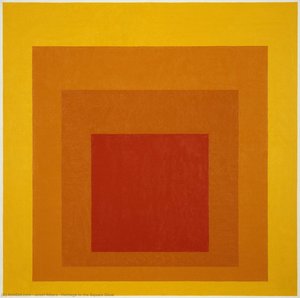
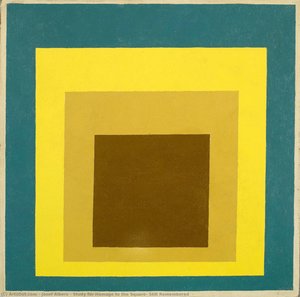
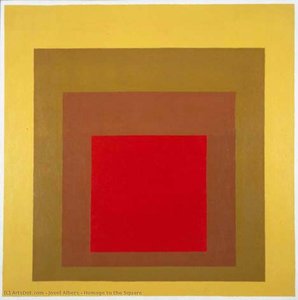
- En 1949, Albers comenzó su serie más famosa, "Homenaje al Cuadrado". Este proyecto continuo consistió en pinturas que presentaban cuadrados anidados dentro de cuadrados, explorando cómo interactúan y se influyen los colores.
- La serie no pretendía ser una celebración de la geometría, sino más bien una investigación sistemática sobre la percepción del color y su naturaleza engañosa.
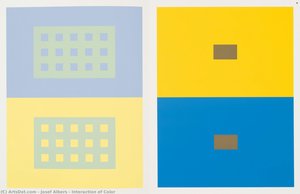
- Albers documentó meticulosamente sus experimentos con el color en su libro seminal, "Interacción del Color" (1963), que presentaba su teoría sobre cómo los colores se gobiernan mutuamente a través de una lógica interna y a menudo engañosa.
Legado Docente e Influencia
- Después de dejar el Black Mountain College en 1950, Albers dirigió el departamento de diseño de la Universidad de Yale hasta su jubilación en 1958.
- Fue un maestro muy influyente que enfatizaba la experimentación práctica y la observación crítica.
- Entre sus alumnos destacados se encuentran Ruth Asawa, Ray Johnson, Robert Rauschenberg, Cy Twombly y Susan Weil, todos ellos influenciados por su enfoque de la creación artística.
Significado Histórico
- Josef Albers es reconocido como una figura clave en el desarrollo del arte abstracto y la teoría del color.
- Su serie "Homenaje al Cuadrado" sigue siendo icónica por su exploración de los fenómenos perceptuales y su estética minimalista.
- “Interacción del Color” continúa siendo un texto fundamental para artistas, diseñadores y educadores interesados en comprender las complejidades de las relaciones de color.
- El énfasis de Albers en la observación empírica y la experimentación sistemática influyó en generaciones de artistas y solidificó su lugar como pionero del arte abstracto.
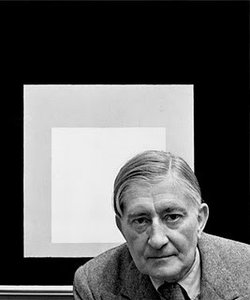
Josef Albers
1888 - 1976 , Alemania
Datos clave
- Artistas Que Influyeron:
- Matisse
- Cézanne
- Klee
- Kandinsky
- Fecha De Fallecimiento: 25 de marzo de 1976
- Fecha De Nacimiento: 19 de marzo de 1888
- Influenciado A Artistas:
- Robert Rauschenberg
- Cy Twombly
- Lugar De Nacimiento: Bottrop, Alemania
- Movimiento Artístico: Arte abstracto
- Nacionalidad: Alemán-estadounidense
- Nombre Completo: Josef Albers
- Obras Notables: ['Homenaje al cuadrado']
Artículos relacionados
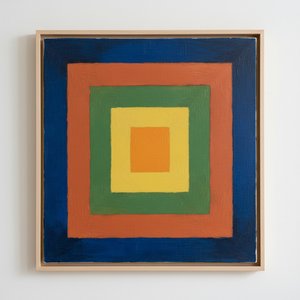
Josef Albers: A Homage to Color Interaction & the Foundations of Visual Perception
Explore Josef Albers's groundbreaking color theory & the 'Homage to the Square' series. Discover how his work revolutionized visual perception and influenced modern art movements like Minimalism & Op Art. Learn about his Bauhaus roots & lasting legacy.

Minimalismo en el Arte: 10 Obras Maestras para Decorar con Elegancia
Descubre 10 obras maestras del arte minimalista: Mondrian, Rothko y más. Explora la historia, técnica y el impacto de estos lienzos abstractos perfectos para una decoración serena y elegante. Encuentra reproducciones de alta calidad en ArtsDot.com.
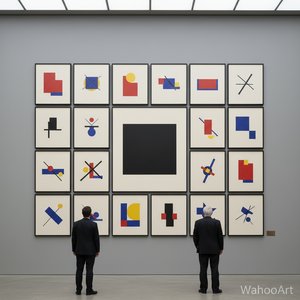
Kazimir Malevich: Las 25 Obras Maestras del Suprematismo para Inspirar tu Hogar
Descubre las 25 obras maestras de Kazimir Malevich, pionero del Suprematismo. Explora la historia, el significado y la belleza del arte abstracto moderno. Reproducciones de alta calidad para inspirar tu hogar en ArtsDot.com.
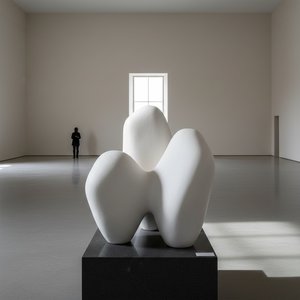
The Subtlety of Form: Exploring Emotional Resonance in Minimalist Art
Explore the emotional depth of minimalist art with ArtsDot. Discover key artists like Agnes Martin & Donald Judd, investment potential, and how to collect this influential movement. Expert insights for discerning collectors.
La Quietud Revelada: El Arte Abstracto Minimalista como Catalizador de Espacios Serenos y Sofisticados
Descubre el poder del arte abstracto minimalista para transformar tus espacios. Guía experta sobre artistas, tendencias y cómo invertir en piezas únicas que transmiten serenidad y sofisticación.