

 Ver en contexto
 Enviar
 Compartir
 Detalles

 Descargar
 Similares
 Radiografía
 Presentación de diapositivas
 Estadísticas
St Monica
 Oil On Canvas
- WallArt
- Mannerist
 1616
1616- Early Modern
 40.0 x 42.0 cm
 Museo del Prado
 Ver más
Reproducción al óleo hecha a mano
Óleo sobre lienzo pintado a mano en el tamaño y marco de su elección, realizado por encargo por nuestros artistas. ( Cambiar a Impresión Cambiar a imagen digital)




P118B $10

P118H $10

P118W $10

P438Z $10

P508JH $12

P508YH $12

P805H $10

P805Z $10

P919BZ $10

P919G $10

P919XJ $10

P959ZH $10

P968JZ $12

W106C $8

W218G $10

W218JH $8

W218Y $10

W307PJ $10

W316G $10

W316PJ $8

W316Y $10

W398PJ $8

W4111J $10

W500HY $15

W500JH $15

W692G $12

W849H $8

W940BG $15

W953PJ $8




Elija entre nuestros tamaños predefinidos que respetan las proporciones originales de la obra.

Puede ingresar sus propias dimensiones para adaptarse a un marco o espacio específico. Si el tamaño seleccionado no coincide con las proporciones de la imagen original, recortaremos la obra o extenderemos la pintura con elementos adicionales pintados a mano. Se le enviará una maqueta digital para su aprobación antes de comenzar la producción.
Tenga en cuenta que la vista previa en pantalla no refleja el recorte o la extensión reales. Solo la maqueta mostrará con precisión la composición final.
Si bien existen tamaños personalizados, recomendamos seleccionar una dimensión de la lista predefinida para preservar las proporciones originales.
Tras realizar el pedido, el equipo de ArtsDot.com enviará un correo electrónico al cliente para solicitar instrucciones y proporcionarle una vista previa del boceto.
Envío a todo el mundo () en 3-4 semanas en lugar de las 5 semanas estándar. (13 septiembre). Sin comprometer la calidad.

Envío exprés gratuito a todo el mundo

Lienzo de lino de alta calidad

Seguro de envío total

Garantía de reembolso de impuestos aduaneros

Garantía de fidelidad cromática exacta

Política de devolución de 100 días (solo por defectos)

Garantía de devolución del 100% del dinero

Descuento por cantidad
 La opción de vidrio solo está disponible en tamaños inferiores a 110 cm.

St Monica
Técnica de reproducción
Dimensiones de la reproducción
-


Precio total final
$ 263
A Meditation in Serenity: Exploring St Monica
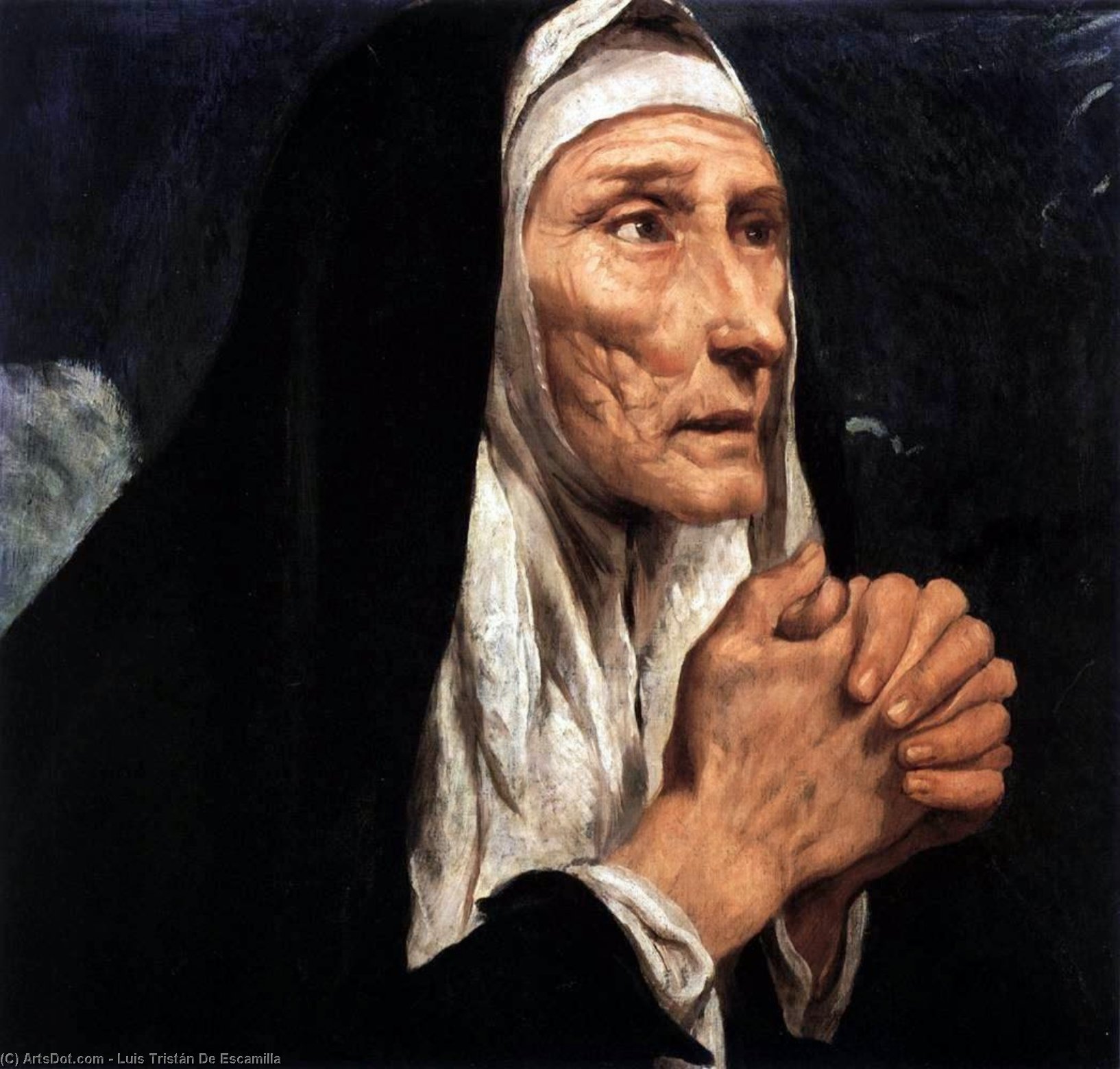
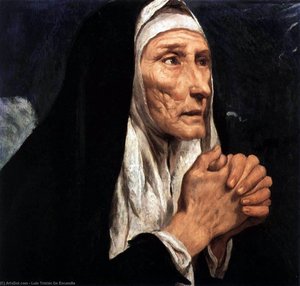
To gaze upon this portrait of St Monica is to encounter a profound stillness, a visual hymn dedicated to enduring faith. The subject, depicted with her hands clasped in earnest prayer, immediately draws the viewer into an atmosphere of deep contemplation. Her countenance, etched with the delicate lines of age and experience, speaks volumes of a life lived in devotion. Clad in the simple dignity of a long white veil, she embodies the quiet strength characteristic of religious figures throughout history. The artist has masterfully captured not merely a likeness, but a state of being—a soul at rest before the divine.
The Hand of Luis Tristán de Escamilla
This evocative piece hails from 1616 and bears the signature touch of Luis Tristán de Escamilla. A pivotal figure in Spanish Mannerism, Tristán’s career is fascinatingly intertwined with the artistic currents of his time, showing a clear lineage from both El Greco's spiritual intensity and the emerging realism championed by Caravaggio. His ability to synthesize these powerful influences results in work that feels both deeply traditional and startlingly modern. When considering a reproduction of this painting for your space, you are acquiring a piece steeped in the sophisticated dialogue between spiritual fervor and naturalistic technique.
Technique and Atmosphere: The Sky Above
Observe how the background interacts with the figure. It is not merely an empty void; rather, it unfolds as a dramatic sky filled with luminous clouds. This celestial backdrop serves to lift the portrait from mere earthly depiction into something transcendent. Tristán employs light—that quintessential element of Caravaggism—to illuminate St Monica’s face and hands, creating a palpable sense of depth and focus. The contrast between the soft luminosity catching her veil and the dramatic sweep of the sky imbues the entire composition with an almost breath-taking dimension. It is a study in chiaroscuro applied to spiritual narrative.
Symbolism and Emotional Resonance
St Monica herself carries immense symbolic weight, often representing perseverance, maternal devotion, and unwavering prayer for salvation. The act of praying, rendered so tenderly here, invites the contemporary viewer to pause their own hurried pace and reflect on personal moments of quiet reckoning. For collectors or those designing a space meant for reflection—perhaps a study, a chapel niche, or a grand drawing-room corner—this artwork offers an immediate emotional anchor. It whispers of resilience, suggesting that even in the face of life's deepest concerns, there remains the solace found in faith and contemplation.
Obras relacionadas


Biografía del artista
The Shadow of El Greco: The Formative Years in Toledo
In the winding, sun-drenched streets of Toledo, a city where history breathes through every stone, the life of Luis Tristán de Escamilla began amidst a profound atmosphere of religious fervor and artistic tradition. Born into a family of merchants and artisans around 1585, Tristán was destined to become a pivotal figure in the Spanish Mannerist movement. His early years were defined by an intimate connection to the masters of his era, most notably through his apprenticeship in the workshop of El Greco between 1603 and 1607. This period of mentorship was transformative; Tristán did not merely learn technique, but absorbed a visual language of spiritual depth and dramatic tension. In those early canvases, one can see him meticulously replicating the elongated figures and expressive chiaroscuro that characterized his teacher’s hand, creating works so closely aligned with El Greco's style that many were historically attributed to the master himself.
As a primary follower of El Greco’s legacy, alongside Jorge Manuel Theotocópuli, Tristán acted as a bridge between the fading echoes of Mannerism and the rising tide of a new aesthetic. His early development was marked by this tension—a struggle to maintain the spiritual, almost otherworldly elegance of the late Renaissance while beginning to grasp the visceral realism that would soon define his mature period.
A Journey Through Light: The Italian Influence and Caravaggisti Innovation
The trajectory of Tristán’s artistic soul underwent a radical shift around 1603 when he embarked on a transformative voyage to Italy. This pilgrimage, which saw him traversing the great artistic hubs of Rome and Naples, irrevocably altered his brushwork. In the heart of Italy, Tristán encountered the burgeoning Caravaggisti movement, a revolution in painting that favored stark realism and theatrical lighting over the idealized forms of the past. The influence of Caravaggio’s dramatic interplay between light and shadow began to seep into his compositions, replacing the ethereal glow of Toledo with a more grounded, tactile intensity.
Upon his return to Spain around 1613, Tristán brought with him a sophisticated synthesis of styles. He had successfully merged the spiritual, elongated grace of the Spanish Mannerist tradition with the gritty, emotive realism of the Italian Baroque. This unique stylistic fusion allowed him to create works that were simultaneously contemplative and profoundly human. His mastery of texture and light is evident in pieces such as The Bread and Egg Watch, where rich textures and layered realism evoke a sense of seventeenth-century compassion, or his Adoration of the Magi, which showcases an exquisite Baroque detail and symbolic depth.
A Legacy Etched in Shadow and Devotion
Though his life was tragically cut short at the age of thirty-nine in 1624, the impact of Luis Tristán de Escamilla remains etched in the annals of Spanish art. He stood as a vanguard artist, navigating the complex transition from the stylistic disquiet of Mannerism to the emotional grandeur of the Baroque. His ability to capture the somber dignity of his subjects—seen in the meticulous rendering of Portrait of Félix Lope de Vega or the serene, prayerful countenance of St. Monica—demonstrates a profound understanding of human emotion and spiritual devotion.
Tristán’s historical significance lies in his role as an artistic conduit. He did not simply follow a single school; rather, he synthesized disparate movements into a cohesive, uniquely Spanish vision. His works continue to reside in some of the world's most prestigious collections, from the Museo de Santa Cruz in Toledo to the Hermitage Museum in St. Petersburg, serving as enduring testaments to a life spent chasing the divine through the medium of light and shadow.
luis tristán de escamilla
1586 - 1624
Datos clave
- Artistic Movement Or Style: Mannerism
- Artists Or Movements Influenced By This Artist: ['Caravaggisti']
- Artists Who Influenced This Artist: ['El Greco']
- Date Of Death: 1624
- Full Name: Luis Tristán de Escamilla
- Nationality: Spanish
- Notable Artworks:
- Saint Louis Distributing Alms.
- The Round of Bread and Eggs.
- Place Of Birth: Toledo, Spain
Artículos relacionados
The Golden Age Reforged: Dramatic Realism & Religious Zeal in Spanish Baroque Art
Explore the dramatic world of Spanish Baroque art! Discover masters like Zurbarán & the powerful influence of religious zeal on painting techniques – a guide for collectors and enthusiasts.

El Greco: Las 25 Obras Maestras que Definen un Genio del Arte y la Fe
Descubre las 25 obras maestras de El Greco, el genio del Renacimiento español. Explora su arte religioso, manierismo y la historia detrás de cuadros icónicos como 'El Entierro del Conde de Orgaz'. Encuentra reproducciones de alta calidad en ArtsDot.com.

The Dramatic Flourish: Exploring the Baroque Movement's Enduring Legacy in Art History
Explore the dramatic world of Baroque art! Discover iconic artists like Caravaggio & Rubens, defining techniques, and its lasting impact on art history. Expert insights for collectors & enthusiasts at ArtsDot.
The Dramatic Flourish: Exploring Themes of Power, Faith & Emotion in Baroque Artworks
Explore the dramatic world of Baroque art! Discover masters like Zurbarán & the powerful influence of religious zeal on painting techniques. Expert insights for collectors and enthusiasts.

Theatricality & Triumph: Baroque Drama in Painting & Sculpture
Explore the dramatic world of Baroque art! Discover its history, defining characteristics, & lasting influence on painting & sculpture. Expert insights into Caravaggio, Zurbarán, and Bernini – plus high-quality reproductions at ArtsDot.