 Ver en contexto
 Enviar
 Compartir
 Detalles

 Descargar
 Similares
 Radiografía
 Presentación de diapositivas
 Estadísticas
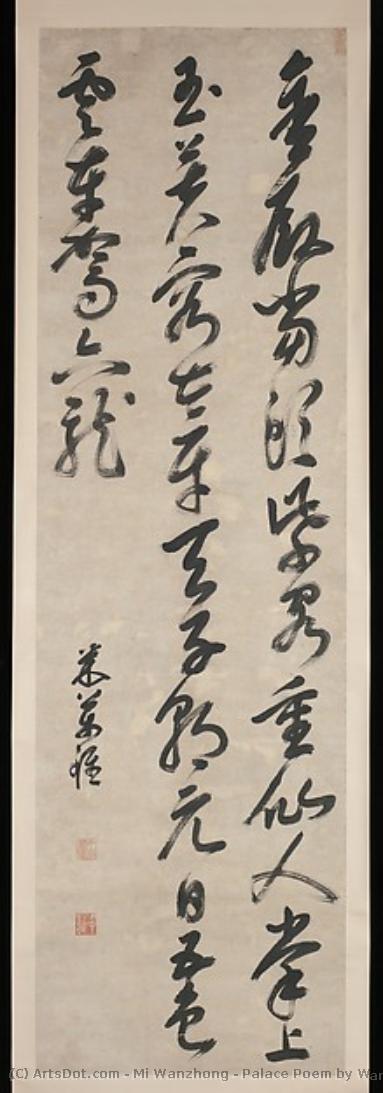
Palace Poem by Wang Jian (d. 830?)
 337.0 x 93.0 cm
 Ver más
Reproducción al óleo hecha a mano
Óleo sobre lienzo pintado a mano en el tamaño y marco de su elección, realizado por encargo por nuestros artistas. ( Cambiar a Impresión Cambiar a imagen digital)




































Elija entre nuestros tamaños predefinidos que respetan las proporciones originales de la obra.

Puede ingresar sus propias dimensiones para adaptarse a un marco o espacio específico. Si el tamaño seleccionado no coincide con las proporciones de la imagen original, recortaremos la obra o extenderemos la pintura con elementos adicionales pintados a mano. Se le enviará una maqueta digital para su aprobación antes de comenzar la producción.
Tenga en cuenta que la vista previa en pantalla no refleja el recorte o la extensión reales. Solo la maqueta mostrará con precisión la composición final.
Si bien existen tamaños personalizados, recomendamos seleccionar una dimensión de la lista predefinida para preservar las proporciones originales.
Tras realizar el pedido, el equipo de ArtsDot.com enviará un correo electrónico al cliente para solicitar instrucciones y proporcionarle una vista previa del boceto.
Envío a todo el mundo () en 3-4 semanas en lugar de las 5 semanas estándar. (9 septiembre). Sin comprometer la calidad.

Envío exprés gratuito a todo el mundo

Lienzo de lino de alta calidad

Seguro de envío total

Garantía de reembolso de impuestos aduaneros

Garantía de fidelidad cromática exacta

Política de devolución de 100 días (solo por defectos)

Garantía de devolución del 100% del dinero

Descuento por cantidad
 La opción de vidrio solo está disponible en tamaños inferiores a 110 cm.

Palace Poem by Wang Jian (d. 830?)
Técnica de reproducción
Dimensiones de la reproducción
-


Precio total final
$ 263
Obras relacionadas









Biografía del artista
The Enigmatic Vision of Zdzisław Beksiński
Zdzisław Beksiński, a name synonymous with haunting surrealism and dystopian landscapes, remains one of the most compelling and unsettling figures in 20th-century art. Born in Sanok, Poland, on February 24, 1929, his life was marked by both artistic fervor and profound personal tragedy. Unlike many artists who consciously cultivate a specific style or message, Beksiński’s work emerged from an intensely private, almost obsessive inner world. He resisted categorization, famously refusing to provide titles for most of his paintings, sculptures, and photographs, believing that naming them would limit the viewer's interpretation and impose a narrative where none was intended. His early life, overshadowed by the horrors of World War II – he witnessed the Katyn Massacre as a child when his father was executed by the Soviets – undoubtedly cast a long shadow over his artistic sensibility, though he rarely spoke directly about its influence. He studied architecture at the Kraków Academy of Fine Arts, but quickly abandoned it for painting, finding greater freedom in expressing his visions through this medium. His initial works were rooted in realism and impressionism, gradually evolving into the uniquely disturbing aesthetic that would define his career.From Realism to Nightmarish Visions
The transition from Beksiński’s early realistic paintings to his signature style was a slow but deliberate process. In the 1960s, he began experimenting with textured surfaces and abstract forms, influenced by Art Informel and the work of artists like Francis Bacon. However, it wasn't until the late 1960s and early 1970s that his distinctive vision fully materialized. This period saw the emergence of what became known as his “fantastic period,” characterized by decaying architecture, skeletal figures, distorted bodies, and unsettling landscapes bathed in a perpetual twilight. He often worked with oil on hardboard, building up layers of paint to create incredibly detailed and tactile surfaces. His technique was meticulous and painstaking; he would spend weeks, even months, on a single piece, obsessively refining every detail. He described his process as an attempt to externalize the images that haunted his dreams, stating that he didn’t *create* these visions but rather *discovered* them. This sense of discovery is palpable in his work; it feels less like a deliberate construction and more like an excavation of something ancient and terrifying lurking beneath the surface of reality. His early fantastic paintings, while disturbing, often possessed a strange beauty, a melancholic grandeur that drew viewers into their unsettling world.The Triad of Artistic Expression: Painting, Sculpture, Photography
While Beksiński is most celebrated for his paintings, he was remarkably prolific across multiple artistic disciplines. In the 1970s and 80s, he began to explore sculpture, creating haunting figures from resin, plaster, and other materials. These sculptures often echoed the themes found in his paintings – decay, fragmentation, and a sense of existential dread. They were frequently more overtly grotesque than his paintings, pushing the boundaries of taste and challenging viewers with their visceral intensity. Simultaneously, he developed a passion for photography, capturing stark, atmospheric images that complemented his other work. His photographs often featured desolate landscapes, abandoned buildings, and decaying objects, further reinforcing the themes of transience and mortality.- Painting: The core of Beksiński’s artistic output, characterized by detailed dystopian scenes.
- Sculpture: Often more visceral and grotesque than his paintings, exploring similar themes in three dimensions.
- Photography: Atmospheric images that complemented his painting and sculpture, focusing on decay and desolation.