

 Ver en contexto
 Enviar
 Compartir
 Detalles

 Descargar
 Similares
 Radiografía
 Presentación de diapositivas
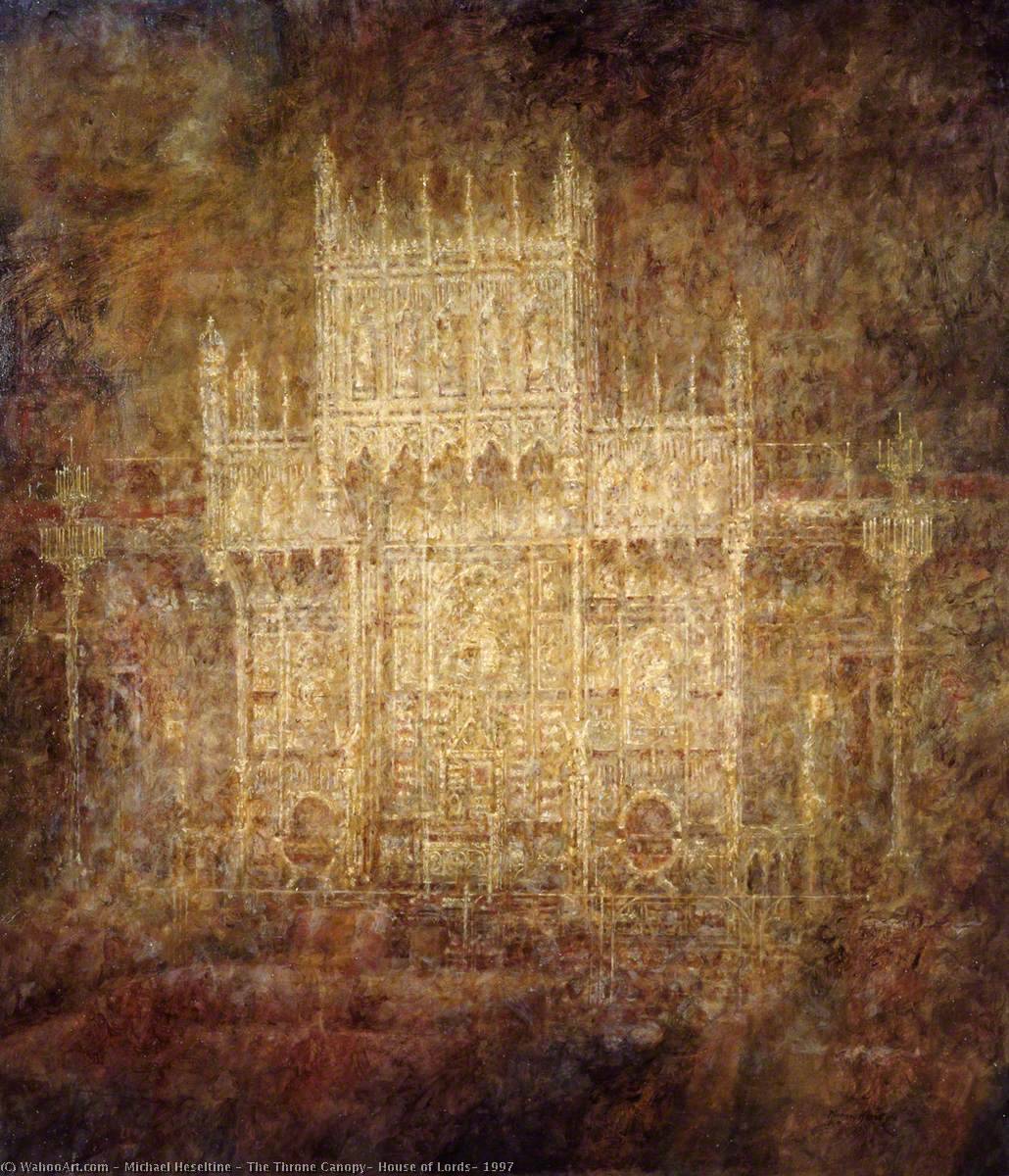
The Throne Canopy, House of Lords, 1997
 1997
1997 94.0 x 81.0 cm
 Ver más
Giclée / Impresión de arte
Impresiones giclée o en lienzo de calidad de museo con producción rápida y opciones de acabado flexibles. ( Comprar pintura hecha a mano Comprar imagen)




































Elija entre nuestros tamaños predefinidos que respetan las proporciones originales de la obra.

Puede introducir sus propias dimensiones para adaptarse a un marco o espacio específico. Si el tamaño seleccionado no coincide con las proporciones de la imagen original, recortaremos la obra de arte o extenderemos la imagen con un borde con efecto espejo o de color sólido. Se enviará una maqueta digital para su aprobación antes de que comience la producción.
Tenga en cuenta que la vista previa en pantalla no refleja el recorte o la extensión real. Solo la maqueta mostrará con precisión la composición final.
Aunque existen tamaños personalizados, recomendamos seleccionar una dimensión de la lista predefinida para preservar las proporciones originales.
Envío a todo el mundo () en 2 semanas en lugar de las 4/5 semanas estándar. (1 septiembre)

Envío exprés gratuito a todo el mundo

Lienzo de lino de alta calidad

Seguro de envío total

Garantía de reembolso de impuestos aduaneros

Garantía de fidelidad cromática exacta

Política de devolución de 60 días (solo por defectos)

Garantía de devolución del 100% del dinero

Descuento por cantidad
 La opción de vidrio solo está disponible en tamaños inferiores a 110 cm.

The Throne Canopy, House of Lords, 1997
Giclée / Impresión de arte
Dimensiones de la reproducción
-


Precio total final
$ 62
Obras relacionadas







Biografía del artista
A Tapestry of Symbolism and Ancient Wisdom
In the quiet, mist-shrouded isolation of a remote Scottish island, the artist Michael Heseltine engages in a profound dialogue between the physical world and the metaphysical realm. Born in February 1961, Heseltine has cultivated a life of contemplative practice that serves as the very heartbeat of his creative output. His work is not merely an exercise in aesthetics but a deep exploration of Buddhist teachings and ancient symbolism, where every brushstroke acts as a vessel for philosophical inquiry. This dedication to spiritual depth informs the very architecture of his compositions, guiding his choice of color palettes and the evocative narratives that emerge from his canvases.
The roots of his artistic journey can be traced back to the industrial heritage of Swansea, Wales. Raised amidst the resilient spirit of the local docklands, Heseltine’s early environment provided a foundational connection to history and legacy that would later resonate through his more abstract explorations. His formal training at the Berkshire College of Art & Design in 1981 equipped him with the meticulous craftsmanship required for both painting and printmaking, establishing a technical rigor that allows his conceptual depth to remain grounded in masterful execution.
The Evolution of Vision and Influence
The trajectory of Heseltine’s career was irrevocably altered by a pivotal encounter in 1983 with the renowned sculptress Elizabeth Frink. Her mastery of bold abstraction and her ability to probe the psychological depths of her subjects left an indelible mark on his psyche. Through this influence, Heseltine began to move beyond mere representation, embracing symbolism as his primary language for conveying emotional resonance and archetypal imagery. This shift allowed him to transform the canvas into a space where the unseen forces of the human experience could be visualized.
His early professional years in London were marked by a fascination with the urban landscape. During this period, he produced large-scale, semi-abstract oil paintings that captured the rhythmic energy of cityscapes. These works served as a bridge between his observational skills and his burgeoning interest in abstraction, as he sought to find the underlying structures within the bustling metropolis. As his career progressed, his focus shifted from the external movement of cities to the internal stillness of historical and spiritual monuments.
Architectural Narratives and Historical Legacy
Throughout the 1990s, Heseltine achieved significant recognition for his ability to capture the grandeur and gravity of British history through architectural portraiture. His exhibitions showcased a remarkable series of works that breathed life into iconic locations, including:
- The London Law Courts, where he explored the intersection of justice and structural permanence.
- Oxford Colleges, capturing the scholarly weight and ancient atmosphere of these academic sanctuaries.
- The Palace of Westminster, through a series of prestigious commissions that documented the heart of British political history.
These works, alongside his depictions of Westminster Hall, Christ Church Cathedral, and the Crypt Chapel of St Mary Undercroft, demonstrate a unique ability to marry architectural precision with a sense of the sacred. By focusing on these historic UK buildings, Heseltine does more than document stone and mortar; he captures the enduring spirit of the past. Today, his legacy continues to grow as he merges the technical mastery of his early training with a transcendent focus on Zen Buddhism and the eternal truths found in ancient symbols, making him a singular voice in contemporary fine art.
Datos clave
- Artistic Movement Or Style: Neo-expressionist
- Artists Or Movements Influenced By This Artist:
- Thich Nhat Hanh
- Eckhart Tolle
- Artists Who Influenced This Artist: ['Elizabeth Frink']
- Date Of Birth: March 21, 1933
- Full Name: Michael Heseltine
- Nationality: British
- Notable Artworks:
- Westminster Hall Art
- Cathedrals Artwork
- Place Of Birth: Swansea, Wales

