 Vista previa
 Compartir
 Compartir
 Ver detalles

 Descargar
 Ver similares
 Radiografía
 Presentación de diapositivas
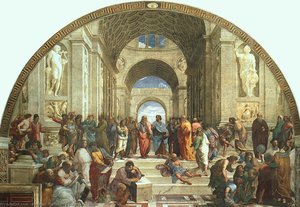
El Stanza della Segnatura Poesía


 Leer más
Reproducción al óleo hecha a mano
Óleo sobre lienzo pintado a mano en el tamaño y marco de su elección, realizado por encargo por nuestros artistas. ( Pedir impresión Comprar descarga)




P118B $10

P118H $10

P118W $10

P438Z $10

P508JH $12

P508YH $12

P805H $10

P805Z $10

P919BZ $10

P919G $10

P919XJ $10

P959ZH $10

P968JZ $12

W106C $8

W218G $10

W218JH $8

W218Y $10

W307PJ $10

W316G $10

W316PJ $8

W316Y $10

W398PJ $8

W4111J $10

W500HY $15

W500JH $15

W692G $12

W849H $8

W940BG $15

W953PJ $8




Elija entre nuestros tamaños predefinidos que respetan las proporciones originales de la obra.

Puede ingresar sus propias dimensiones para adaptarse a un marco o espacio específico. Si el tamaño seleccionado no coincide con las proporciones de la imagen original, recortaremos la obra o extenderemos la pintura con elementos adicionales pintados a mano. Se le enviará una maqueta digital para su aprobación antes de comenzar la producción.
Tenga en cuenta que la vista previa en pantalla no refleja el recorte o la extensión reales. Solo la maqueta mostrará con precisión la composición final.
Si bien existen tamaños personalizados, recomendamos seleccionar una dimensión de la lista predefinida para preservar las proporciones originales.
Tras realizar el pedido, el equipo de ArtsDot.com enviará un correo electrónico al cliente para solicitar instrucciones y proporcionarle una vista previa del boceto.
Envío a todo el mundo () en 3-4 semanas en lugar de las 5 semanas estándar. (20 agosto). Sin comprometer la calidad.

Envío exprés gratuito a todo el mundo

Lienzo de lino de alta calidad

Seguro de envío completo

Garantía de reembolso de aranceles aduaneros

Garantía de fidelidad cromática exacta

Política de devolución de 60 días (solo por defectos)

Garantía de devolución del 100% del dinero

Oferta por volumen
 La opción de vidrio solo está disponible en tamaños inferiores a 110 cm.

El Stanza della Segnatura Poesía
Técnica de reproducción
Tamaño de la reproducción
-


Precio total
$ 263
Descripción de la obra
The Stanza della Segnatura Poetry
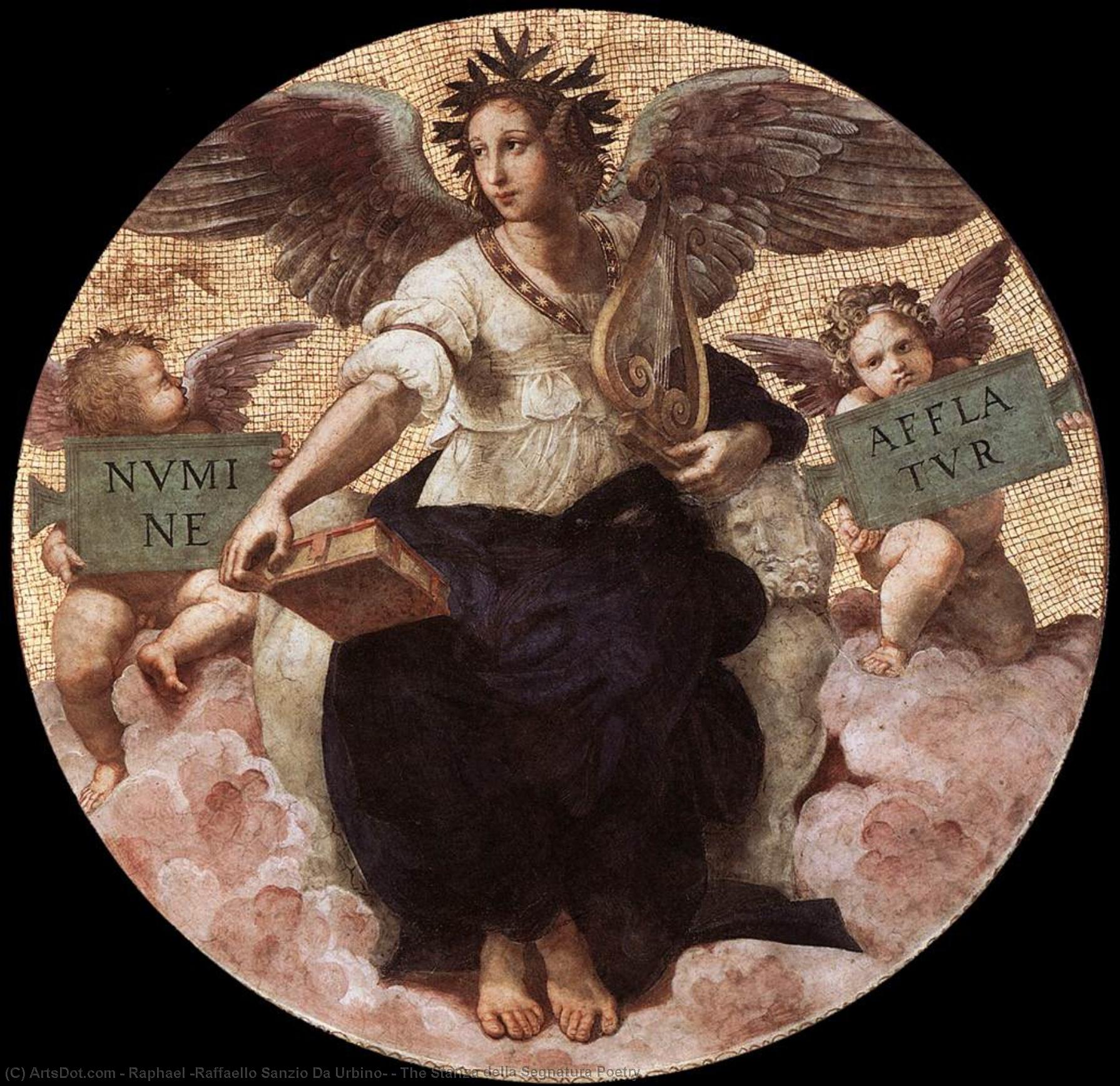
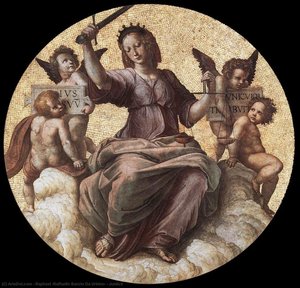
Within the breathtaking fresco cycle adorning the walls and ceiling of the Stanza della Segnatura in the Vatican, lies a delicate yet profound depiction of Poetry – a testament to Raphael’s mastery of form, color, and allegorical representation. This segment of the larger decorative scheme, commissioned by Pope Julius II, isn't merely an illustration; it is an embodiment of Renaissance humanism, celebrating one of the four pillars of knowledge alongside Philosophy, Theology, and Law. The image, often described as a serene angel cradling a harp amidst swirling clouds, transcends simple religious iconography to become a visual poem itself.
Raphael’s artistic journey was one of remarkable assimilation and innovation. Born in Urbino in 1483, he absorbed the refined aesthetics of his father, Giovanni Santi, a court painter, and the intellectual atmosphere of the ducal court. His subsequent travels to Florence exposed him to the groundbreaking work of Leonardo da Vinci and Michelangelo, influencing his style towards greater monumentality and dynamic composition. However, Raphael never merely imitated; he synthesized these influences with his innate grace and clarity, forging a uniquely harmonious aesthetic. The *Poetry* fresco exemplifies this synthesis – it possesses the compositional balance characteristic of High Renaissance ideals, yet retains a lyrical quality that is distinctly Raphaelian. The central figure, often identified as the Muse Calliope or Polyhymnia, isn’t presented with dramatic intensity but rather with an ethereal serenity. Her gaze is inward, lost in contemplation, suggesting the source of poetic inspiration lies within.
The technique employed in *Poetry* is characteristic of Raphael's fresco work: a meticulous layering of pigments onto wet plaster, demanding both speed and precision. The soft modeling of the figure’s face and drapery, achieved through subtle gradations of light and shadow – known as chiaroscuro – creates a sense of volume and realism. The surrounding clouds aren't merely atmospheric elements; they are rendered with delicate brushstrokes that evoke a feeling of weightlessness and transcendence. The two putti flanking the central figure, each bearing inscribed tablets reading “NUMINE” and “AFFLATUR” (divine inspiration), further emphasize the spiritual source of poetic creation. These details aren’t simply decorative; they are integral to the allegorical meaning, inviting viewers to contemplate the relationship between divine grace and human artistry.
The Stanza della Segnatura as a whole represents a pivotal moment in art history – a visual manifesto of Renaissance ideals. Julius II envisioned this room as a showcase for the highest achievements of human intellect, and Raphael’s frescoes perfectly embody that ambition. *Poetry*, within this context, isn't simply about verses and rhymes; it symbolizes the power of imagination, the pursuit of beauty, and the enduring legacy of classical learning. A reproduction of this exquisite fresco brings not only a piece of art historical significance into a space but also an atmosphere of contemplation, intellectual curiosity, and timeless elegance – a reminder of the profound connection between art, knowledge, and the human spirit.
Considered one of Raphael’s most serene and emotionally resonant works, *Poetry* stands apart from his other frescoes in its understated grandeur. Unlike the dramatic confrontations depicted in *The School of Athens* or *The Disputation*, this scene exudes tranquility—a deliberate choice reflecting the humanist ethos championed by Julius II. The angel holding the harp embodies the very essence of poetic inspiration: a quiet contemplation, fueled by divine grace and directed inward.
Raphael’s masterful use of chiaroscuro is particularly noteworthy. Observe how Raphael skillfully manipulates light and shadow to sculpt the angel's face and drapery, creating an illusion of depth that draws the viewer into the composition. The swirling clouds surrounding Calliope are rendered with meticulous brushstrokes—a testament to Raphael’s dedication to achieving a sense of ethereal beauty.
The symbolism embedded within *Poetry* is rich and multilayered. The tablets inscribed “NUMINE” (divine inspiration) and “AFFLATUR” serve as visual anchors, reminding us that poetic creativity originates from a higher power—a concept central to Renaissance philosophy. Furthermore, the positioning of the angel and the harp suggests an ideal state of artistic contemplation: a harmonious balance between intellect and emotion.
The fresco’s enduring appeal lies in its ability to evoke feelings of peace and wonder. It invites viewers to pause and reflect on the transformative power of art—a legacy that continues to inspire artists and collectors alike. Reproducing *Poetry* brings home not just a stunning visual masterpiece but also an invitation to embrace the beauty and contemplation inherent in the pursuit of knowledge.
The Stanza della Segnatura’s overall design—executed by Raphael alongside Michelangelo and Sodoma—represents a triumph of Renaissance artistic ambition. It stands as a testament to Julius II's desire to elevate Rome to the cultural apex of Europe, cementing Raphael’s place among the giants of his era.
Obras relacionadas
Biografía del artista
**vida temprana y formación**
Rafael (rafaello sanzio da urbino), un renombrado pintor y arquitecto italiano, nació entre el 28 de marzo y el 6 de abril de 1483, en la pequeña pero culturalmente significativa ciudad de Urbino. Su padre, Giovanni Santi, era pintor de corte para el duque, proporcionando a Rafael una exposición temprana al mundo artístico. Después de fallecer su padre a los once años, Rafael probablemente administró el taller familiar, consolidando aún más su base artística.**carrera artística e influencias**
El viaje artístico de Rafael puede categorizarse en tres fases distintas, cada una marcada por un estilo único:- primeros años en Umbría: caracterizado por la influencia de su padre y el ambiente cultural de Urbino.
- período florentino (1504-1508): absorbiendo las tradiciones artísticas de Florencia, que influyeron significativamente en su estilo.
- período romano (1508-1520): trabajando para dos papas y sus asociados, produciendo algunas de sus obras más celebradas, incluyendo la escuela de Atenas en la stanza della segnatura del Vaticano.
**obras notables y legado**
Algunas de las obras notables de Rafael incluyen:- el juicio de Salomón (ver en ArtsDot)
- la madona de Esterházy (ver en ArtsDot)
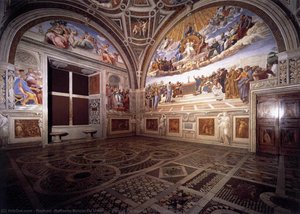
- Stanze Vaticane - vista de la stanza della segnatura (ver en ArtsDot)
- San Sebastián (ver en ArtsDot)
- La dama velada (ver en ArtsDot)
**influencia y legado**
La influencia de Rafael en el arte es profunda, con su obra siendo un pilar del Renacimiento italiano. Su estilo sereno y armonioso ha sido un modelo para la pintura neoclásica, como señaló el historiador de arte Johann Joachim Winckelmann. A pesar de la influencia posterior del estilo de Miguel Ángel, Rafael sigue siendo uno de los artistas más reverenciados en la historia. ver el perfil de Rafael en ArtsDot
Rafael
1483 - 1520 , Italia
Datos clave
- Artistas Influyentes:
- Giovanni Santi
- Pietro Perugino
- Estilo Artístico: Alto Renacimiento
- Fecha De Muerte: 06/04/1520
- Fecha De Nacimiento: 28/03/1483
- Influencia En Artistas: Neoclasicismo
- Lugar De Nacimiento: Urbino, Italia
- Nacionalidad: Italiano
- Nombre Completo: Rafael (Raffaello Sanzio)
- Obras Notables:
- El Juicio de Salomón
- Madonna del Cardellino
- La Escuela de Atenas
- San Sebastián
- La Dama Velada
Artículos relacionados
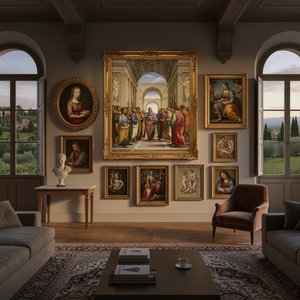
Rafael: Las 25 Obras Maestras que Definen al Genio del Renacimiento | ArtsDot
Descubre las 25 obras maestras de Rafael Sanzio, el genio del Renacimiento. Explora su historia, técnica y significado en pinturas icónicas como 'La Escuela de Atenas'. Reproducciones de arte de alta calidad para decorar tu hogar con elegancia. ¡Explora la colección completa en ArtsDot.com!

Legado en las Paredes: Frescos Familiares que Trascienden el Tiempo
Descubre el arte del fresco muralístico para inmortalizar tu historia familiar. Expertos en frescos personalizados y técnicas ancestrales. Crea un legado visual único con .

The Enduring Legacy of Fresco Painting: Techniques, History & Contemporary Relevance
Explore the rich history & enduring artistry of fresco painting – from Giotto to Michelangelo! Discover techniques, conservation efforts, & modern applications. Learn how ArtsDot brings this timeless art form to your home.

The Enduring Legacy of Fresco: Technique, History & Artistic Expression Across Cultures
Explore the rich history & enduring legacy of fresco painting! Discover ancient techniques, Giotto's masterpieces, and modern applications. Expert insights for art lovers & professionals.
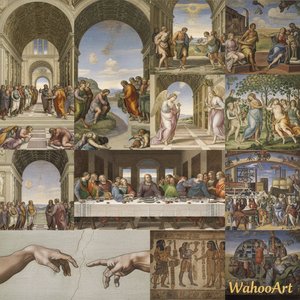
Frescos Legendarios: 10 Obras Maestras que Revolucionaron la Historia del Arte | ArtsDot
Descubre los 10 frescos más legendarios de la historia del arte, desde Miguel Ángel y Rafael hasta Giotto. Explora sus técnicas, historias y el impacto cultural que perdura. Reproducciones de alta calidad en ArtsDot.com.