

![Estancias Vaticanas – La Misa De Bolsena (detalle) [01] — Rafael](/media/artworks/images-full/0c/d7/0cd7d502194b1857265f438b6df9b85f.jpg)
 Ver en contexto
 Enviar
 Compartir
 Detalles

 Descargar
 Similares
 Radiografía
 Presentación de diapositivas
Estancias Vaticanas – La Misa de Bolsena (detalle) [01]


 Ver más
Adquiera una imagen digital de alta resolución y optimizada, muy superior a la vista previa en línea.
Cada archivo es preparado meticulosamente por nuestros especialistas internos mediante el uso de herramientas avanzadas y un experto retoque manual. Nos aseguramos de que cada imagen posea una claridad excepcional, una precisión cromática impecable y un detalle minucioso.
El archivo final se entrega por correo electrónico en un plazo de 72 horas, optimizado para su uso inmediato en entornos profesionales, editoriales y de impresión. Esta es la misma calidad en la que confían los estudios de diseño, las editoriales y las galerías de primer nivel.
Imagen Digital
Descarga un archivo de alta resolución para exhibición personal, impresión y proyectos creativos. ( Comprar impresión Comprar pintura hecha a mano)
Incluido en cada pedido de imágenes digitales
Entrega digital experta, garantizada.
Al elegir ArtsDot.com, no solo está adquiriendo una imagen; está recibiendo una obra de arte digital mejorada profesionalmente, elaborada con precisión y respaldada por una garantía de satisfacción. Esto es todo lo que incluye su pedido, automáticamente:

Entrega rápida por email
Recibirá su archivo de imagen digital en alta resolución por correo electrónico en un plazo de 72 horas tras realizar su pedido, listo para su uso inmediato.

Archivo digital optimizado por IA
Su obra de arte se optimiza profesionalmente mediante herramientas avanzadas de IA y edición manual, garantizando el máximo detalle, claridad y precisión cromática.

Reenvío gratuito de por vida
¿Has borrado o perdido tu archivo por error? No te preocupes: te lo volveremos a enviar en cualquier momento, sin coste adicional.

Sin gastos de importación, siempre
Disfrute de su obra de arte al instante sin aduanas, aranceles ni gastos de envío; las descargas digitales siempre están libres de impuestos.

Garantía de fidelidad de color
Garantizamos que su imagen digital refleje los colores originales con la mayor fidelidad posible, mediante el uso de herramientas profesionales y gestión del color.

Garantía de satisfacción de 60 días
Si no está satisfecho con su imagen digital, la revisaremos o le reembolsaremos el 100% en un plazo de 60 días, sin preguntas.

100% Garantía de devolución de dinero
¿No está satisfecho? Obtenga un reembolso completo dentro de los 60 días posteriores a la recepción de su archivo digital, sin necesidad de explicaciones.

Descuentos por pedidos grandes
Compra 3 imágenes, ahorra 10% - Compra 5, ahorra 15% - Compra 10+, ahorra 20%. Ideal para proyectos creativos, galerías y agencias.
Descripción del coleccionable
Raphael’s Miraculous Vision: “The Mass at Bolsena” – A Renaissance Masterpiece
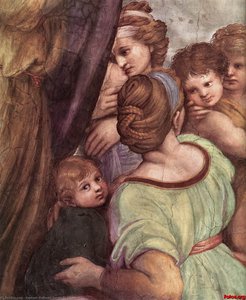
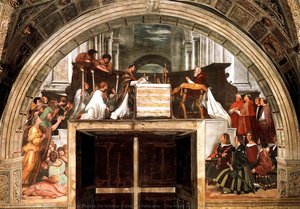
“The Mass at Bolsena,” painted between 1512 and 1514 by Raphael, stands as a pivotal work within the grand cycle of frescoes adorning the Vatican’s Stanze. More than simply a depiction of a religious miracle, this fresco embodies the humanist ideals of the High Renaissance, seamlessly blending theological narrative with masterful artistic technique. It's a deeply moving exploration of faith, doubt, and divine intervention, rendered in Raphael’s signature style – characterized by luminous color, graceful composition, and an unparalleled sense of realism.
The scene unfolds within a meticulously recreated church setting, transporting the viewer to Bolsena, a small town near Orvieto. At the heart of the fresco is the central drama: a Bohemian priest, consumed by skepticism regarding the doctrine of transubstantiation – the belief that during Mass, the bread and wine truly become the body and blood of Christ — celebrates the sacrament. As he raises the chalice, an astonishing event occurs; the consecrated host begins to bleed, a tangible manifestation of God’s grace and a profound confirmation of the Eucharist’s sacredness. This miraculous episode, recounted in hagiography, served as the impetus for the establishment of the Feast of Corpus Christi by Pope Urban IV in 1264.
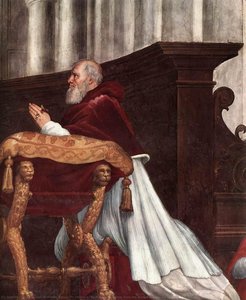
Raphael’s genius lies not merely in faithfully recreating this event but in imbuing it with a palpable sense of intimacy and emotional resonance. The figures are arranged within a shallow, stage-like space, drawing the viewer directly into the scene. Pope Julius II, kneeling prominently on the right, exudes authority and piety, while his daughter, Felice della Rovere, stands gracefully at his side, representing the continuity of papal lineage. A self-portrait of Raphael himself appears as one of the Swiss Guard in the lower right corner — a subtle yet significant inclusion that underscores the artist’s own deep engagement with the subject matter. The details are exquisite: the folds of the priest’s robes, the expressions on the faces of the onlookers, the textures of the altar and the corporal upon which the blood flows—all contribute to an overwhelming sense of realism.
The Techniques of a Master – Color, Composition, and Detail
“The Mass at Bolsena,” showcases Raphael’s mastery of fresco painting, a technique demanding both technical skill and artistic vision. Fresco involves applying pigments directly to wet plaster, creating a durable and permanent image. Raphael skillfully employed the *buon fresco* method, utilizing oil-based pigments mixed with lime to achieve vibrant colors and nuanced gradations — a departure from the more traditional tempera paints used by his predecessors. The use of oil allowed for richer hues and greater luminosity than was possible with tempera alone.
The composition is carefully balanced, guiding the viewer’s eye through the scene. Raphael utilizes linear perspective to create an illusion of depth, drawing attention to the central miracle while simultaneously establishing a sense of spatial coherence. The figures are arranged in a pyramidal structure, lending stability and harmony to the overall design. Furthermore, the artist’s meticulous attention to detail is breathtaking; from the intricate patterns on the altar cloth to the subtle expressions on the faces of the onlookers, every element contributes to the painting’s immersive quality.
Historical Context — The Renaissance Spirit
“The Mass at Bolsena” emerged during a period of profound intellectual and artistic transformation—the High Renaissance. This era witnessed a revival of classical ideals, fueled by humanist scholarship and driven by an ambition to capture the grandeur of human experience. Raphael’s patrons, Pope Julius II and Cardinal Giovanni Bramante, were champions of this movement, commissioning ambitious projects that aimed to elevate Rome as the center of artistic excellence. The fresco reflects the Renaissance fascination with anatomy, proportion, and idealized beauty—principles that informed Raphael’s approach to portraying biblical figures.
Symbolism — Faith, Doubt, and Divine Intervention
Beyond its narrative depiction of a miracle, “The Mass at Bolsena” is laden with symbolic significance. The bleeding host serves as a potent emblem of divine grace—a visible manifestation of God’s intervention in human affairs. It represents the overcoming of doubt and the acceptance of faith’s transformative power. The positioning of Pope Julius II and Felice della Rovere underscores the importance of papal authority alongside spiritual contemplation, embodying the harmonious reconciliation between earthly governance and religious devotion.
A Legacy of Luminosity — Reproduction Possibilities
ArtsDot offers meticulously crafted hand-painted reproductions of “The Mass at Bolsena,” allowing art enthusiasts to bring this Renaissance masterpiece into their homes or offices. Our skilled artists replicate Raphael’s techniques and color palette with exceptional accuracy, capturing the painting’s luminous quality and emotional depth. We offer a range of sizes and framing options to suit your individual preferences and spaces. Investing in an ArtsDot reproduction is not merely acquiring an image; it’s owning a piece of art history—a testament to Raphael’s genius and a window into the spiritual heart of the Renaissance.
Obras relacionadas
![Stanze Vaticane - El Fuego En El Borgo (detalle) [01] — Rafael, High Renaissance](/media/artworks/images-thumb/76/f6/76f6220ba33c4e1d9790e47ace4c7148.jpg)
![La Escuela De Atenas (detalle) [03] — Rafael, High Renaissance](/media/artworks/images-thumb/30/f3/30f39c600ce9f8eb336752926431690e.jpg)
![Stanze Vaticane - La Misa De Bolsena (detalle) [02] — Rafael, High Renaissance](/media/artworks/images-thumb/62/41/624194b07468da733268bcf747604218.jpg)
Biografía del artista
**vida temprana y formación**
Rafael (rafaello sanzio da urbino), un renombrado pintor y arquitecto italiano, nació entre el 28 de marzo y el 6 de abril de 1483, en la pequeña pero culturalmente significativa ciudad de Urbino. Su padre, Giovanni Santi, era pintor de corte para el duque, proporcionando a Rafael una exposición temprana al mundo artístico. Después de fallecer su padre a los once años, Rafael probablemente administró el taller familiar, consolidando aún más su base artística.**carrera artística e influencias**
El viaje artístico de Rafael puede categorizarse en tres fases distintas, cada una marcada por un estilo único:- primeros años en Umbría: caracterizado por la influencia de su padre y el ambiente cultural de Urbino.
- período florentino (1504-1508): absorbiendo las tradiciones artísticas de Florencia, que influyeron significativamente en su estilo.
- período romano (1508-1520): trabajando para dos papas y sus asociados, produciendo algunas de sus obras más celebradas, incluyendo la escuela de Atenas en la stanza della segnatura del Vaticano.
**obras notables y legado**
Algunas de las obras notables de Rafael incluyen:- el juicio de Salomón (ver en ArtsDot)
- la madona de Esterházy (ver en ArtsDot)
- Stanze Vaticane - vista de la stanza della segnatura (ver en ArtsDot)
- San Sebastián (ver en ArtsDot)
- La dama velada (ver en ArtsDot)
**influencia y legado**
La influencia de Rafael en el arte es profunda, con su obra siendo un pilar del Renacimiento italiano. Su estilo sereno y armonioso ha sido un modelo para la pintura neoclásica, como señaló el historiador de arte Johann Joachim Winckelmann. A pesar de la influencia posterior del estilo de Miguel Ángel, Rafael sigue siendo uno de los artistas más reverenciados en la historia. ver el perfil de Rafael en ArtsDot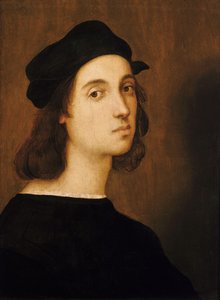
Rafael
1483 - 1520 , Italia
Breves datos
- Artistas Influyentes:
- Giovanni Santi
- Pietro Perugino
- Estilo Artístico: Alto Renacimiento
- Fecha De Muerte: 06/04/1520
- Fecha De Nacimiento: 28/03/1483
- Influencia En Artistas: Neoclasicismo
- Lugar De Nacimiento: Urbino, Italia
- Nacionalidad: Italiano
- Nombre Completo: Rafael (Raffaello Sanzio)
- Obras Notables:
- El Juicio de Salomón
- Madonna del Cardellino
- La Escuela de Atenas
- San Sebastián
- La Dama Velada

