 Ver en contexto
 Enviar
 Compartir
 Detalles

 Descargar
 Similares
 Radiografía
 Presentación de diapositivas
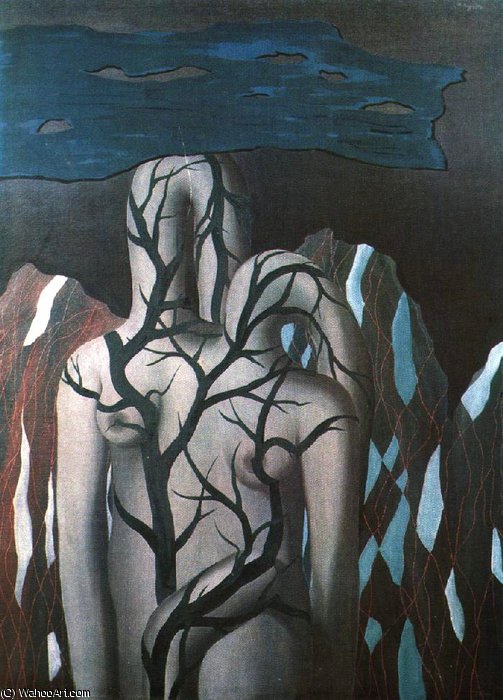
LANDSCAPE,1926, Private


 Ver más
Reproducción al óleo hecha a mano
Óleo sobre lienzo pintado a mano en el tamaño y marco de su elección, realizado por encargo por nuestros artistas. ( Comprar impresión Comprar imagen)




P118B $10

P118H $10

P118W $10

P438Z $10

P508JH $12

P508YH $12

P805H $10

P805Z $10

P919BZ $10

P919G $10

P919XJ $10

P959ZH $10

P968JZ $12

W106C $8

W218G $10

W218JH $8

W218Y $10

W307PJ $10

W316G $10

W316PJ $8

W316Y $10

W398PJ $8

W4111J $10

W500HY $15

W500JH $15

W692G $12

W849H $8

W940BG $15

W953PJ $8




Elija entre nuestros tamaños predefinidos que respetan las proporciones originales de la obra.

Puede ingresar sus propias dimensiones para adaptarse a un marco o espacio específico. Si el tamaño seleccionado no coincide con las proporciones de la imagen original, recortaremos la obra o extenderemos la pintura con elementos adicionales pintados a mano. Se le enviará una maqueta digital para su aprobación antes de comenzar la producción.
Tenga en cuenta que la vista previa en pantalla no refleja el recorte o la extensión reales. Solo la maqueta mostrará con precisión la composición final.
Si bien existen tamaños personalizados, recomendamos seleccionar una dimensión de la lista predefinida para preservar las proporciones originales.
Tras realizar el pedido, el equipo de ArtsDot.com enviará un correo electrónico al cliente para solicitar instrucciones y proporcionarle una vista previa del boceto.
Envío a todo el mundo () en 3-4 semanas en lugar de las 5 semanas estándar. (7 septiembre). Sin comprometer la calidad.

Envío exprés gratuito a todo el mundo

Lienzo de lino de alta calidad

Seguro de envío total

Garantía de reembolso de impuestos aduaneros

Garantía de fidelidad cromática exacta

Política de devolución de 100 días (solo por defectos)

Garantía de devolución del 100% del dinero

Descuento por cantidad
 La opción de vidrio solo está disponible en tamaños inferiores a 110 cm.

LANDSCAPE,1926, Private
Técnica de reproducción
Dimensiones de la reproducción
-


Precio total final
$ 263
A Surreal Echo of Loss and Hidden Reality
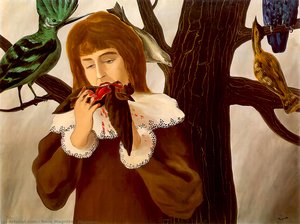
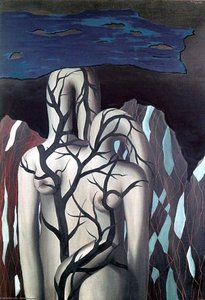
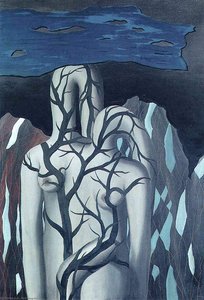
René Magritte’s “Landscape,” painted in 1926, stands as a deceptively simple yet profoundly unsettling image—a testament to the enduring influence of personal trauma on artistic expression. During his formative years as a surrealist artist, Magritte began to master the art of the visual paradox, creating works that invite the viewer into a deep contemplation of subconscious anxieties and the elusive nature of perception. The painting depicts a woman whose torso is intimately intertwined with tree roots, presenting a striking confrontation between the human form and the relentless growth of the natural world. This deliberate pairing speaks to themes of resilience amidst decay and the inescapable connection between our individual experiences and the organic cycles of life.
The emotional weight of the piece is anchored in its muted palette, primarily composed of earthy browns and deep greens. These tones create an atmosphere of quiet, somber contemplation, punctuated by jarring visual anomalies that disrupt the stillness. Magritte’s signature surrealist style eschews realistic representation in favor of dreamlike imagery and illogical juxtapositions. His brushstrokes are remarkably smooth, contributing to a sense of eerie calm that belies the unsettling symbolism at play. For the collector or interior designer, this painting offers a sophisticated layer of mystery, acting as a focal point that provokes thought and invites long-term engagement through its layered, enigmatic composition.
Symbolism and the Unconscious Mind
The tree roots emerging from the woman’s torso are arguably the painting's most potent symbol. They represent not merely physical growth but also the inescapable influence of past experiences on present consciousness. There is a haunting resonance here with Magritte’s own history; much like the traumatic image of his mother’s body being recovered from the River Sambre, these roots evoke a sense of loss and the way memory can take root within us, becoming an inseparable part of our identity. This exploration of the unseen and the veiled aligns perfectly with André Breton's surrealist manifesto, which advocated for the liberation of the mind from rational thought to explore the vast, often dark, realms of the unconscious.
Beyond the central figure, Magritte introduces subtle elements that add profound depth to the scene. A boat visible in the distant background and a smaller, secondary figure on the right side of the canvas serve to expand the world of the painting, suggesting a larger, perhaps even more complex, reality lurking just beyond our immediate view. This layering of subjects creates a sense of narrative ambiguity, making the artwork an ideal choice for those who appreciate art that functions as a window into another dimension—a piece that does not merely decorate a space but transforms it into a site of psychological discovery.
A Timeless Masterpiece for the Modern Collector
To possess a reproduction of “Landscape” is to hold a fragment of art history’s most intriguing movement. Magritte’s ability to render the familiar as something strange and the ordinary as something profound has left an indelible mark on everything from pop art to conceptualism. This work serves as a bridge between the tangible world we inhabit and the dreamscapes of our inner lives. For those seeking to curate a collection defined by intellectual depth and aesthetic intrigue, this painting offers a unique opportunity to integrate a masterpiece of surrealist tension into a contemporary setting, providing an enduring source of inspiration and conversation.
Obras relacionadas
Biografía del artista
vida temprana y comienzos artísticos
René François Ghislain Magritte, un reconocido artista surrealista belga, nació el 21 de noviembre de 1898 en Lessines, provincia de Hainaut, Bélgica. Su vida temprana permanece algo misteriosa, con poco conocimiento sobre su infancia. Sin embargo, está documentado que comenzó clases de dibujo en 1910.evolución artística e influencias
El estilo artístico de Magritte evolucionó significativamente a lo largo de los años, influenciado por diversos movimientos como el impresionismo, el futurismo y el cubismo. Sus primeras pinturas, datadas alrededor de 1915, eran de estilo impresionista. De 1916 a 1918, estudió en la Academia Real de Bellas Artes de Bruselas, bajo Constant Montald.período surrealista y obras notables
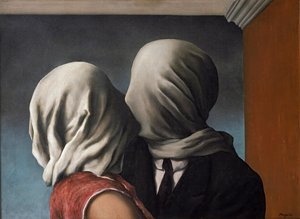
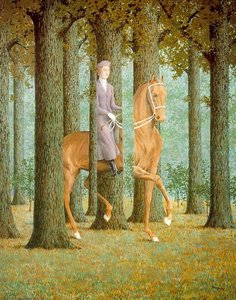
En 1926, Magritte produjo su primer cuadro surrealista, El jinete perdido (Le jockey perdu), marcando el comienzo de su asociación con el movimiento surrealista. Su obra se caracteriza por imágenes provocadoras, a menudo representando objetos ordinarios en contextos inusuales, desafiando las percepciones de la realidad de los observadores.- Les amants (1927-1928), una serie de pinturas que presentan a personas con tela cubriendo sus rostros, se cree que fue inspirada por la historia de la muerte de su madre.
- Los amantes, otra pieza icónica, presenta a una pareja besándose con sus rostros cubiertos por telas blancas, invitando al espectador a reflexionar sobre el amor y la identidad. (disponible para su compra como una reproducción de pintura al óleo hecha a mano o impresión en lienzo en ArtsDot.com)
vida tardía y legado
La obra de Magritte fue exhibida en los Estados Unidos en 1936 y nuevamente en dos exposiciones retrospectivas, una en el Museo de Arte Moderno en 1965 y la otra en el Metropolitan Museum of Art en 1992. Se mantuvo comprometido con la izquierda política pero abogó por la autonomía artística. Museos notables que exhiben la obra de Magritte:- Musée royal des beaux-arts de Belgique, Bruselas, Bélgica (descubra las obras maestras del musée royal des beaux-arts de belgique en ArtsDot.com)
- Musée Magritte, parte del musée royal des beaux-arts de Belgique, que exhibe la colección mundial más grande de obras de Magritte.
Conclusión
El legado de René Magritte como maestro surrealista perdura, con sus imágenes provocadoras que continúan inspirando e intrigando. Su obra, caracterizada por su mezcla única del ordinario y lo inesperado, sigue siendo un pilar fundamental del arte surrealista. Más información sobre René Magritte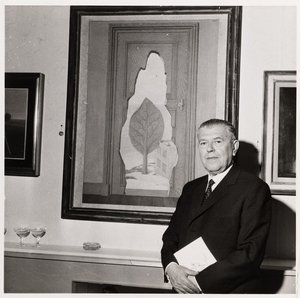
René Magritte
1898 - 1967 , bélgica
Datos clave
- Artistas Que Influyeron:
- Impresionismo
- Futurismo
- Cubismo
- Estilo Artístico: Surrealismo
- Fecha De Muerte: 15 de agosto de 1967
- Fecha De Nacimiento: 21 de noviembre de 1898
- Influenciado A Artistas:
- Pop Art
- Minimalismo
- Arte conceptual
- Lugar De Nacimiento: Lessines, Bélgica
- Nacionalidad: Belga
- Nombre Completo: René François Ghislain Magritte
- Obras Notables:
- Le Jockey Perdu
- Les Amants
- La traición de las imágenes
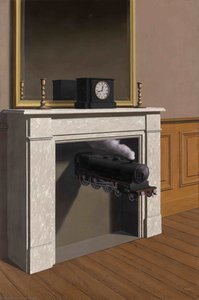
- Tiempo transcurrido
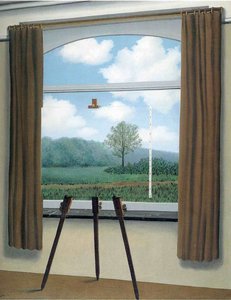
- La condición humana
Artículos relacionados

Katsushika Hokusai: Las 25 Obras Maestras del Ukiyo-e que Transformaron el Arte Japonés | ArtsDot
Descubre las 25 obras maestras de Katsushika Hokusai, el genio del ukiyo-e. Explora 'La Gran Ola', paisajes japoneses y su impacto en el arte moderno. Reproducciones de alta calidad para tu hogar en ArtsDot.com.

Paisajes Románticos: 10 Obras Maestras que Definieron un Movimiento Artístico
Descubre los 10 paisajes románticos más influyentes de artistas como Caspar David Friedrich y Turner. Explora la belleza, el simbolismo y las técnicas del movimiento romántico. Reproducciones de arte exclusivas en ArtsDot.com.
Arboreal Echoes: A Historical & Artistic Exploration of Trees in Painting
Explore the rich history of trees in painting! Discover symbolism, Romantic masterpieces by Caspar David Friedrich & beyond. A curated journey for art enthusiasts.

John Constable: Las 25 Obras Maestras del Paisaje Inglés | ArtsDot
Descubre las 25 obras maestras de John Constable, el pintor romántico inglés que capturó la belleza del paisaje. Explora su técnica, historia y significado en ArtsDot.com. Reproducciones de arte de alta calidad para tu hogar.

Paul Cézanne: Las 25 Obras Maestras que Definieron el Arte Moderno | ArtsDot
Descubre las 25 obras maestras de Paul Cézanne que revolucionaron el arte moderno. Explora su técnica, inspiración y significado en paisajes, bodegones y retratos. Reproducciones de alta calidad para decorar tu hogar con arte inolvidable. ¡Explora la colección completa en ArtsDot.com!