

 Ver en contexto
 Comprar impresión
 Enviar
 Compartir


 Descargar
 Similares
 Radiografía
 Presentación de diapositivas
Diseño para ‘Destino’, 1947


Design for 'Destino', 1947 - Salvador Dalí
“Design for ‘Destino’” stands as a cornerstone of Salvador Dalí’s oeuvre, encapsulating the very essence of Surrealism and marking a pivotal moment in his artistic trajectory. Created in 1947 during Walt Disney's ambitious foray into animated filmmaking—a project ultimately abandoned due to financial constraints—this painting transcends mere visual representation; it embodies a profound exploration of the subconscious mind and the dreamscape, mirroring Dalí’s fascination with mythology and psychoanalysis.
The genesis of “Design for ‘Destino’” lies in Dalí's collaboration with John Hench, Disney’s chief animator, who painstakingly transcribed Dalí’s cryptic sketches into detailed storyboards. This partnership wasn’t simply about logistical efficiency; it represented a crucial dialogue between Dalí’s visionary aesthetic and the practical demands of cinematic storytelling—a testament to Hench’s ability to translate Dalí's conceptual ideas into tangible visual form.
Stylistically, “Design for ‘Destino’” exemplifies Dalí’s signature Surrealist style. Characterized by illogical juxtapositions, distorted perspectives, and dreamlike imagery—elements readily identifiable in works like “The Persistence of Memory”—the painting employs a muted palette dominated by earthy tones punctuated by splashes of vibrant color. Dalí’s meticulous attention to detail—evident in the rendering of melting clocks and floating objects—further underscores his mastery of oil paint on canvas.
Symbolically, “Design for ‘Destino’” delves into themes of fate, desire, and transformation. The central figure—a woman with elongated limbs and a serene expression—represents both divinity and mortality, embodying Dalí’s preoccupation with archetypal imagery rooted in Greco-Roman mythology. Surrounding her are surreal elements—including a crumbling tower and a solitary snail—that evoke feelings of vulnerability and decay.
Ultimately, “Design for ‘Destino’” resonates deeply with viewers through its evocative emotional impact. The painting’s unsettling beauty compels contemplation on the nature of consciousness and the elusive realm of dreams. It serves as a powerful reminder that art can transcend literal representation to communicate profound psychological truths—a legacy cemented by Walt Disney's decision to include it in Fantasia 2000, where its imagery captivated audiences worldwide.
- Artist: Salvador Dalí
- Year: 1947
- Style: Surrealism
- Medium: Oil on Canvas
- Series: Destino
To discover more about Salvador Dalí and his remarkable artistic achievements, visit Wikipedia.
For a captivating glimpse into “Design for ‘Destino’”’s visual splendor, explore this high-resolution reproduction: 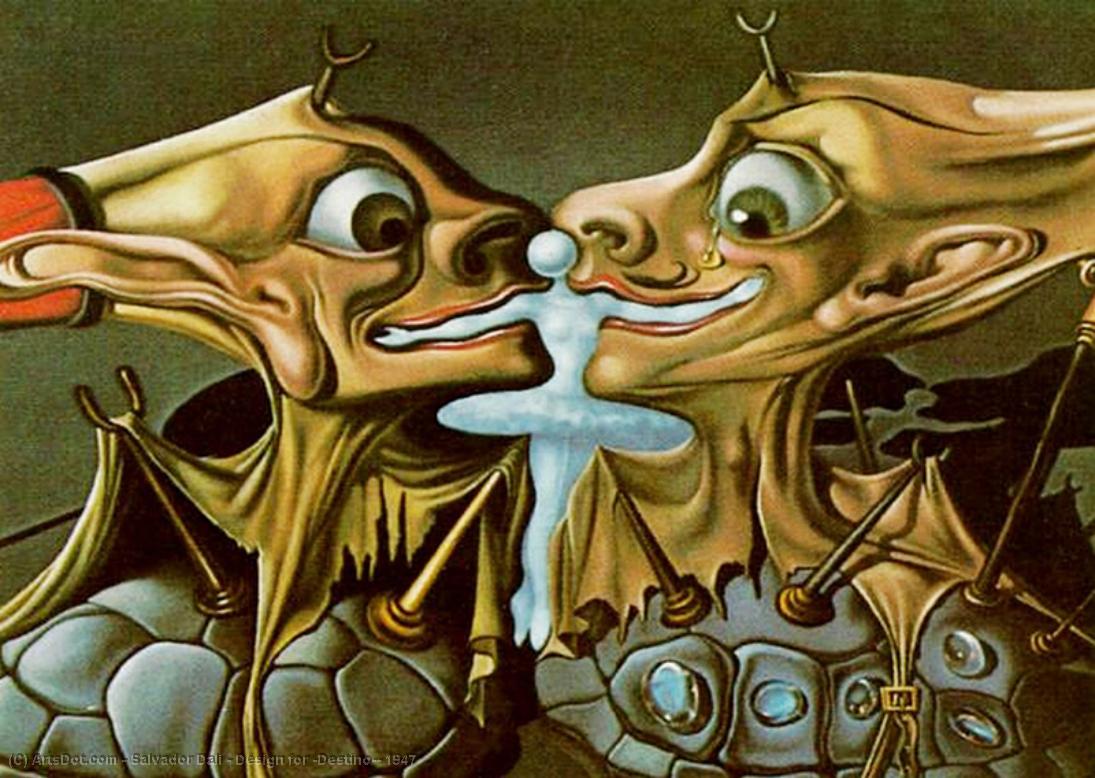
Explore other exceptional artworks by Dalí on our website: ArtsDot.com
Salvador Dalí (1904 – 1989)
¡Explora a Salvador Dalí (1904-1989), el maestro del Surrealismo! Descubre paisajes oníricos, imágenes icónicas y su impacto perdurable en el arte y la cultura pop. #SalvadorDali #Surrealismo
Sobre esta obra
- Título: Diseño para ‘Destino’, 1947
- Artista: Salvador Dalí
- Formato: Formato horizontal
- Estado de derechos de autor: Bajo derechos de autor
- Técnica o medio: Arte de pared
- Contexto del corpus: exploring subconscious , disney collaboration
- Paleta de colores: Tonos oscuros
- Palabras clave: dalí , gala dalí , pintura óleo lienzo
- Matiz de color: Gama de verdes
- Brillo percibido: sombra
Datos clave
- Ubicación: Museo Dalí
- Medio: Serigrafía/Papel tejido
- Movimiento: Surrealismo
- Influencias: Luis Buñuel
- Elementos notables: Dos figuras surrealistas con rostros fundidos.
- Tema: Proyecto cinematográfico
- Año: 1947
Código QR


