Menú
Ver en contextoVer en contexto Vista previa en RAVista previa en RA Comprar impresión Comprar impresiónComprar imagen Comprar imagen EnviarEnviar
DetallesDetalles Añadir a favoritos Añadir a favoritos DescargarDescargar SimilaresSimilares RadiografíaRadiografía Presentación de diapositivasPresentación de diapositivas

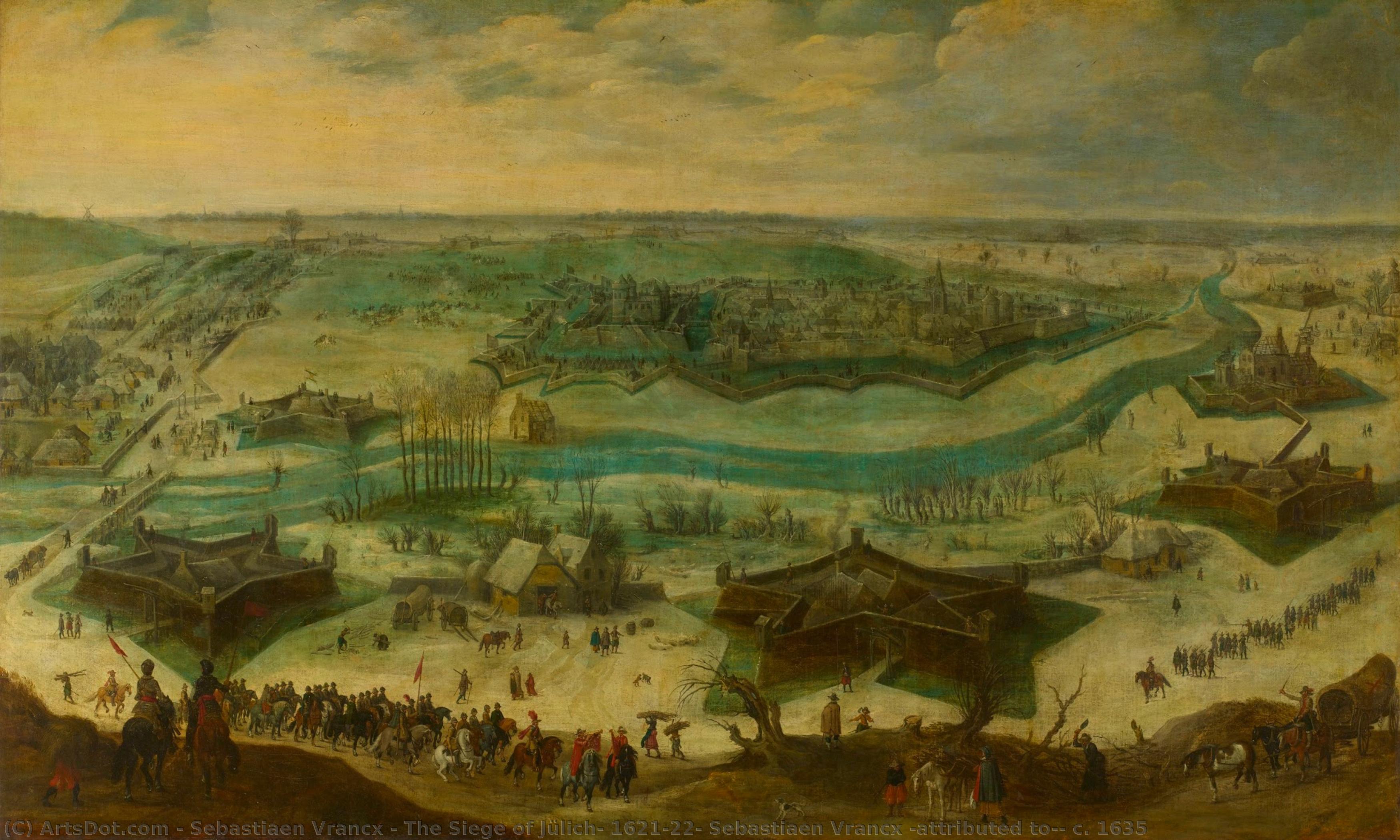
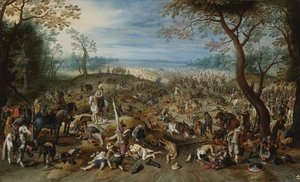
The Siege of Jülich, 1621-22, Sebastiaen Vrancx (attributed to), c. 1635

  • Fecha de creación1635
  • Dimensiones142.0 x 233.0 cm

Descubre la maestría de Sebastián Vrancx en escenas épicas y paisajes impresionistas. Pintor barroco flamenco reconocido por su escuela antuerpsina y obras como "El Escarmizón entre Cuirassiers", este artista capturó la esencia del siglo XVII con una habilidad excepcional.

Reproducción al óleo hecha a mano

Óleo sobre lienzo pintado a mano en el tamaño y marco de su elección, realizado por encargo por nuestros artistas. (Comprar impresión Comprar impresiónComprar imagen Comprar imagen)

Estándar
a medida
CM
INCH

Elija entre nuestros tamaños predefinidos que respetan las proporciones originales de la obra.

ancho
altura

Puede ingresar sus propias dimensiones para adaptarse a un marco o espacio específico. Si el tamaño seleccionado no coincide con las proporciones de la imagen original, recortaremos la obra o extenderemos la pintura con elementos adicionales pintados a mano. Se le enviará una maqueta digital para su aprobación antes de comenzar la producción.
Tenga en cuenta que la vista previa en pantalla no refleja el recorte o la extensión reales. Solo la maqueta mostrará con precisión la composición final.
Si bien existen tamaños personalizados, recomendamos seleccionar una dimensión de la lista predefinida para preservar las proporciones originales.

Ejemplos de lo que se puede personalizar: Reemplace el rostro con una foto del cliente; Agregue una mascota (por ejemplo, cambie un gato por un perro); Incluya un mensaje oculto en el fondo; Cambie el paisaje o los elementos del fondo.
Tras realizar el pedido, el equipo de ArtsDot.com enviará un correo electrónico al cliente para solicitar instrucciones y proporcionarle una vista previa del boceto.

Envío a todo el mundo () en 3-4 semanas en lugar de las 5 semanas estándar. (6 septiembre). Sin comprometer la calidad.

why_choose_icon
Envío exprés gratuito a todo el mundo
why_choose_icon
Lienzo de lino de alta calidad
why_choose_icon
Seguro de envío total
why_choose_icon
Garantía de reembolso de impuestos aduaneros
why_choose_icon
Garantía de fidelidad cromática exacta
why_choose_icon
Política de devolución de 100 días (solo por defectos)
why_choose_icon
Garantía de devolución del 100% del dinero
why_choose_icon
Descuento por cantidad

Precio total

$ 263

reproduction

The Siege of Jülich, 1621-22, Sebastiaen Vrancx (attributed to), c. 1635

Técnica de reproducción

Dimensiones de la reproducción

-

Precio total final

$ 263

Following the war of the Jülich (Gulick) succession and the siege of the town in 1609-14, the next investment of Jülich, a strategically important centre some 25 kilometres north-east of Aachen, lasted some five months during the exceptionally cold winter of 1621/22.10 From the viewpoint of the Eighty Years’ War, it was the first major event following the end of the Twelve Years Truce in April 1621.11 The town was garrisoned by the army of Wolfgang Ernst I (1560-1633), Count of Isenburg, made up of 4000 soldiers and eight cannon, and commanded by the Dutch military governor, Lieutenant-Colonel Frederik Pithan. The town was invested by Hendrik (1573-1638), Count van den Bergh, on orders from Ambrogio Spinola (1569-1630), commander-in-chief of the Spanish army in the Netherlands, leading some 7000 Spanish infantry and 700 cavalry to be reinforced by further troops.12 The siege began on 5 September and the town surrendered on 3 February. It remained under Spanish control until 1660. Although early identified as the 1603 siege of Wassendonk or Wachtendonk, there can be no doubt that the view in the present picture is of Jülich taken from the west. It shows a snow-covered landscape with the frozen river Roer or Ruhr. Beyond is the town with the two round towers of the Hexenturm and, nearby, the spire of the parish church, Maria Himmelfahrt. To the left is the citadel – the palazzo in fortezza designed by Alessandro Pasqualini, responsible for the lay-out of Jülich as an ideal Renaissance town from 154813 – with its towers incorrectly configured. To the left is the village of Broich, and beyond what was described in contemporary prints as ‘Das erste Principal Quartier’ of the Spanish army.14 Before the citadel is a cavalry skirmish, perhaps that which took place on 21 October,15 near the Cologne road. In the near middle ground is the line of the besiegers’ fortified outworks. Two Spanish cavalry patrols at some distance approach each other. That to the left has two trumpeters in the van, which might well indicate that its commander, thus suitably escorted and wearing a red plume to his helmet and red sash, was intended to be identified as van den Bergh himself (he wears the Spanish army commander’s red armband in Anthony van Dyck’s portrait in the Museo Nacional del Prado).16 The Amsterdam picture was given to the museum as the work of Sebastiaen Vrancx, an attribution which was early changed to his pupil, Peeter Snayers (1592-1667), and has been accepted as such ever since. In fact, Snayers did depict the siege from a similar, but higher, viewpoint.17 However, the figures in the Snayers are quite differently handled and Vander Auwera agrees that those in the museum picture should be returned to Vrancx.18 As he points out, Vrancx painted another view of the siege, probably in the mid-1620s;19 this has a lower viewpoint and was taken from a position further from the redoubts. In all three works the configuration of the outworks and cottages is similar, but not the same. Judging only from a digital image Vander Auwera believes that the landscape in the present picture is also by Vrancx working in the 1630s. The state of the paint surface and discoloured varnish makes assessment of it difficult. While it might be thought that the fieldworks, buildings and defences round the town and citadel are too crude to be his work, he points out that in the 1630s Vrancx’s manner of execution is ‘somewhat less finished and weaker as to definition of form’.20 Against this are the pentiments, seemingly incoherent, in the foreground redoubts, buildings and walls betraying an uncertainty not easily explained if his, as Vrancx had painted the view before. In one instance – the cottage in the right foreground – a pentiment in the roof makes it accord with that in his earlier picture. A further complication is that the design of the outworks is more like those devised by Snayers. Such being the case it seems wisest at this stage to attribute the painting as a whole to Vrancx, without ruling out the possibility that the landscape is the work of a lesser hand to which Vrancx added figures. Dautzenberg is the last to repeat that the star-shaped redoubts (in the Snayers) are probably imagined.21 However, contemporary prints of the siege, published by Neumann, show similar field-works.22 These were aerial views mostly taken from the north, which would have provided sufficient information for Vrancx and Snayers to execute their seemingly more realistic formulations of the event as seen from the east. Gregory Martin, 2022

Biografía del artista

el legado de un pintor barroco flamenco

Sebastiaan Vrancx o Sebastian Vranckx, un destacado pintor barroco flamenco, dejó una huella imborrable en el mundo del arte con sus pioneras escenas de batalla. Nacido en 1573 y fallecido en 1647, la obra de Vrancx no solo dominó el género pictórico neerlandés, sino que también exhibió su versatilidad en paisajes, escenas mitológicas y celebraciones urbanas.

contribuciones artísticas

El escaramuzado entre cuiráses, 5 de febrero de 1600, en la vughterheide, es una pieza notable que resalta el dominio de Vrancx al capturar momentos de batalla intensos. Una kermés de pueblo muestra su habilidad para retratar vibrantes escenas rurales, a menudo impregnadas de elementos alegóricos. Paisaje invernal con patinadores en un canal congelado demuestra su destreza para representar paisajes serenos, una desviación de sus habituales escenas bélicas.

museos que exhiben la obra de Vrancx

Musée d'Ixelles (Bruselas, Bélgica): este museo alberga una impresionante colección de más de 10,000 obras de arte, incluyendo piezas de Vrancx. Onze-Lieve-Vrouwekerk (Brujas, Bélgica): aunque conocido principalmente por sus obras religiosas, esta iglesia gótica también presenta trabajos de Vrancx y otros pintores flamencos.

movimientos artísticos y medios clave

  • Barroco: caracterizado por la iluminación dramática y las emociones intensas, lo cual se refleja en las escenas de batalla de Vrancx.
  • Escuela de Amberes: influenciada por la ciudad donde Vrancx fue activo, conocida por su estilo vibrante y detallado.
  • Óleo y grafito: los medios principales utilizados por Vrancx para dar vida a sus visiones.

más exploración en ArtsDot.com

* visita la página de Sebastiaan Vrancx o Sebastian Vranckx para más obras de arte e información detallada: https://ArtsDot.com/@/sebastiaan-vrancx-or-sebastian-vranckx * descubre el Musée d'Ixelles (Bruselas, Bélgica) y sus obras maestras: https://ArtsDot.com/@@/a@d3cen7

desentrañando el misterio del arte de Sebastiaen Vrancx

sumérgete en el mundo de este pintor barroco flamenco y experimenta la evolución de la pintura neerlandesa a través de sus obras en ArtsDot.com.
Sebastián Vrancx

Sebastián Vrancx

1573 - 1647 , Bélgica

Datos clave

  • Artistic Movement Or Style: Baroque
  • Artists Who Influenced This Artist:
    • Peter Paul Rubens
    • Anthony van Dyck
  • Date Of Birth: January 22, 1573
  • Date Of Death: May 19, 1647
  • Full Name: Sebastiaan Vrancx
  • Nationality: Flemish
  • Notable Artworks:
    • A Company of Cavalry
    • The Battle of Leckerbeetje
    • January
  • Place Of Birth: Antwerp, Belgium