Menú
Asesoría de arte gratuita
Ver en contextoVer en contexto Vista previa en RAVista previa en RA Comprar pintura hecha a mano Comprar pintura hecha a manoComprar imagen Comprar imagen EnviarEnviar
DetallesDetalles Añadir a favoritos Añadir a favoritos DescargarDescargar SimilaresSimilares RadiografíaRadiografía Presentación de diapositivasPresentación de diapositivas

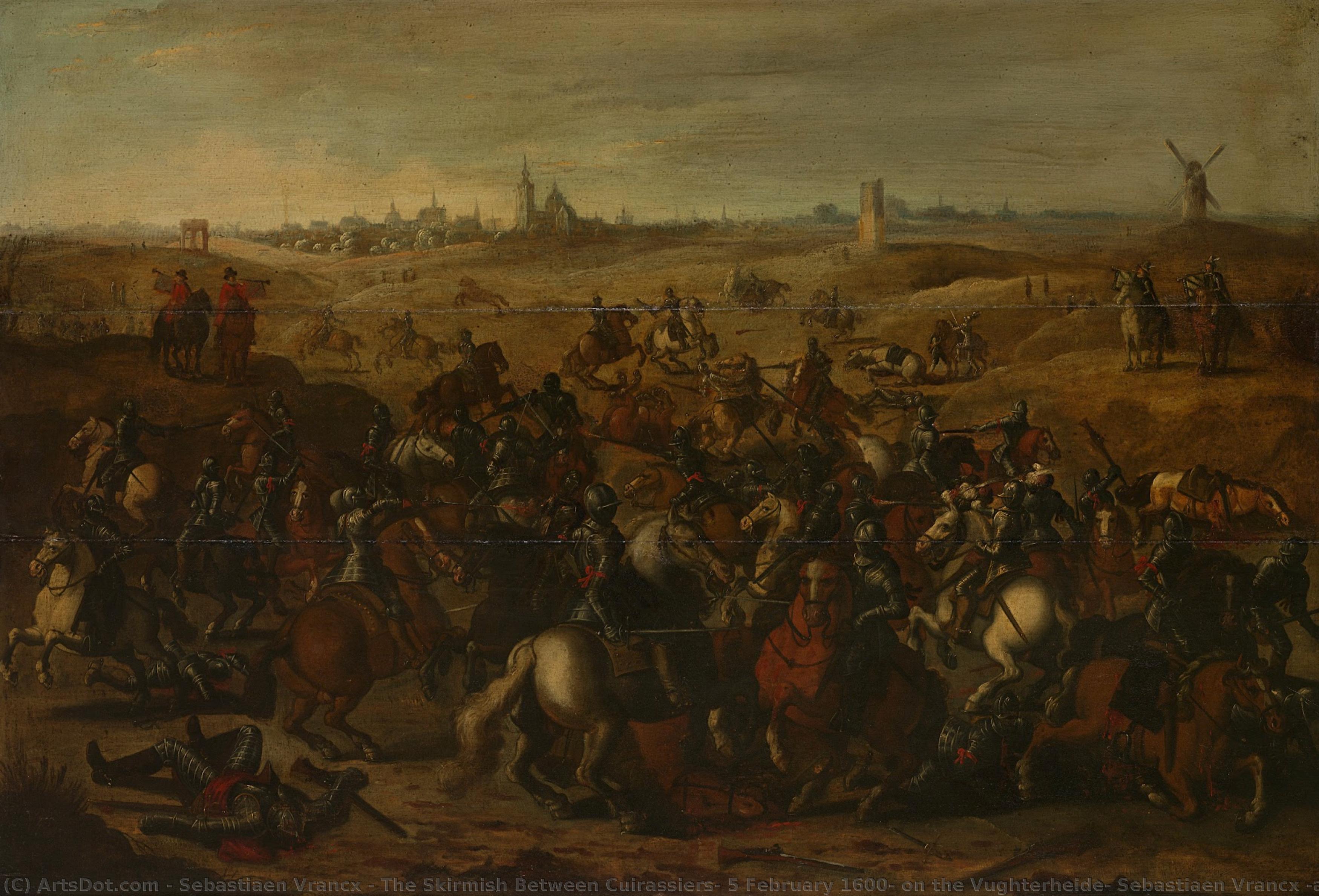
The Skirmish Between Cuirassiers, 5 February 1600, on the Vughterheide, Sebastiaen Vrancx (after), c. 1635

  • Fecha de creación1635
  • Dimensiones72.0 x 106.0 cm

Descubre la maestría de Sebastián Vrancx en escenas épicas y paisajes impresionistas. Pintor barroco flamenco reconocido por su escuela antuerpsina y obras como "El Escarmizón entre Cuirassiers", este artista capturó la esencia del siglo XVII con una habilidad excepcional.

Giclée / Impresión de arte

Impresiones giclée o en lienzo de calidad de museo con producción rápida y opciones de acabado flexibles. (Comprar pintura hecha a mano Comprar pintura hecha a manoComprar imagen Comprar imagen)

Estándar
a medida
CM
INCH

Elija entre nuestros tamaños predefinidos que respetan las proporciones originales de la obra.

ancho
altura

Puede introducir sus propias dimensiones para adaptarse a un marco o espacio específico. Si el tamaño seleccionado no coincide con las proporciones de la imagen original, recortaremos la obra de arte o extenderemos la imagen con un borde con efecto espejo o de color sólido. Se enviará una maqueta digital para su aprobación antes de que comience la producción.
Tenga en cuenta que la vista previa en pantalla no refleja el recorte o la extensión real. Solo la maqueta mostrará con precisión la composición final.
Aunque existen tamaños personalizados, recomendamos seleccionar una dimensión de la lista predefinida para preservar las proporciones originales.

Envío a todo el mundo () en 2 semanas en lugar de las 4/5 semanas estándar. (4 septiembre)

why_choose_icon
Envío exprés gratuito a todo el mundo
why_choose_icon
Lienzo de lino de alta calidad
why_choose_icon
Seguro de envío total
why_choose_icon
Garantía de reembolso de impuestos aduaneros
why_choose_icon
Garantía de fidelidad cromática exacta
why_choose_icon
Política de devolución de 60 días (solo por defectos)
why_choose_icon
Garantía de devolución del 100% del dinero
why_choose_icon
Descuento por cantidad

Precio total

$ 62

reproduction

The Skirmish Between Cuirassiers, 5 February 1600, on the Vughterheide, Sebastiaen Vrancx (after), c. 1635

Giclée / Impresión de arte

Dimensiones de la reproducción

-

Precio total final

$ 62

This notorious incident took place on the Vughterheide not far from ’s-Hertogenbosch on 5 February 1600.11 It resulted from a challenge by Pierre (or François) de Bréauté (1580-1600), a Norman cavalry officer based in Geertruidenberg, in the service of Prince Maurits of Orange, the Dutch stadholder, offered to Anton Schetz (1564-1640), from 1619 2nd Baron Grobbendonck and from 1598 governor of ’s-Hertogenbosch, which city remained under Spanish suzerainty until 1629.12 He appointed a native of Brabant from the city, Gerard Abramsz van Houwelingen (c. 1560-1600), his lieutenant, to answer the summons. Houwelingen had an odd nickname, Leckerbeetje, which has had various interpretations; Vander Auwera has recently suggested that the Dutch nickname should mean ‘he who likes tasty things’.13 The formalities seem to have followed those of the traditional, medieval tournament.14 Settled beforehand by the heralds would have been the place and time of the encounter – the Vughterheide between the Vught windmill and the ’s-Hertogenbosch gallows on the 5 February 1600 – and the numbers on each side, twenty-two. The cuirassiers are wearing three-quarter length, heavy armour and are fighting with pistols/bludgeons and armour piercing swords. Houwelingen wears a red sash and his comrades the red armband of the Spanish army (their opponents’ armbands should be green). The Rijksmuseum picture, which is on an oak support that has not been dated, is a copy of the print, designed by Sebastiaen Vrancx and engraved by Joannes van Doetecum II (by 1587-1630), of which there appear to be no extant examples.15 It has been suggested that the engraver worked from a painting by Vrancx,16 but this is unlikely as the latter is described as the ‘inventor’ and this in spite of there being a record of a painting of the skirmish (mêlée) by Vrancx of 1601.17 The plates, which made up the print, were purchased after Van Doetecum’s death by Claes Jansz Visscher (1587-1652) and republished by him in 1631 as Batalie van Breaute ende Leckerbeetien.XXII.Tegens XXII. Inscriptions on Visscher’s print identify the town, centre, as ‘shertogenbos’ (’s-Hertogenbosch) and the villages to the left and right as ‘Orten’ (Orthen) and ‘Vucht’ (Vught) respectively. The present copy is not accurate; in particular the gallows in the middle distance, left, was misunderstood and the tower to the left of the windmill differs, as do the buildings along the horizon. There are far fewer spectators in the middle ground. Dendrochronological analysis of the three pieces of oak timber which make up the support might provide a terminus post quem for its execution. Hofstede de Groot suggested that it was the work of Gerrit van Santen (1609/11-1687/1700),18 but it seems rather to be the work of a not very skilful, journeyman hand active very probably in the Netherlands in the first half of the seventeenth century. Depicted is the moment after the impact of the first charge, which would have been signalled by each sides’ trumpet-blowing heralds on raised ground to the left and right. At this first encounter, De Bréauté shot Houwelingen dead and his own horse was killed. The former, identified as Lieutenant Lackbeetken (Leckerbeetje), is shown lying prone in the left foreground of the print, while De Bréauté is identified in the print as the cuirassier remounting by his dead charger, to the left of the heralds on the right. Whether these identifications are as Vrancx intended is an open question, but it seems likely. As is shown in the print (and painted copy), this skirmish was to the death (a mêlée à outrance) and thus fiercely contested.19 Nineteen of De Bréauté’s companions were killed as were four Brabanters and thirty horses. Among the Brabanters to die were Houwelingen’s brother and brother-in-law. De Bréauté was himself captured and then murdered as he was brought into ’s-Hertogenbosch. An account of the mêlée in Dutch and French is given at the base of Visscher’s print. Although Houwelingen is prominently depicted in the foreground, and De Bréauté is inconspicuous in the middle ground, the accounts are sympathetic to him and condemn his murder in cold blood, after his surrender and disarming, by a cornet, Jan van Mil, acting on the orders of the governor, who had been driven by hatred and revenge (haet en wraeck). This was to be expected as the print was published in the northern Netherlands; the narratives were probably the work of, or commissioned by, Visscher as the governor is referred to by his title, inherited in 1619. The prototype of the image is one of the few prints engraved by Van Doetecum when he was working independently in Rotterdam (1598-1603).20 Vrancx only became a master in the Antwerp guild in 1600/01; how the two came into contact and whether the design was commissioned by the engraver remains unknown, as do the sources on which Vrancx relied for the design. An earlier depiction of a mêlée à outrance is the print by Lucas Cranach I (1472-1553) of 1../..

Biografía del artista

el legado de un pintor barroco flamenco

Sebastiaan Vrancx o Sebastian Vranckx, un destacado pintor barroco flamenco, dejó una huella imborrable en el mundo del arte con sus pioneras escenas de batalla. Nacido en 1573 y fallecido en 1647, la obra de Vrancx no solo dominó el género pictórico neerlandés, sino que también exhibió su versatilidad en paisajes, escenas mitológicas y celebraciones urbanas.

contribuciones artísticas

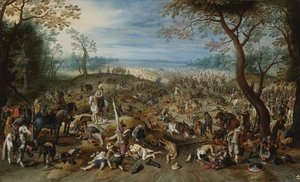
El escaramuzado entre cuiráses, 5 de febrero de 1600, en la vughterheide, es una pieza notable que resalta el dominio de Vrancx al capturar momentos de batalla intensos. Una kermés de pueblo muestra su habilidad para retratar vibrantes escenas rurales, a menudo impregnadas de elementos alegóricos. Paisaje invernal con patinadores en un canal congelado demuestra su destreza para representar paisajes serenos, una desviación de sus habituales escenas bélicas.

museos que exhiben la obra de Vrancx

Musée d'Ixelles (Bruselas, Bélgica): este museo alberga una impresionante colección de más de 10,000 obras de arte, incluyendo piezas de Vrancx. Onze-Lieve-Vrouwekerk (Brujas, Bélgica): aunque conocido principalmente por sus obras religiosas, esta iglesia gótica también presenta trabajos de Vrancx y otros pintores flamencos.

movimientos artísticos y medios clave

  • Barroco: caracterizado por la iluminación dramática y las emociones intensas, lo cual se refleja en las escenas de batalla de Vrancx.
  • Escuela de Amberes: influenciada por la ciudad donde Vrancx fue activo, conocida por su estilo vibrante y detallado.
  • Óleo y grafito: los medios principales utilizados por Vrancx para dar vida a sus visiones.

más exploración en ArtsDot.com

* visita la página de Sebastiaan Vrancx o Sebastian Vranckx para más obras de arte e información detallada: https://ArtsDot.com/@/sebastiaan-vrancx-or-sebastian-vranckx * descubre el Musée d'Ixelles (Bruselas, Bélgica) y sus obras maestras: https://ArtsDot.com/@@/a@d3cen7

desentrañando el misterio del arte de Sebastiaen Vrancx

sumérgete en el mundo de este pintor barroco flamenco y experimenta la evolución de la pintura neerlandesa a través de sus obras en ArtsDot.com.
Sebastián Vrancx

Sebastián Vrancx

1573 - 1647 , Bélgica

Datos clave

  • Artistic Movement Or Style: Baroque
  • Artists Who Influenced This Artist:
    • Peter Paul Rubens
    • Anthony van Dyck
  • Date Of Birth: January 22, 1573
  • Date Of Death: May 19, 1647
  • Full Name: Sebastiaan Vrancx
  • Nationality: Flemish
  • Notable Artworks:
    • A Company of Cavalry
    • The Battle of Leckerbeetje
    • January
  • Place Of Birth: Antwerp, Belgium