

 Ver en contexto
 Enviar
 Compartir
 Detalles

 Descargar
 Similares
 Radiografía
 Presentación de diapositivas
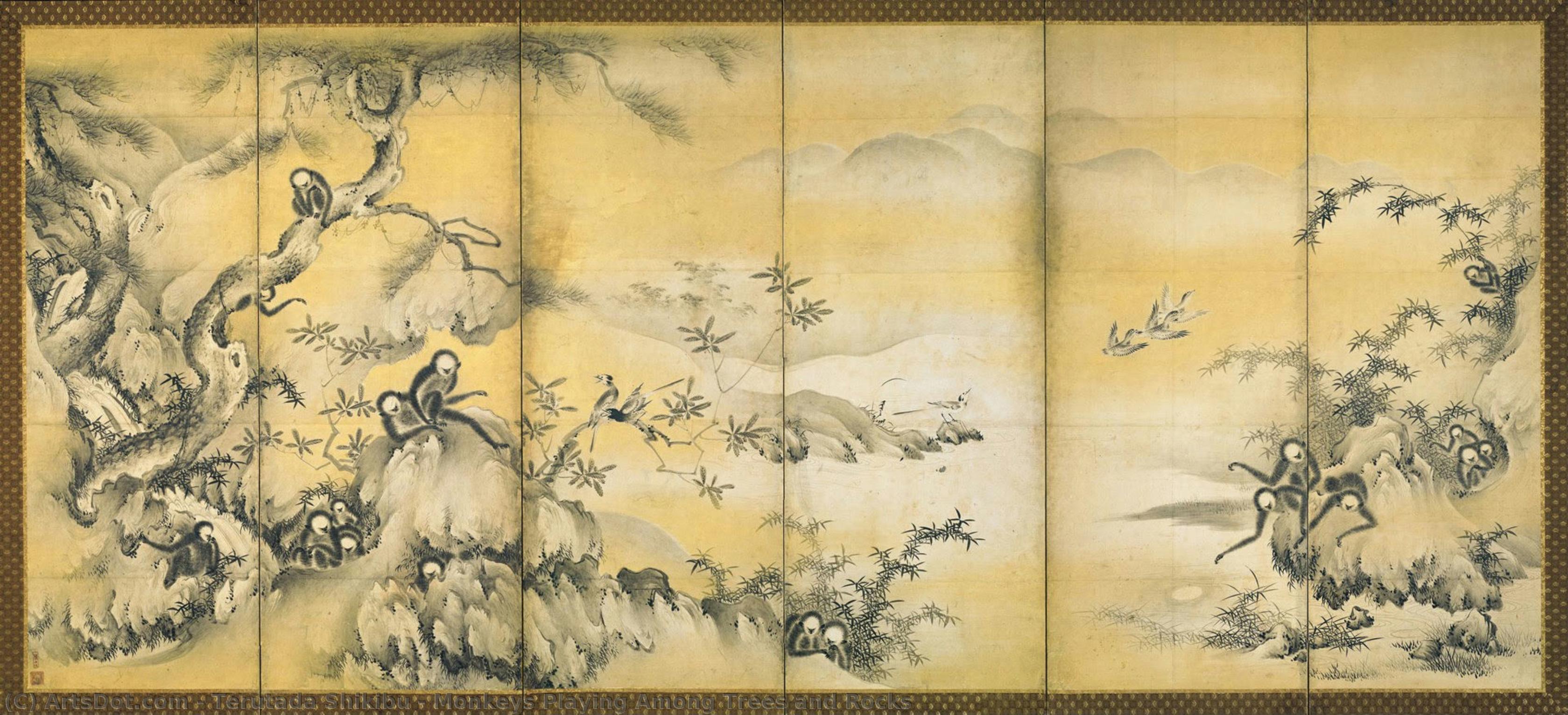
Monkeys Playing Among Trees and Rocks
 Ver más
Giclée / Impresión de arte
Impresiones giclée o en lienzo de calidad de museo con producción rápida y opciones de acabado flexibles. ( Comprar pintura hecha a mano Comprar imagen)




































Elija entre nuestros tamaños predefinidos que respetan las proporciones originales de la obra.

Puede introducir sus propias dimensiones para adaptarse a un marco o espacio específico. Si el tamaño seleccionado no coincide con las proporciones de la imagen original, recortaremos la obra de arte o extenderemos la imagen con un borde con efecto espejo o de color sólido. Se enviará una maqueta digital para su aprobación antes de que comience la producción.
Tenga en cuenta que la vista previa en pantalla no refleja el recorte o la extensión real. Solo la maqueta mostrará con precisión la composición final.
Aunque existen tamaños personalizados, recomendamos seleccionar una dimensión de la lista predefinida para preservar las proporciones originales.
Envío a todo el mundo () en 2 semanas en lugar de las 4/5 semanas estándar. (25 agosto)

Envío exprés gratuito a todo el mundo

Lienzo de lino de alta calidad

Seguro de envío total

Garantía de reembolso de impuestos aduaneros

Garantía de fidelidad cromática exacta

Política de devolución de 60 días (solo por defectos)

Garantía de devolución del 100% del dinero

Descuento por cantidad
 La opción de vidrio solo está disponible en tamaños inferiores a 110 cm.

Monkeys Playing Among Trees and Rocks
Giclée / Impresión de arte
Dimensiones de la reproducción
-


Precio total final
$ 62
Descripción de la pieza
Obras relacionadas


Biografía del artista
The Enigmatic Brush of Terutada Shikibu
In the annals of Japanese art history, few figures possess the haunting allure of Terutada Shikibu. A name whispered through the centuries, he remains a figure shrouded in artistic mystery, largely due to the scarcity of verifiable biographical details and the difficulty surrounding his historical identification. While some scholars once mistakenly conflated him with other masters, it is now understood that Shikibu was a distinct and vital presence, primarily active in the Kantō region of Eastern Japan during the transition between the Muromachi and Edo periods. Though his early life remains obscured by the mists of time, his work serves as a luminous window into the refined aesthetic sensibilities and spiritual currents that defined his era.
The essence of Shikibu’s artistry lies in his ability to capture the ephemeral beauty of the natural world with both precision and profound poetic resonance. He was a master of the Kacho-ga (bird and flower) genre, creating works that were far more than mere botanical studies. His paintings—most notably his celebrated seasonal landscapes—function as meditations on the passage of time and the cyclical nature of existence. Through a meticulous observation of flora and fauna, he achieved an idealized representation of nature that transcends simple realism, inviting the viewer into a space of quiet contemplation and spiritual depth.
Artistic Lineage and Stylistic Evolution
The development of Shikibu’s style is a fascinating study in the synthesis of tradition and individual innovation. While his precise training remains a subject of scholarly debate, there is strong evidence that he emerged from the influence of Kenkō Shōkei, a central figure in the late medieval painting circles of the Kantō region. By emulating the complex brushstrokes and structured compositions of Shōkei, Shikibu built a foundation of technical mastery that allowed him to later integrate the bold, vigorous elements of the Kano school.
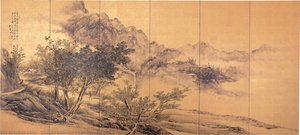
This stylistic evolution is particularly evident in his more dynamic compositions. In works such as Monkeys Playing Among Trees and Rocks, one can observe a breathtaking duality: the soft, delicate touch reminiscent of the Song-dynasty master Muqi meets the dense, powerful compositional methods characteristic of the Kano tradition. This ability to blend the delicate with the robust allowed him to appeal to a wide range of patrons, from the austere temples of the Muromachi period to the powerful Imagawa family, lords of the Suruga province. It has even been suggested by some historians that his prolific output of fan paintings indicates he may have led a dedicated workshop, further cementing his influence on the regional artistic landscape.
Symbolism and the Spirit of the Seasons
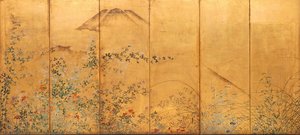
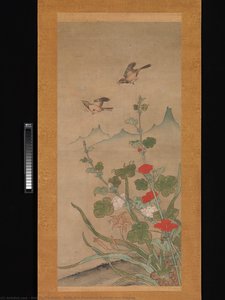
To gaze upon a work by Terutada Shikibu is to engage with a complex language of symbols. His landscapes are rarely just scenery; they are tapestries of meaning woven from the threads of Zen Buddhism and classical Japanese poetry. In his masterful pair, Birds and Flowers of Summer and Autumn, every element carries a weight of significance:
- The Flora: The presence of lilies and hollyhocks evokes themes of purity and seasonal vitality, while the chrysanthemum serves as a timeless emblem of longevity and endurance.
- The Fauna: Birds such as the black-backed wagtail or the watchful oriole are not merely decorative; they symbolize freedom, aspiration, and the harmonious balance of the natural order.
- The Seasonal Cycle: Through his depiction of changing landscapes—from the blossoming mountains of spring to the snow-covered retreats of winter—Shikibu captures the Buddhist concept of impermanence, reminding the viewer of the fleeting yet beautiful nature of all life.
Ultimately, the historical significance of Terutada Shikibu lies in his role as a bridge between eras. He carried the refined, spiritual traditions of the Muromachi period into the burgeoning cultural landscape of the Edo period, ensuring that the delicate echoes of tranquility found in his floral landscapes would continue to resonate through the centuries.
terutada shikibu
Japan
Datos clave
- Artistic Movement Or Style: Muromachi Period Landscape Painting
- Date Of Birth: Living
- Full Name: Terutada Shikibu
- Nationality: Japanese
- Notable Artworks:
- Landscape of the four seasons, one of a pair
- Birds and Flowers of Summer and Autumn
- Place Of Birth: Kyoto, Japan

