


 Ver en contexto
 Enviar
 Compartir
 Detalles

 Descargar
 Similares
 Radiografía
 Presentación de diapositivas
St Paul
 1546
1546 61.0 x 50.0 cm
 Mónisterio de Stavronikita
 Ver más
Reproducción al óleo hecha a mano
Óleo sobre lienzo pintado a mano en el tamaño y marco de su elección, realizado por encargo por nuestros artistas. ( Comprar impresión Comprar imagen)




































Elija entre nuestros tamaños predefinidos que respetan las proporciones originales de la obra.

Puede ingresar sus propias dimensiones para adaptarse a un marco o espacio específico. Si el tamaño seleccionado no coincide con las proporciones de la imagen original, recortaremos la obra o extenderemos la pintura con elementos adicionales pintados a mano. Se le enviará una maqueta digital para su aprobación antes de comenzar la producción.
Tenga en cuenta que la vista previa en pantalla no refleja el recorte o la extensión reales. Solo la maqueta mostrará con precisión la composición final.
Si bien existen tamaños personalizados, recomendamos seleccionar una dimensión de la lista predefinida para preservar las proporciones originales.
Tras realizar el pedido, el equipo de ArtsDot.com enviará un correo electrónico al cliente para solicitar instrucciones y proporcionarle una vista previa del boceto.
Envío a todo el mundo () en 3-4 semanas en lugar de las 5 semanas estándar. (26 agosto). Sin comprometer la calidad.

Envío exprés gratuito a todo el mundo

Lienzo de lino de alta calidad

Seguro de envío total

Garantía de reembolso de impuestos aduaneros

Garantía de fidelidad cromática exacta

Política de devolución de 60 días (solo por defectos)

Garantía de devolución del 100% del dinero

Descuento por cantidad
 La opción de vidrio solo está disponible en tamaños inferiores a 110 cm.

St Paul
Técnica de reproducción
Dimensiones de la reproducción
-


Precio total final
$ 263
Obras relacionadas
Biografía del artista
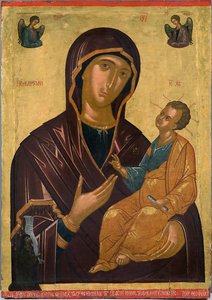
The Legacy of Theophanes the Cretan: A Master of Byzantine Light
In the hallowed, incense-filled corridors of the Great Lavra Monastery on Mount Athos, the brushstrokes of Theophanes the Cretan continue to whisper the spiritual truths of a bygone era. Born into the illustrious Strelitzas-Bathas family—a lineage where art was as much a vocation as a way of life—Theophanes (also known as Theophanes Bathas or Theophanis Strelitzas) emerged as a pivotal figure in the post-Byzantine Renaissance. His life, spanning from approximately 1490 to 1559, was a profound journey of devotion, where the boundaries between the earthly artist and the monastic monk became beautifully blurred. Inheriting the technical mastery of his father, Nikolaos Bathas, Theophanes did not merely replicate tradition; he breathed new life into it, blending the rigid, sacred geometry of Byzantine iconography with a burgeoning sense of human emotion.
The trajectory of his career was irrevocately altered by his move to the autonomous monastic republic of Mount Athos around 1527. This transition from the vibrant, culturally contested landscape of Crete to the contemplative silence of the Holy Mountain allowed Theophanes to refine a style that would become synonymous with the Cretan School. Within the walls of the Lavra Monastery, he found more than just a place of worship; he found a canvas for his most enduring achievements. His monumental frescoes in the Great Lavra Church stand as a testament to his ability to command space and light, utilizing biblical narratives to create a sense of dynamic movement and spiritual intensity that captivated both contemporary patrons and future generations of believers.
A Synthesis of East and West
What distinguishes Theophanes from his predecessors is the sophisticated stylistic synthesis he achieved through extensive travel and exposure to diverse artistic currents. While his heart remained rooted in the Eastern Orthodox tradition, his travels through Crete and Italy brought him into contact with the burgeoning influences of Western European art, particularly the elegance of the Venetian style. This intersection of worlds allowed him to infuse the traditional, two-dimensional iconographic language with subtle elements of perspective and a more nuanced approach to color and composition.
This stylistic evolution is evident in his mastery of several key artistic elements:
- Emotional Depth: Moving beyond static representations, Theophanes introduced a remarkable dynamism to his figures, imbuing sacred characters with a palpable sense of human feeling.
- Chromatic Brilliance: His use of color was both symbolic and transformative, employing rich pigments to guide the viewer's eye through complex theological compositions.
- The Cretan Synthesis: He successfully harmonized the austere, spiritual discipline of Byzantine art with the softer, more naturalistic tendencies emerging from the Italian Renaissance.
Enduring Influence and Historical Significance
Theophanes the Cretan was not merely a solitary genius but the patriarch of an artistic dynasty. His influence radiated through his family, most notably through his son and apprentice, Symeon Bathas Strelitzas, who carried forward the family's prestigious reputation. The works of Theophanes served as a foundational pillar for later masters of the Cretan School, such as Fragkos Katelanos and Dionysius of Fourna, ensuring that the technical and spiritual innovations he pioneered would endure for centuries.
Today, his legacy is preserved in the countless icons and frescoes distributed throughout Greece and the monastic communities of Mount Athos. When we gaze upon masterpieces like 'St Paul' or 'The Ascension', we are not simply looking at religious artifacts; we are witnessing a moment in history where the sacred and the human met on the tip of a brush. Theophanes remains a monumental figure whose work continues to bridge the gap between the temporal world and the divine, reminding us of the power of art to serve as a window into the eternal.
theophanes the cretan (theophanes strelitzas)
1527 - 1559
Datos clave
- Artistic Movement Or Style: Cretan School
- Artists Or Movements Influenced By This Artist: ['El Greco']
- Artists Who Influenced This Artist:
- Angelos Akotantos
- Andreas Pavias
- Date Of Birth: c. 1490
- Date Of Death: 1559
- Full Name: Theophanes Bathas Strelitzas
- Nationality: Greek
- Notable Artworks:
- St Paul icon
- The Ascension painting
- Place Of Birth: Heraklion, Crete

