The Genesis of Disquiet: Defining the Metaphysical Movement
 Metaphysical painting
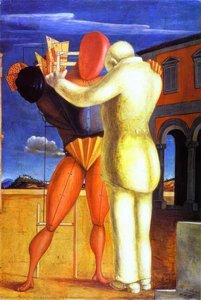
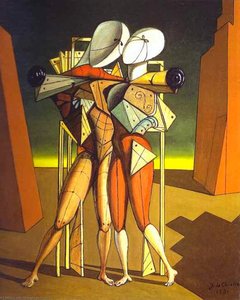
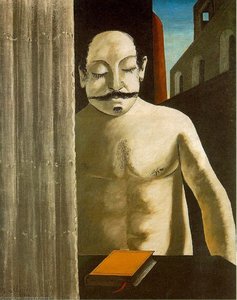
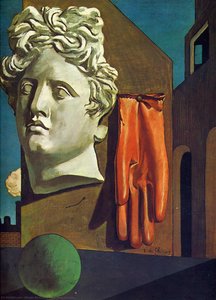
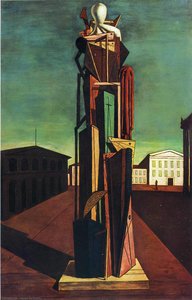
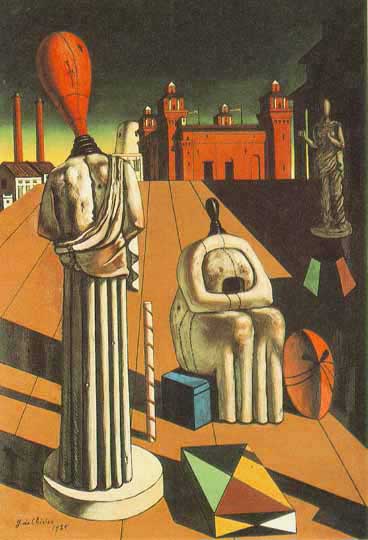
Metaphysical painting (Italian: pittura metafisica) or metaphysical art was a style of painting developed by the Italian artists Giorgio de Chirico and Carlo Carrà. The movement began in 1910 with de Chirico, whose dreamlike works with sharp contrast...
To step into a Metaphysical painting is to enter a world where time itself seems to have held its breath. Unlike the vibrant, light-drenched moments we adore in Impressionism—where the sun dances upon the Seine or flickers through a garden of poppies—Metaphysical art offers an eerie stillness, a profound pause in the rhythm of existence. Emerging in Italy around 1910, this movement, known as pittura metafisica, was not merely a stylistic innovation but a profound attempt to capture the hidden realities beneath the surface of everyday life. It sought to reveal the unsettling poetry lurking within familiar spaces, presenting a realm beyond the visible where memory, emotion, and philosophical inquiry converge.
The movement found its primary architects in Giorgio de Chirico and Carlo Carrà, who formally established its principles in 1917. While contemporaries like the Cubists were busy fracturing form and the Futurists were celebrating the frenetic speed of modern machinery, De Chirico sought something deeper and more enigmatic. He rejected the superficiality of contemporary modernism, finding little to admire in the works of Cézanne or the rapid movements of his era. Instead, he turned toward a style that could paint "that which cannot be seen," focusing on the unsettling resonance of objects divorced from their context and the weight of unspoken histories. This was an art of the unseen, a deliberate construction of dreamscapes designed to provoke contemplation on the elusive nature of reality itself.
Shadows of the Subconscious: The Visual Language of Giorgio de Chirico
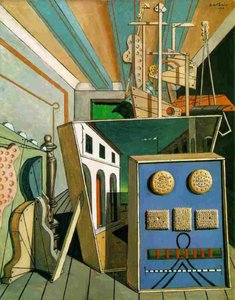 Metaphysical Interior with Biscuits
A Haunting Reverie: De Chirico’s *Metaphysical Interior with Biscuits* Giorgio de Chirico's 1916 painting, *Metaphysical Interior with Biscuits*, is not merely a depiction of a room; it’s an immersion into the unsettling realm of the subconscious. Th...
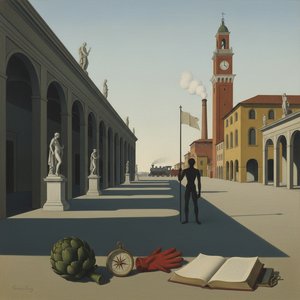
The visual vocabulary of De Chirico is one of haunting beauty and profound unease. His canvases are often populated by deserted Italian piazzas, characterized by long, dramatic shadows that stretch across sun-blelemmed stones like reaching fingers. Roman arcades loom with an almost oppressive grandeur, their receding perspectives often deliberately skewed to create a sense of spatial ambiguity and disorientation. In these silent squares, one might encounter featureless dressmakers' mannequins or lonely, classical statues, acting as silent observers in a world stripped of human warmth. This use of chiaroscuro—the dramatic contrast between light and shadow—serves to heighten the psychological tension, making the familiar feel profoundly alien.
In masterpieces such as Vast Metaphysical Interior, De Chirico invites us into an immersion of the subconscious. The meticulous detail with which he renders these spaces—a monumental window flooding a room with light, yet simultaneously accentuating a sense of isolation—creates a meticulously crafted illusion. Even in works like Metaphysical Interior with Biscuits, where ordinary objects such as a guitar, a vase, or a clock are scattered throughout a room, there is a loaded symbolic weight. The presence of clocks, for instance, serves as a potent reminder of time’s relentless passage and the fragility of human existence. For those who wish to bring this sense of mystery into their own homes, our museum-quality oil reproductions capture every subtle brushstroke and tonal depth, allowing the haunting atmosphere of De Chirico's vision to reside within your personal gallery.
Philosophical Foundations: Nietzsche, Schopenhauer, and the Poetics of Absence
 Giorgio de Chirico: Metaphysical Realities & the Poetics of Absence
The Genesis of Metaphysical Painting: A Rejection of Modernism Wikipedia: Giorgio de Chirico Giuseppe Maria Alberto Giorgio de Chirico ( KIRR-ik-oh; Italian: [ˈdʒordʒo de ˈkiːriko]; 10 July 1888 – 20 November 1978) was an Italian artist and writer bo...
The intellectual marrow of Metaphysical art is drawn from the profound philosophical currents of the late 19th and early 20th centuries. De Chirico’s artistic journey was deeply informed by the writings of Friedrich Nietzsche and Arthur Schopenhauer, thinkers who explored the irrationality of human desire, the subjective nature of reality, and the concept of eternal recurrence. The imagery in his work—the juxtaposition of medieval armor with modern architecture, as seen in Il Trovatore—mirrors Nietzsche’s exploration of temporal layers and the persistence of myth within the modern psyche. There is a palpable sense of existentialism in these works, an engagement with the anxieties and intellectual upheavals of pre-war Europe.
This philosophy manifests as a "poetics of absence." The emptiness of the piazzas and the stillness of the figures are not merely voids; they are active elements that evoke nostalgia, isolation, and an almost unbearable longing for something lost or unattainable. By stripping the world of its usual kinetic energy, De Chirico forces the viewer to confront the "metaphysical" reality—the essence that remains when the distractions of the material world are removed. It is a heavy, contemplative experience, one that requires the viewer to look past the canvas and into the psychological landscape of the mind.
Beyond the Visible: Architectural Enigmas and the Architecture of Dreams
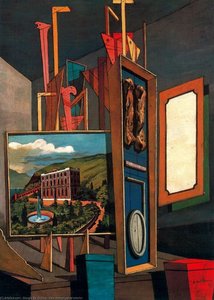 Vast metaphysical interior
A Journey Into the Unconscious: De Chirico’s “Vast Metaphysical Interior” Giorgio de Chirico's "Vast Metaphysical Interior" is not merely a depiction of a room; it’s an immersion into the unsettling realm of the subconscious, a meticulously crafted d...
Architecture in Metaphysical art serves as more than just a setting; it is a character in its own right. The use of classical elements—arcades, columns, and pedestals—provides a sense of permanence and historical weight, yet these structures are often placed in illogical or impossible configurations. This architectural disorientation challenges our conventional understanding of spatial reality, creating a "dreamscape" where the laws of physics seem suspended. De Chirico’s early influences, such as the symbolic landscapes of Arnold Böcklin and Max Klinger, provided him with the tools to construct these unsettling, monumental spaces that feel both grounded in classical heritage and untethered from logic.
This architectural enigma is often paired with a muted palette of ochre, deep shadows, and cool blues, lending an air of melancholy to the compositions. The precision of his technique—layering oil paints to create texture and depth—ensures that even the most abstract or dreamlike elements possess a tangible, sculptural quality. At ArtsDot.com, we honor this architectural precision in our handmade reproductions. Our artists, holding degrees from prestigious Fine Arts academies, use 100% cotton canvas and traditional oils to ensure that the structural integrity and atmospheric depth of these historical masterpieces are preserved for generations.
The Legacy of Stillness: From Metaphysical Art to the Rise of Surrealism
Surrealism is an art and cultural movement that developed in Europe in the aftermath of World War I in which artists aimed to allow the unconscious mind to express itself, often resulting in the depiction of illogical or dreamlike scenes and ideas. I...
While the Metaphysical movement was a distinct entity, its influence on the subsequent rise of Surrealism is undeniable. The Surrealists, led by figures like André Breton, sought to resolve the contradictory conditions of dream and reality into a "super-reality." They found in De Chirico’s work a blueprint for expressing the unconscious mind through illogical scenes and unexpected juxtapositions. The mannequins, the distorted perspectives, and the sense of profound alienation that defined the scuola metafisica became foundational elements of the Surrealist movement, which would go on to dominate the European art scene in the aftermath of World War I.
The legacy of Metaphysical art lies in its ability to transform the mundane into the miraculous and the terrifying. It taught us that there is a hidden dimension to our surroundings, waiting to be uncovered through careful observation and philosophical inquiry. Whether you are a student of art history or a dedicated collector, the works of De Chirico and his contemporaries offer an eternal invitation to explore the shadows. If you find yourself moved by these enigmatic dreamscapes, we invite you to explore our collection of hand-painted reproductions or consult with our experts to find a piece that resonates with your own sense of mystery.