The Genesis of Perception: Defining the Op Art Movement
To step into the world of Op Art is to enter a dialogue with one’s own biology. Emerging prominently in the 1960s, Optical Art—or Op Art—was never merely about the canvas; it was about the physiological response of the viewer. Unlike the emotive, swirling brushstrokes of Abstract Expressionism that sought to externalize the artist's psyche, Op Art turned the gaze inward, focusing on the mechanics of sight itself. It is a movement rooted in the tension between what we see and what we know to be true, utilizing precise geometric configurations to trigger retinal fatigue, flickering light, and the sensation of undulating surfaces.
This movement challenged the traditional passivity of the spectator. In an Op Art exhibition, the viewer does not simply observe a static image; they participate in a kinetic event. As the eye moves across the surface, the artwork appears to breathe, rotate, or vibrate. This era marked a profound shift where art became a laboratory for testing the boundaries of human perception, blending the rigor of mathematics with the unpredictable nature of visual neurology. It is an art of pure, unadulterated impact, stripping away narrative and subject matter to leave only the raw, electric interaction between light, pattern, and the human eye.
The Geometry of Illusion: Analyzing Victor Vasarely’s Mathematical Precision
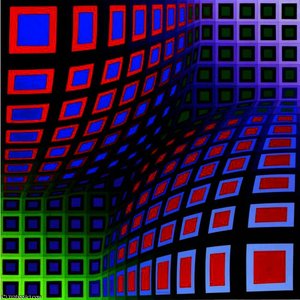
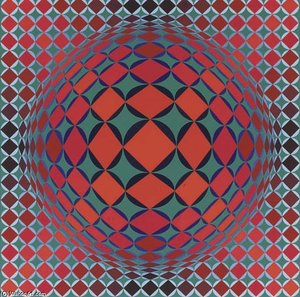
At the heart of this perceptual revolution stands the visionary Victor Vasarely, often revered as the pioneer of Op Art. His work serves as a masterclass in how structured geometry can dissolve into perceived chaos. In masterpieces such as Jong, Vasarely employs distorted lines and central spheres to create a sense of depth that defies the two-dimensional plane. He does not rely on traditional shading or perspective; instead, he uses the strategic placement of shapes to trick the brain into perceiving volume and weight where none exists.
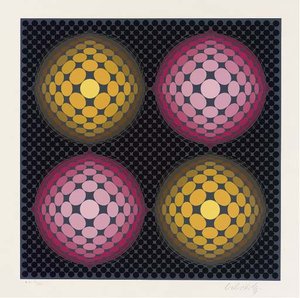
The brilliance of Vasarely lies in his ability to manipulate form through repetition and variation. Consider works like OND-II-VA, where dynamic spiral patterns in oil evoke a sense of centrifugal force, or Lang, a stark black and white composition that induces a dizzying sense of disorientation. In pieces such as Zebra, the artist utilizes precise geometric patterns to explore movement and form, proving that even the most rigid mathematical structures can possess a rhythmic, organic vitality. Through his hands, the canvas becomes a playground of algorithmic beauty, where every line is a calculated strike against the stability of reality.
Neuroaesthetics and the Eye: The Science Behind Visual Distortion and Motion
The "magic" of Op Art is, in truth, a sophisticated application of neuroaesthetics. When we encounter high-contrast patterns—such as the alternating black and white stripes found in Zebra—our retinal ganglion cells experience a phenomenon known as lateral inhibition. This biological process helps our eyes define edges, but when presented with repetitive, high-frequency patterns, the neurons become overstimulated. The result is a perceived "shimmer" or "flicker," an optical vibration that suggests motion in a completely stationary object.
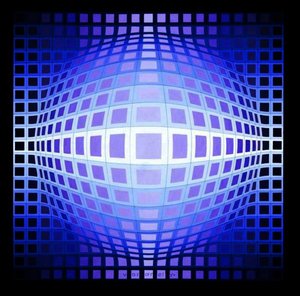
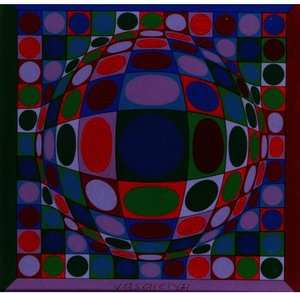
This scientific interplay extends to how we perceive depth and color. In works like Vega-Lila, the introduction of a blue sphere amidst intricate geometric patterns forces the brain to reconcile disparate layers of information, creating a sense of three-dimensional protrusion. The movement we perceive is actually a cognitive struggle; our brains are attempting to resolve the conflicting signals sent by the eyes. By understanding this science, the art student can appreciate that Op Art is not a trick of the hand, but a sophisticated manipulation of the neural pathways that govern our very existence.
Color, Contrast, and Kinetic Energy: Technical Elements of Optical Vibration
The technical execution of Op Art requires an almost architectural discipline. Color is used not for its emotional resonance, but as a structural tool to drive kinetic energy. In Rhombus-B, the vibrant interplay between yellow and blue spiral patterns demonstrates how complementary colors can be used to create "chromatic aberration," where the edges of shapes appear to bleed or vibrate against one's retina. This use of high-contrast color palettes is essential for generating the necessary tension to sustain an illusion.
Furthermore, the mastery of scale and density plays a critical role. The artist must carefully calibrate the spacing between lines and the size of geometric elements to ensure the desired level of disorientation. Too much stability, and the illusion fails; too much chaos, and the pattern becomes mere noise. Achieving that perfect equilibrium—where a piece like Jong feels both mathematically grounded and visually unstable—requires an intimate knowledge of how light interacts with pigment and how the human eye tracks movement across a surface.
Preserving the Illusion: Collecting and Curating Op Art Masterpieces
For the serious collector or the dedicated student of art history, acquiring works that embody this era is an invitation to possess a piece of scientific history. Because Op Art relies so heavily on the purity of line and the vibrancy of color, the quality of reproduction is paramount. A mere print often lacks the necessary depth; it is the physical texture of paint—the way light catches a slight impasto or the subtle variation in a hand-painted stroke—that truly brings the illusion to life.
When seeking to integrate these dynamic works into a modern collection, one must look for pieces that maintain their structural integrity. At ArtsDot.com, we specialize in providing museum-quality, hand-painted oil reproductions that honor the mathematical precision of masters like Vasarely. Our artists, trained in the finest academies, meticulously recreate the tension and vibration of these iconic works on 100% cotton canvas. Whether you are looking for a large-scale multi-panel installation to transform a contemporary space or a singular, striking piece like a reproduction of OND-II-VA, our process ensures that the "soul" of the optical illusion remains intact. We invite you to explore our curated selection and bring the captivating science of movement into your own environment.