The Subtractive Philosophy: Understanding the Essence of Relief Printing
 Mastering the Woodcut: A Definitive Guide to the Art of Relief Printing and its Historical Legacy
The Genesis of Relief: Understanding the Mechanics of Woodcut Printing Relief printing Relief printing is a family of printing methods where a printing block, plate or matrix, which has had ink applied to its non-recessed surface, is brought into con...
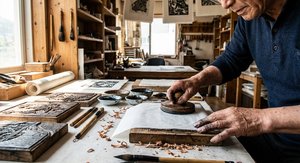
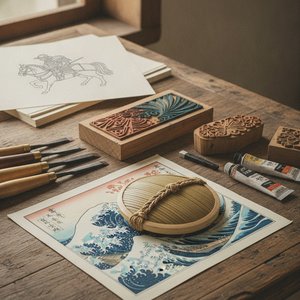
To encounter a woodcut is to witness a profound dialogue between presence and absence, a silent struggle where light is invited into the composition through the very act of removal. Unlike the additive grace of an oil painting, where layers of pigment build a world upon a canvas, or the delicate, recessed whispers of intaglio, relief printing operates through a subtractive philosophy. It is an art of excavation. The artist approaches a block of wood—perhaps a dense, fine-grained cherry or a supple pearwood—and begins the meditative, laborious task of carving away the areas intended to remain white. What remains at the original surface level constitutes the image itself.
This mechanical simplicity belelies a staggering complexity in execution. Every stroke of the chisel, every decisive gouge of the tool, is an irreversible commitment; once the wood is removed, that space is forever surrendered to the light. There is no room for the atmospheric hesitation found in watercolor or the fluid, continuous transitions of a brush. Instead, the medium demands a mastery of negative space, where the rhythmic interplay of dark ink and raw paper creates a structural energy that defines the very essence of the relief. It is a discipline of intention, where the artist must envision the final image not by what they apply, but by what they choose to take away.
A Global Tapestry: From Ancient Chinese Traditions to European Mastery
 The Enduring Legacy of Printmaking: Techniques, Themes & Artistic Innovation Across Centuries
The Genesis of Printmaking: From Ancient Origins to Early European Developments Wikipedia: Printmaking Printmaking is the process of creating artworks by printing, normally on paper, but also on fabric, wood, metal, and other surfaces. "Traditional p...
The story of the woodblock is a testament to humanity’s enduring desire to share visions beyond the limits of a single hand-painted surface. This journey began millennia ago, far from the grand galleries of Europe, rooted in the ancient traditions of East Asia. As early as the 7th century, during China's Tang Dynasty, woodblock printing flourished, initially used to adorn textiles with intricate patterns before evolving into a sophisticated method for reproducing text and imagery on paper. The famous Buddhist Diamond Sutra, printed in 868, stands as a breathtaking relic of this era, proving that even then, the medium possessed a spiritual and communicative power that could transcend time.
As these techniques traveled westward, they underwent a transformative evolution. By the 14th century, woodcut printing began to appear in Europe, initially serving more functional and devotional purposes. The creation of
Blockbücher—small, illustrated books carved entirely from wooden matrices—marked a crucial bridge between the era of hand-illuminated manuscripts and the true revolution of the printing press. When Johannes Gutenberg introduced movable type in the mid-15th century, the woodcut found its most powerful ally. The integration of carved illustrations with printed text allowed for an unprecedented dissemination of knowledge, fueling the Renaissance and allowing the artistic spirit to reach a wider, more diverse audience than ever before.
The Artist's Struggle: Texture, Tension, and the Physicality of the Grain
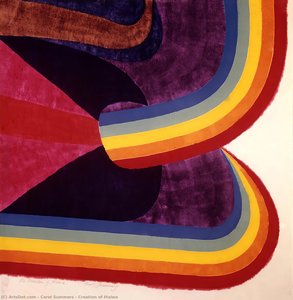 carol summers
Carol Summers: Weaver of Vibrant Landscapes Carol Summers (December 26, 1925 – October 27, 2016) stands as a singular figure in American printmaking, renowned for his distinctive “Carol Summers technique” – a revolutionary approach to woodcut that yi...
There is a primal, almost rebellious energy found within the grain of a woodcut that stands in stark contrast to the hyper-smooth precision of our modern digital age. To look upon a true relief print is to feel the physical resistance of the medium. It is an art form born of tension—the tension between the artist’s tool and the organic, stubborn fibers of the wood. Unlike the effortless glide of a brush across silk, the woodcut demands a certain level of physical engagement; it requires carving, gouging, and excavating. This process leaves behind an unmistakable energy, a high-impact power that resonates through the finished work.
The texture of the wood itself often becomes a silent participant in the composition. The artist does not merely work
on the wood, but
with it, navigating the natural ridges and imperfections of the grain to enhance the emotional weight of the image. In the hands of masters like Carol Summers, this relationship reached new heights of luminosity. Through his revolutionary technique, Summers moved beyond the flat, often monochromatic constraints of traditional woodcut, finding ways to layer ink that yielded extraordinary textural depth and an ethereal, blurred glow. His work reminds us that even within a medium defined by sharp lines and decisive cuts, there exists a profound capacity for softness, light, and breathtaking atmospheric beauty.
Modern Echoes: How Woodcut Energy Inspires Contemporary Visual Expression
 john william kuznetov
Early Life and Artistic Foundation John William Kuznetov, born in New York City in 1948, embarked on a creative journey that would firmly establish him as a significant figure in American woodcut printmaking. His formative years were steeped in the v...
While the world has moved toward the ephemeral nature of pixels and screens, the raw, rugged aesthetic of the woodcut continues to exert a powerful influence on contemporary visual language. We see its echoes in the bold, geometric abstractions of artists like John William Kuznetov, who liberated the medium from its illustrative origins to explore pure form and color. His work, shaped by the dynamic energy of New York’s art scene, utilizes the stark contrasts inherent in relief printing to create compositions that vibrate with a modern, intellectual intensity.
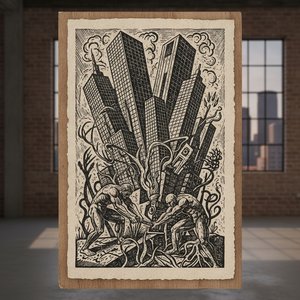
This enduring influence is not merely about technique, but about an aesthetic philosophy. The woodcut offers a sense of permanence and "truth" in an era of digital reproduction. It celebrates the visible mark of the human hand and the beautiful imperfections of the natural world. Whether it is through the architectural precision found in the works of Armin Landeck or the surreal, nature-infused visions of John Talleur, the spirit of the woodcut—its emphasis on structure, contrast, and the physical reality of the medium—continues to provide a vital counterpoint to the smoothness of modern life, reminding us of the beauty found in the struggle between creator and material.
Preserving the Impression: The Enduring Allure of Graphic Art in Private Collections
 Gabinetto Nazionale delle Stampe
A Journey Through Graphic Expression: Exploring the Gabinetto Nazionale delle Stampe Nestled within the elegant Palazzo Braschi in Rome, Italy, lies a treasure trove for anyone captivated by the art of printmaking – the Gabinetto Nazionale delle Stam...
For the true enthusiast, the collection of prints and works on paper is an intimate pursuit, a way to curate a sanctuary of lines and shadows. Institutions like the
Kupferstichkabinett in Berlin or the
Gabinetto Nazionale delle Stampe in Rome serve as profound reminders of why we cherish these works. These are not monumental canvases that demand attention through sheer scale; rather, they offer an encounter with art distilled to its most essential form. To wander through such collections is to feel the breath of the artist still palpable in every etched line and inked stroke.
In our own homes, integrating the spirit of these graphic traditions allows us to surround ourselves with works that possess a unique, tactile soul. Whether it is a carefully chosen reproduction that captures the light-drenched essence of an Impressionist landscape or a custom piece that reimagines personal history through a historical lens, the allure remains the same. We seek art that moves us, art that possesses a sense of history and a physical presence that can withstand the passage of time. In the grain of the wood and the depth of the ink, we find a timeless beauty that continues to enrich our lives and our understanding of the human experience.
Discover more at ArtsDot.com — where we celebrate the enduring legacy of the masters through exquisite, hand-painted reproductions and bespoke art commissions designed for the discerning collector.