

 プレビュー
プレビュー
 プリントを購入
 シェアする
シェアする シェアする
シェアする
 詳細を見る
詳細を見る

 ダウンロード
 似ている作品
 X線調査
X線調査 スライドショー
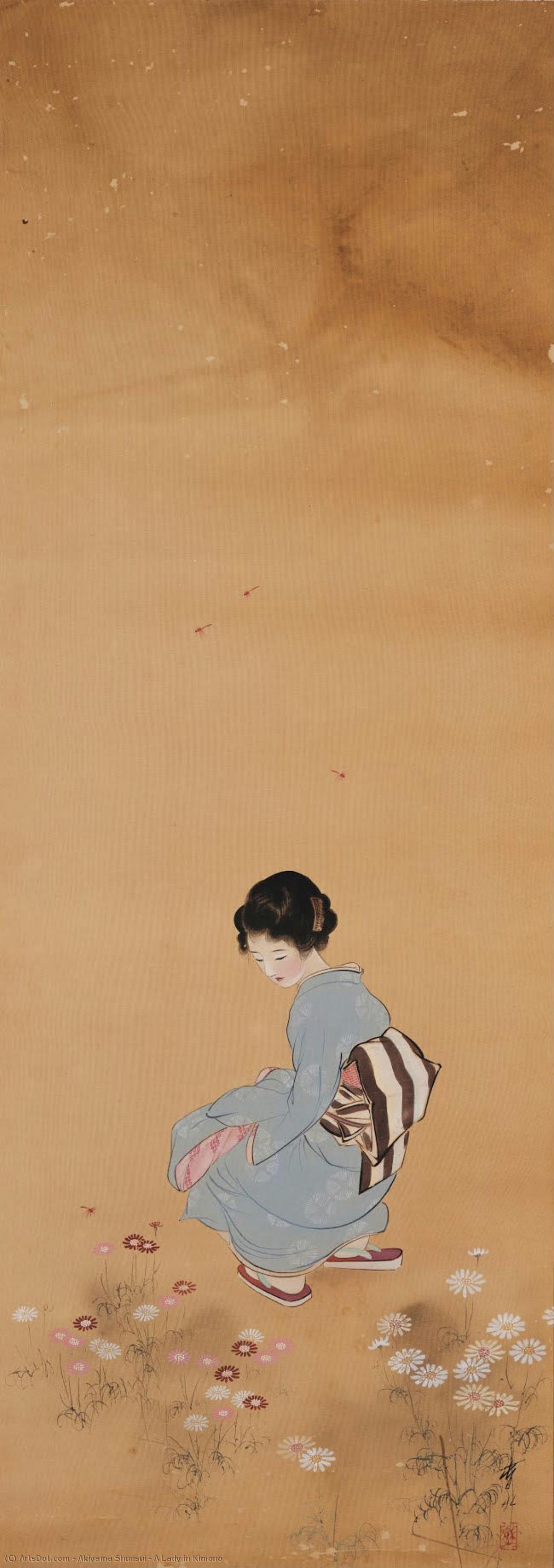
A Lady in Kimono
 123.0 x 42.0 cm
 国立台湾美術館
 詳細を見る
詳細を見る




































作品のオリジナル比率に合わせた、当店の規定サイズからお選びください。

特定のフレームやスペースに合わせて、ご希望のサイズをご入力いただけます。選択されたサイズが元の画像の比率と異なる場合、アートワークをトリミングするか、手描きで要素を追加して絵画を拡張いたします。デジタルモックアップ を制作し、制作開始前にご確認(承認)をいただきます。
画面上のプレビューは、実際のトリミングや拡張を正確に反映しているものではありません。最終的な構図は、モックアップによってのみ正確にご確認いただけます。
カスタムサイズもご利用いただけますが、元の比率を維持するためには、あらかじめ用意されたリストからサイズを選択することをお勧めいたします。
ご注文後、ArtsDot.com チームより詳細な指示をお送りするとともに、仕上がりイメージ(モックアップ)をご提供いたします。


 ガラスオプションは、110cm未満のサイズでのみご利用いただけます。

A Lady in Kimono
複製技法
複製画のサイズ
-


合計金額
$ 263
関連作品





アーティストの略歴
The Quietude of Tamsui: Exploring the World of Akiyama Shunsui
Akiyama Shunsui, a name synonymous with serene landscapes and masterful ink work, stands as a compelling figure in contemporary Japanese art. Though biographical details remain somewhat elusive – a testament to his focus on the artwork itself rather than personal fanfare – Shunsui’s impact is powerfully felt through his evocative depictions of Tamsui, Taiwan. Born in Japan, he dedicated himself to the delicate art of *sumi-e*, or ink wash painting, and it is within this tradition that his unique voice truly resonates. He isn't merely a painter; he is a storyteller who uses the subtle gradations of black ink to capture not just a place, but a feeling – the quiet nostalgia for a Tamsui seemingly lost in time. His most celebrated work, simply titled ‘Tamsui’, has become emblematic of his style and a poignant reflection on memory and atmosphere.Early Influences and Artistic Development
Shunsui’s artistic journey was deeply rooted in the classical Japanese aesthetic. While specific teachers or formal training remain undocumented, it is clear that he absorbed the principles of traditional Chinese landscape painting – an art form that has long been integral to Japanese artistic practice. The influence of the Song Dynasty masters is palpable in his compositions; a reverence for nature, a focus on atmospheric perspective, and a restrained palette are hallmarks of his work. However, Shunsui didn’t simply replicate these historical styles. He infused them with a distinctly Japanese sensibility – a quiet minimalism, an emphasis on *ma* (negative space), and a profound respect for the ephemeral beauty of the natural world. His early works likely explored various traditional motifs before he settled upon Tamsui as his primary subject, suggesting a period of dedicated study and refinement. The choice of Tamsui itself is significant; it represents a departure from purely Japanese landscapes, hinting at an openness to new perspectives and experiences that would shape his artistic vision.Tamsui: A Recurring Vision
The series of paintings known collectively as ‘Tamsui’ are not depictions of a specific moment in time, but rather composite impressions – memories filtered through the lens of artistic interpretation. Shunsui repeatedly returned to this coastal town in Taiwan, capturing its essence across different seasons and times of day. The scenes often feature simple elements: weathered boats gently bobbing on the water, traditional houses lining the riverbanks, distant mountains shrouded in mist. Yet, within these seemingly straightforward compositions lies a remarkable depth of emotion. He masterfully employs varying ink densities to create a sense of atmosphere – soft washes evoke hazy sunlight, while bolder strokes suggest the weight of rain or the strength of the wind. The absence of human figures in many of his paintings is also noteworthy; it allows the viewer to project themselves into the scene, experiencing Tamsui as a solitary and contemplative space. This deliberate omission transforms the landscape into a psychological portrait – a reflection on longing, tranquility, and the passage of time.Technique and Artistic Philosophy
Shunsui’s technique is characterized by its remarkable simplicity and control. He works primarily with black ink (*sumi*) applied to paper or silk using traditional brushes. The key lies in his ability to manipulate the ink – controlling the water-to-ink ratio, varying brush pressure, and utilizing different brushstrokes to create a wide range of tones and textures. He doesn’t rely on elaborate detail or vibrant colors; instead, he focuses on capturing the essence of the subject through subtle gradations of gray. This minimalist approach reflects his artistic philosophy – a belief that true beauty lies in simplicity and restraint. He sought to convey not just what Tamsui *looked* like, but how it *felt*. His paintings are imbued with a sense of quietude and contemplation, inviting the viewer to slow down and appreciate the subtle nuances of the natural world.Legacy and Historical Significance
While Shunsui remains a relatively unknown figure outside of specialist circles, his work has garnered significant attention within Japan and among collectors of Asian art. His paintings are prized for their technical mastery, emotional depth, and evocative atmosphere. He represents a continuation of the *sumi-e* tradition, but with a distinctly contemporary sensibility. In an age dominated by hyperrealism and digital imagery, Shunsui’s minimalist landscapes offer a refreshing alternative – a reminder of the power of simplicity and the enduring beauty of nature.- His work provides a valuable insight into the artistic exchange between Japan and Taiwan.
- He demonstrates the continued relevance of traditional art forms in the 21st century.
- ‘Tamsui’ has become an iconic representation of a specific place and time, preserving a sense of nostalgia for a bygone era.
akiyama shunsui
Japan
基本情報
- Artistic Movement Or Style: Ink painting
- Full Name: Akiyama Shunsui
- Nationality: Japanese
- Notable Artworks: ['Tamsui']
- Place Of Birth: Japan