

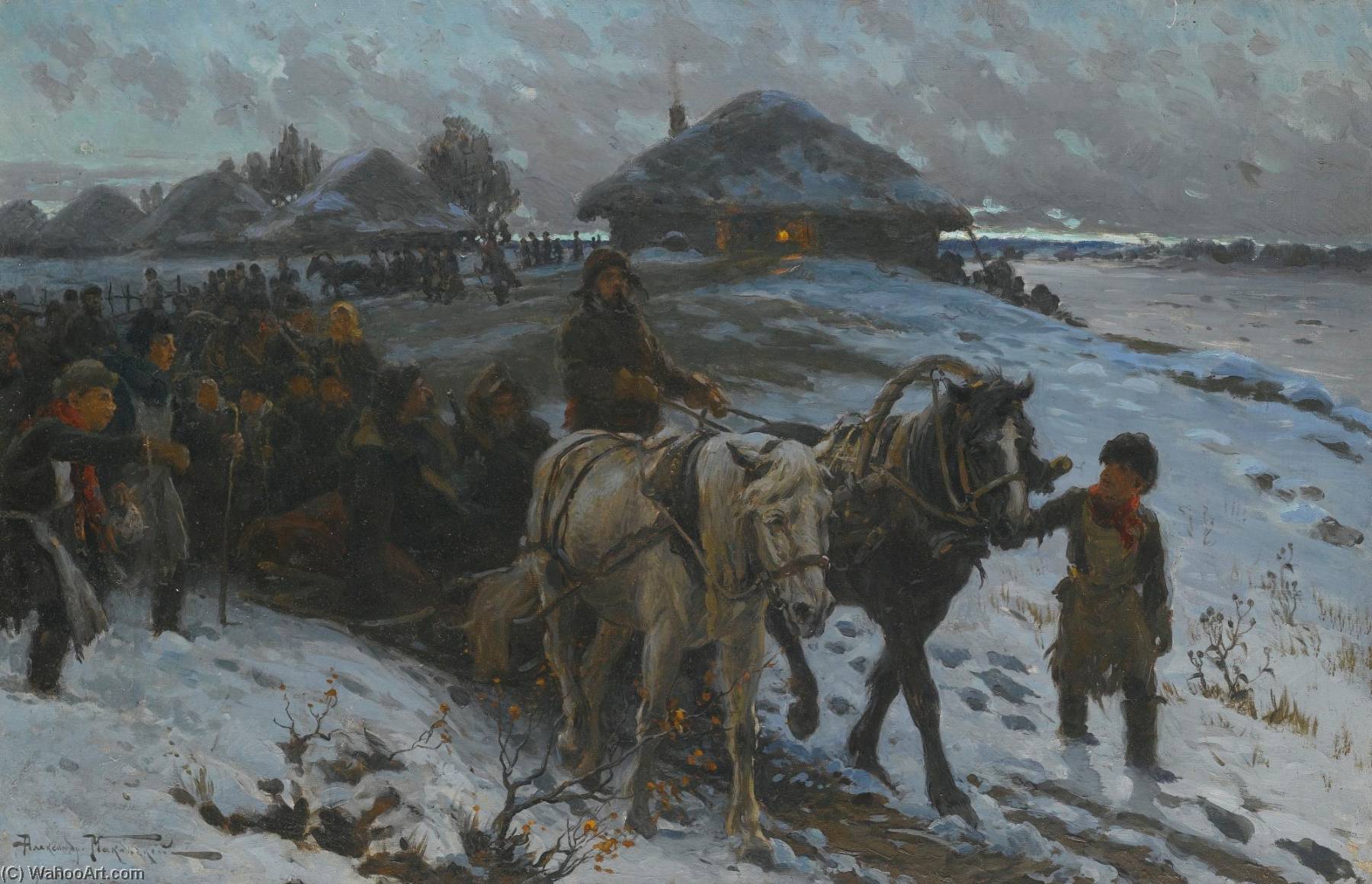
 プレビュー
プレビュー
 シェアする
シェアする シェアする
シェアする
 詳細を見る
詳細を見る

 ダウンロード
 似ている作品
 X線調査
X線調査 スライドショー
 Stats
StatsLeaving for the Hunt
 詳細を見る
詳細を見る
手描き油彩複製画
当社のアーティストが、お客様のご希望のサイズと額縁に合わせて、キャンバスに手描きで制作する油彩画です。 ( Switch to Print Switch to Digital Image)




































作品のオリジナル比率に合わせた、当店の規定サイズからお選びください。

特定のフレームやスペースに合わせて、ご希望のサイズをご入力いただけます。選択されたサイズが元の画像の比率と異なる場合、アートワークをトリミングするか、手描きで要素を追加して絵画を拡張いたします。デジタルモックアップ を制作し、制作開始前にご確認(承認)をいただきます。
画面上のプレビューは、実際のトリミングや拡張を正確に反映しているものではありません。最終的な構図は、モックアップによってのみ正確にご確認いただけます。
カスタムサイズもご利用いただけますが、元の比率を維持するためには、あらかじめ用意されたリストからサイズを選択することをお勧めいたします。
ご注文後、ArtsDot.com チームより詳細な指示をお送りするとともに、仕上がりイメージ(モックアップ)をご提供いたします。


 ガラスオプションは、110cm未満のサイズでのみご利用いただけます。

Leaving for the Hunt
複製技法
複製画のサイズ
-


合計金額
$ 263
関連作品








アーティストの略歴
The Soul of a Russian Master
Aleksandr Vladimovitch Makovsky was far more than a mere chronicler of his era; he was a poet of the canvas, a painter whose brushstrokes breathed life into the very soul of Russia. Born in Moscow on April 5, 1869, Makovsky emerged from a prestigious artistic dynasty, a lineage that deeply rooted him in the traditions of Russian Realism. His earliest lessons were whispered to him by his father, Vladimir Makovsky, a master of depicting Moscow life, who instilled in his son a rigorous devotion to observation and an unwavering respect for the truth found in nature. This foundational training, combined with the influence of his uncles Konstantin and Nikolay, placed Aleksandr at the heart of a movement dedicated to capturing the authentic pulse of the Russian people.
His formal education at the Moscow School of Painting, Sculpture and Architecture in 1884 served as a crucible for his developing talent. Studying alongside luminaries such as Vasily Polenov and Ilya Repin, Makovsky absorbed the profound weight of the Peredvizhniki movement—the Wanderers—which sought to bring art to the people through social relevance and emotional honesty. Yet, even as he mastered the academic foundations of his homeland, a restless curiosity drove him toward the broader horizons of Europe. His journey took him to Paris between 1889 and 1893, where the shimmering light of Impressionism and the ethereal mysteries of Symbolism began to dance within his technique. Under the guidance of Fernand Cormon, he learned to balance the stark realities of life with a newfound sensitivity to atmospheric effects, allowing color and light to convey moods that words often fail to capture.
A Tapestry of Light and Life
The brilliance of Makovsky’s oeuvre lies in its remarkable ability to traverse the boundaries between the mundane and the magnificent. His works are characterized by a profound duality: he possessed the eye of a realist capable of documenting the quiet dignity of peasant families and the bustling energy of market days, yet he maintained the spirit of a dreamer. In his landscapes, one does not simply see a winter forest; one feels the biting chill of the air and the solemn, husle silence of the snow-laden branches. His mastery of light allowed him to capture fleeting moments—the way sunbeams pierce through a heavy mist or the soft glow of dusk settling over a rural village—transforming everyday scenes into timeless meditations on existence.
Makovsky’s thematic range was as vast as the Russian landscape itself. He moved seamlessly between genres, finding profound meaning in diverse subjects:
- Genre Painting: His depictions of rural life, such as the tender and lively Geese, showcase his ability to find beauty in the simple rhythms of the peasantry.
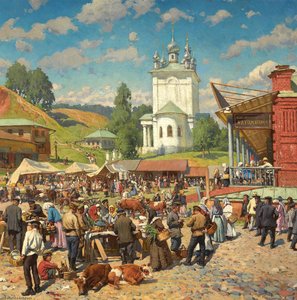
- Landscape Art: Works like Market Day in Plyos demonstrate his skill in capturing the unique character of Russian towns, blending topographical accuracy with emotional resonance.
- Narrative Realism: In pieces such as Leaving for the Hunt or the poignant Fed Up, he explored the human condition, using subtle gestures and facial expressions to tell stories of anticipation, exhaustion, and the quiet struggles of daily life.
Legacy of a Visionary
As his career progressed, Makovsky achieved significant academic recognition, becoming a member of the Academy of Arts in 1911 and attaining the rank of Professor by 1913. This prestige was a testament to his technical prowess and his ability to synthesize the competing artistic currents of his time—Realism, Impressionism, and Symbolism—into a cohesive and uniquely Russian voice. Even as the political and social landscape of Russia underwent seismic shifts, Makovsky’s commitment to capturing the essence of his homeland remained steadfast.
Though he passed away in Leningrad in 1924, leaving behind a legacy that continues to resonate within the halls of the State Russian Museum and beyond, his impact remains indelible. Aleksandr Makovsky did not merely paint what he saw; he painted what it felt like to belong to a land of profound beauty and complex history. Through his eyes, we continue to witness the quiet dignity, the seasonal splendor, and the enduring spirit of the Russian soul, preserved forever in the amber of his masterful artistry.
alexander vladimirovich makovsky
1869 - 1924
基本情報
- Artistic Movement Or Style: Realism
- Artists Or Movements Influenced By This Artist: ['Peredvizhniki']
- Artists Who Influenced This Artist: ['Vladimir Makovsky']
- Date Of Birth: April 5, 1869
- Date Of Death: October 26, 1924
- Full Name: Aleksandr Vladimirovich Makovsky
- Nationality: Russian
- Notable Artworks:
- Bothered
- The Tea Drinkers
- The Procession of Saints
- Place Of Birth: Moscow, Russia