

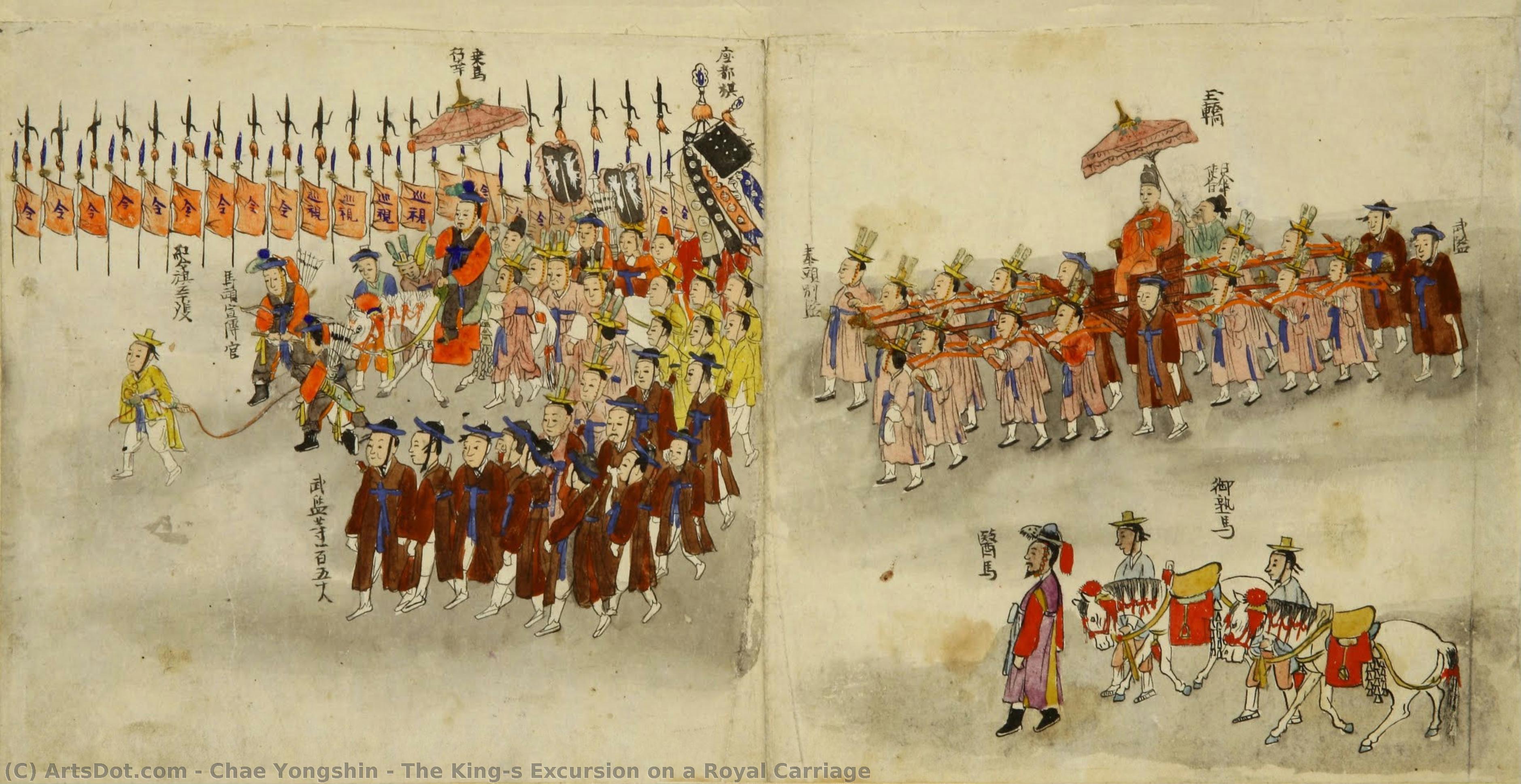
 プレビュー
プレビュー
 シェアする
シェアする シェアする
シェアする
 詳細を見る
詳細を見る

 ダウンロード
 似ている作品
 X線調査
X線調査 スライドショー
 Stats
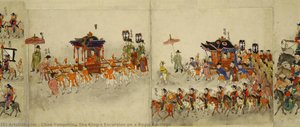
StatsThe King’s Excursion on a Royal Carriage


 詳細を見る
詳細を見る
オンラインプレビューをはるかに凌ぐ、高解像度で鮮明なデジタル画像をご購入いただけます。
各ファイルは、社内の専門家が高度なツールと熟練した手作業によるレタッチを用いて、細心の注意を払って準備されています。すべての画像において、卓越した鮮明度、正確な色彩再現性、そして繊細なディテールを保証いたします。
最終ファイルは、プロフェッショナルな編集・印刷環境ですぐにご利用いただけるよう最適化された状態で、72時間以内にメールにてお届けいたします。これは、一流のデザインスタジオ、出版社、ギャラリーから信頼されているものと同等の品質です。
デジタルアート
個人での鑑賞、印刷、クリエイティブなプロジェクト用に、高解像度ファイルをダウンロードできます。 ( Switch to Print 手描きの絵画を購入)
デジタル画像のご注文に付随する特典
高品質なデジタル画像配信を、確かな品質で。
ArtsDot.com を選ぶことは、単に画像を手に入れることではありません。それは、プロの手によって精密に仕上げられ、満足保証が付いた高品質なデジタルアートワークを受け取ることを意味します。ご注文いただいた際に自動的に付随する内容は、以下の通りです:

メールですぐにお届け
ご注文から72時間以内に、高解像度のデジタル画像ファイルがメールでお手元に届きます。すぐにそのままご利用いただけます。

AI技術で最適化されたデジタルファイル
お客様の作品は、高度なAIツールと専門家による手作業の編集を組み合わせてプロフェッショナルに最適化されており、細部のディテール、鮮明さ、そして正確な色再現性を最大限に引き出しています。

一生涯無料の再送サービス
ファイルを誤って削除したり、紛失してしまったりしましたか?ご安心ください。いつでも無料で再送いたします。

輸入手数料は一切かかりません
関税や手数料、配送料を気にすることなく、お気に入りのアートワークをすぐにお楽しみいただけます。デジタルダウンロードは常に免税です。

色彩再現の保証
プロ仕様のツールとカラーマネジメント技術を用いることで、デジタル画像が元の色を最大限に忠実に再現することを保証いたします。

100日間満足保証
ご購入いただいたデジタル画像にご満足いただけない場合は、100日以内であれば、理由を問わず修正または100%の返金対応をさせていただきます。

100% 返金保証
ご満足いただけない場合は、デジタルファイルを受け取ってから100日以内であれば、理由を問わず全額返金いたします。

まとめ買い割引
3枚購入で10%OFF - 5枚購入で15%OFF - 10枚以上購入で20%OFF。クリエイティブなプロジェクト、ギャラリー、エージェンシーに最適です。
関連作品





作家の略歴
Maurits Cornelis Escher: The Architect of Impossible Worlds
Born in Leeuwarden, Netherlands, in 1898, Maurits Cornelis Escher was a graphic artist whose singular vision transformed the world of printmaking. For most of his life, he remained largely unrecognized within the established art world, a quiet observer and meticulous craftsman working primarily for personal satisfaction. It wasn’t until the late twentieth century that his intricate and mathematically-driven creations – impossible constructions, tessellations, reflections, and metamorphoses – gained widespread acclaim, cementing his place as one of the most innovative and enduring artists of the 20th century. Escher's legacy lies not just in his stunning visual artistry but also in his profound engagement with fundamental concepts of geometry, perspective, and infinity.
Escher’s early life offered little indication of the extraordinary career that lay ahead. He initially pursued a path in architecture at the Haarlem School of Architecture, a decision influenced by his father's profession. However, he quickly realized his true passion resided in drawing and printmaking, abandoning architectural studies to dedicate himself fully to artistic pursuits. This shift was supported by Samuel Jesserun de Mesquita, a teacher who recognized Escher’s exceptional talent and encouraged him to follow his artistic inclinations. His formative years were marked by an intense study of nature – insects, landscapes, and plants – meticulously rendered in detailed drawings that would later serve as the foundation for his complex compositions.
A pivotal moment in Escher's career occurred during his travels through Italy and Spain in the 1920s. He was particularly captivated by the intricate tilework of the Alhambra palace in Granada and the Mezquita-Cathedral of Córdoba, marveling at their geometric patterns and repeating motifs. These experiences ignited a deep fascination with tessellations – the art of covering a surface with repeating shapes without gaps or overlaps – which would become a central theme throughout his work. He began experimenting with woodcuts and lithographs, translating these visual discoveries into tangible forms. The influence of Giorgio de Chirico’s surrealist paintings, particularly *The Song of Love*, introduced him to the concept of juxtaposing seemingly unrelated objects in unsettling yet intriguing ways – a technique he would masterfully employ throughout his career.
Mathematical Foundations and Artistic Innovation
Escher's art is inextricably linked to mathematics. He wasn’t a mathematician himself, but he cultivated close relationships with leading figures like George Pólya, Roger Penrose, and Donald Coxeter, seeking their insights into the underlying principles governing his creations. These collaborations fueled his exploration of concepts such as infinity, perspective, symmetry, and hyperbolic geometry. His work isn't simply decorative; it’s a rigorous investigation of mathematical possibilities, demonstrating how geometric rules can be manipulated to create illusions of depth, movement, and transformation.
Key elements in Escher’s artistic vocabulary include impossible objects – constructions that defy our intuitive understanding of three-dimensional space—such as *Hand with Reflecting Sphere* (1935) and *Drawing Hands* (1948). These works exploit the limitations of human perception, presenting visual paradoxes that challenge our assumptions about reality. His tessellations, exemplified by *Sky and Water I* (1937), demonstrate his mastery of repeating patterns and intricate arrangements. Escher’s use of perspective—often employing forced perspective to create dramatic illusions—further enhances the sense of disorientation and wonder in his images. The recurring motifs – birds, fish, animals, and human figures – are not merely decorative elements but contribute to the overall narrative and thematic complexity of his work.
Major Works and Recognition
Escher’s oeuvre is remarkably extensive, comprising over 300 prints, woodcuts, lithographs, and mezzotints. Some of his most celebrated works include *Relativity* (1953), a stunning depiction of gravity warping space; *Waterfall* (1961), which visually represents the flow of water through an impossible landscape; and *Metamorphosis I, II, and III* (1937-1938), showcasing his ability to transform one image into another through intricate geometric manipulations. His work gained significant recognition in the late 20th century, largely thanks to the efforts of Martin Gardner, a popular science writer who featured Escher’s art in his *Mathematical Games* column in *Scientific American*. This exposure sparked widespread interest and led to numerous exhibitions around the world.
Legacy and Influence
Maurits Cornelis Escher died in 1972, leaving behind a body of work that continues to fascinate and inspire. His art transcends categorization, blending elements of geometry, mathematics, surrealism, and printmaking into a uniquely captivating style. Escher’s influence can be seen in various fields, including architecture, graphic design, and computer animation. His exploration of impossible spaces and optical illusions has captivated artists and designers for decades, demonstrating the enduring power of his innovative vision. He remains an icon of artistic ingenuity, a testament to the boundless possibilities of human creativity when combined with rigorous intellectual inquiry.

chae yongshin
1898 - 1972 , South Korea
プロフィール概要
- Artistic Movement Or Style: Graphic art, Printmaking
- Artists Or Movements Influenced By This Artist:
- Rene Magritte
- Martin Gardner
- Artists Who Influenced This Artist:
- George Arnold Escher
- Roger Penrose
- Date Of Birth: 17 June 1898
- Date Of Death: 27 March 1972
- Full Name: Maurits Cornelis Escher
- Nationality: Dutch
- Notable Artworks:
- Hand with Reflecting Sphere
- Drawing Hands
- Relativity
- Waterfall
- Ascending and Descending
- Place Of Birth: Leeuwarden, Netherlands