

![Cottage, Knebworth, Hertfordshire County, England; [exterior Elevations, Floor Plans, Sketches] — Charles Augustus Henry Lutyens](/media/artworks/images-full/fc/d3/fcd3ceefd82fe55e4d533868093efda6.jpg)
 プレビュー
プレビュー
 シェアする
シェアする シェアする
シェアする
 詳細を見る
詳細を見る

 ダウンロード
 似ている作品
 X線調査
X線調査 スライドショー
Cottage, Knebworth, Hertfordshire County, England; [exterior elevations, floor plans, sketches]

 詳細を見る
詳細を見る
ジークレー/アートプリント
迅速な制作と多彩な仕上げオプションを備えた、ミュージアムクオリティのジークレーまたはキャンバスプリント。 ( 手描きの絵画を購入 画像を購入)




































作品のオリジナル比率に合わせた、当店の規定サイズからお選びください。

特定のフレームやスペースに合わせて、ご自身でサイズを指定することも可能です。選択されたサイズが元の画像の比率と一致しない場合、作品をトリミングするか、鏡面反射または単色での塗りつぶしによって画像を拡張いたします。制作を開始する前に、ご確認用のデジタルモックアップをお送りいたします。
画面上のプレビューには、実際のトリミングや拡張は反映されませんのでご注意ください。最終的な構図を正確に確認できるのは、モックアップのみとなります。
カスタムサイズも承っておりますが、元の比率を維持するためには、あらかじめ用意されたリストからサイズを選択することをお勧めいたします。


 ガラスオプションは、110cm未満のサイズでのみご利用いただけます。

Cottage, Knebworth, Hertfordshire County, England; [exterior elevations, floor plans, sketches]
ジークレー/アートプリント
複製画のサイズ
-


合計金額
$ 62
関連作品

アーティストの略歴
The Dual Legacy of a Visionary: Soldier, Painter, and Architect
To contemplate the life of Charles Augustus Henry Lutyens is to traverse the complex landscape of the British imperial era, where the precision of military discipline met the fluid grace of artistic expression. Born in 1829 into a distinguished military lineage, Lutyens was shaped by a heritage of service and structure. As the son of Major Lutyens, a man whose career spanned the Peninsular War and diplomatic missions to Denmark, the young Charles was immersed from birth in an environment where duty and global perspective were paramount. While history often remembers him through the lens of his architectural contributions and his identity as a painter, his very essence was forged in this crucible of Victorian order and expansive colonial ambition.
His early years were marked by a profound intellectual curiosity that transcended the boundaries of a single discipline. Though he initially turned toward the spiritual path of theology during his studies at Oxford University, the call of design and visual storytelling proved irresistible. This transition from the sacred to the aesthetic allowed him to infuse his later works with a sense of monumental permanence and spiritual gravity. His artistic development was deeply influenced by the prevailing movements of his time, particularly the Gothic Revivalism and the Beaux Arts principles that emphasized classical symmetry and intricate ornamentation. This period of formation instilled in him a lifelong reverence for craftsmanship and an ability to see the structural potential within the purely decorative.
A Tapestry of Technique and Memory
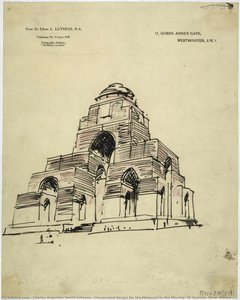
As a painter and draftsman, Lutyens possessed a rare ability to translate the weight of history onto paper. His work often serves as a poignant window into the collective psyche of an era grappling with loss and reconstruction. One can observe this most movingly in his architectural drawings, such as his unexecuted design for the Memorial to the Missing in St Quentin, France. In these monochromatic studies, he utilized the stark, evocative power of black and white line work to create a landscape of memory. Through meticulous hatching and varying line densities, he achieved a sculptural quality that made stone appear almost tactile, capturing the interplay of light and shadow to evoke the somber atmosphere of post-war mourning.
His technical mastery was not merely about precision but about the emotional resonance of scale. By incorporating small, silhouetted figures within his grand architectural visions, Lutyens masterfully established a sense of human vulnerability against the backdrop of monumental structures. This technique grounded his sweeping, imperial ambitions in the intimate reality of individual lives. Whether capturing the delicate beauty of Cupids and Flowers or the imposing geometry of a commemorative tower, his hand remained dedicated to the idea that art should serve as an axis mundi—a bridge between the earthly realm of human experience and the eternal realm of remembrance.
The Architectural Shadow and Historical Significance
While Charles Augustus Henry Lutyens is often discussed in relation to the monumental architectural achievements of his era, his historical significance lies in the foundational aesthetic values he championed. His involvement with the Arts and Crafts movement, alongside figures like William Morris, reinforced a commitment to authenticity and a rejection of mass production. This dedication to meticulous detailing and the use of genuine materials became a hallmark of the period's design language. He viewed architecture not merely as the construction of shelter, but as the creation of spaces that embodied ideals of order, permanence, and authority.
His legacy is inextricably linked to the broader narrative of British architectural evolution, providing a bridge between the traditionalism of the early 19th century and the transformative urban planning seen in projects like New Delhi. Though he shared the spotlight with other great designers of his time, his unique position as both a soldier and an artist allowed him to approach design with a singular perspective—one that understood both the rigid requirements of structure and the delicate necessity of beauty. Today, his works remain vital touchstones for understanding how the visual arts were used to navigate the complexities of identity, empire, and the enduring human desire to leave a lasting mark upon the world.
charles augustus henry lutyens
1829 - 1915
基本情報
- Artistic Movement Or Style: Arts and Crafts
- Artists Who Influenced This Artist:
- William Morris
- Gustav Stickley
- Date Of Birth: 1829
- Date Of Death: 1915
- Full Name: Charles Augustus Henry Lutyens
- Nationality: British
- Notable Artworks:
- India Gate
- Houses of Parliament
- Scottish Rite Temple
- Place Of Birth: London, England

