 プレビュー
プレビュー
 シェアする
シェアする シェアする
シェアする
 詳細を見る
詳細を見る

 ダウンロード
 似ている作品
 X線調査
X線調査 スライドショー
Jeanne-Marguerite Lecadre in the Garden, oil on


 詳細を見る
詳細を見る
ジークレー/アートプリント
迅速な制作と多彩な仕上げオプションを備えた、ミュージアムクオリティのジークレーまたはキャンバスプリント。 ( 手描きの絵画を購入 画像を購入)




P118B $10

P118H $10

P118W $10

P438Z $10

P508JH $12

P508YH $12

P805H $10

P805Z $10

P919BZ $10

P919G $10

P919XJ $10

P959ZH $10

P968JZ $12

W106C $8

W218G $10

W218JH $8

W218Y $10

W307PJ $10

W316G $10

W316PJ $8

W316Y $10

W398PJ $8

W4111J $10

W500HY $15

W500JH $15

W692G $12

W849H $8

W940BG $15

W953PJ $8




作品のオリジナル比率に合わせた、当店の規定サイズからお選びください。

特定のフレームやスペースに合わせて、ご自身でサイズを指定することも可能です。選択されたサイズが元の画像の比率と一致しない場合、作品をトリミングするか、鏡面反射または単色での塗りつぶしによって画像を拡張いたします。制作を開始する前に、ご確認用のデジタルモックアップをお送りいたします。
画面上のプレビューには、実際のトリミングや拡張は反映されませんのでご注意ください。最終的な構図を正確に確認できるのは、モックアップのみとなります。
カスタムサイズも承っておりますが、元の比率を維持するためには、あらかじめ用意されたリストからサイズを選択することをお勧めいたします。


 ガラスオプションは、110cm未満のサイズでのみご利用いただけます。

Jeanne-Marguerite Lecadre in the Garden, oil on
ジークレー/アートプリント
複製画のサイズ
-


合計金額
$ 62
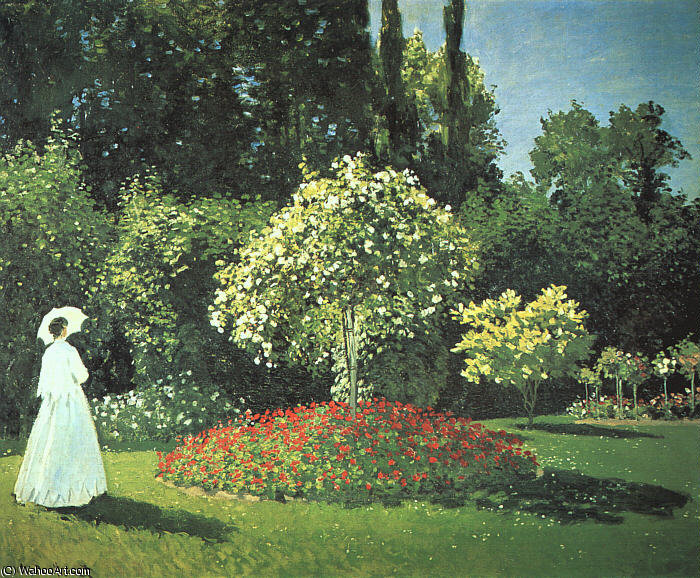
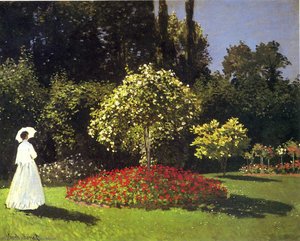
Jeanne-Marguerite Lecadre in the Garden (also known as “Woman in the Garden”) — Claude Monet
Jeanne-Marguerite Lecadre in the Garden (also circulated under the alternative title Woman in the Garden) is an oil painting by Claude Monet, executed in 1866–1867. The canvas measures approximately 82 × 101 cm and is preserved in the State Hermitage Museum, St. Petersburg (inv. no. ГЭ-6505). The work represents a solitary elegantly dressed woman within a flowering garden and is among Monet’s early, sustained investigations of natural light acting on color in an outdoor setting.
Identification of the sitter and the site
The figure is identified as Jeanne-Marguerite Lecadre, the young wife of Monet’s cousin Paul-Eugène Lecadre. The scene is associated with the Lecadre family property in Sainte-Adresse (near Le Havre), where Monet stayed and worked in the summer of 1867. The subject and setting place the painting within Monet’s early period, when he frequently used relatives and close acquaintances as models while pursuing a decisive shift toward plein-air observation.
Historical context within Monet’s 1860s production
In the later 1860s Monet had not yet reached the full dissolution of form and abbreviated notation of his mature Impressionism; nevertheless, he was already committed to painting outdoors and to recording the optical conditions of a particular time of day and season. This painting belongs to the phase in which Monet tests how direct sunlight transforms local color, how open-air shadows behave chromatically, and how a figure can function less as a portrait subject than as an instrument for studying light’s effects on fabric, foliage, and atmosphere.
Composition and pictorial structure
The composition is organized around three principal elements: the standing figure at left, a central flowering shrub/rose tree with a saturated red flower bed at its base, and a darker mass of foliage to the right. The sitter is positioned slightly left of center, shown largely in profile and turned away from the viewer. This orientation minimizes anecdotal narrative and directs attention to the relationships of light, color, and surface across the dress, parasol, and surrounding vegetation.
Monet establishes a controlled circuit for the viewer’s gaze: the bright silhouette of the white dress against darker foliage draws the eye first; attention then moves toward the central flowering mass, continues to the right-side shrubbery, and returns to the figure through repeated chromatic correspondences between whites, greens, and red accents. The result is a stable structure that supports what is, essentially, an optical experiment in sunlight and shadow.
Light, color, and the treatment of the white dress
The dress is not rendered as uniform “white,” but as a complex field of modulated tones: cool, bluish shadows articulate the folds while warmer highlights and reflected light establish the garment’s volume in direct sun. The parasol contributes a second register of light—filtered and slightly warmed—introducing subtle shifts in value and hue. These effects demonstrate Monet’s attention to open-air color phenomena, specifically the way shadows in daylight carry chromatic information rather than collapsing into neutral darks.
Within the broader palette, greens dominate the ground and surrounding shrubs, punctuated by concentrated reds in the flower bed and intermittent pale blossoms. A small patch of blue sky in the upper right provides an additional cool counterpoint and reinforces the outdoor, sunlit condition of the scene.
Brushwork and degree of finish
Although painted outdoors, the handling remains comparatively controlled by Monet’s later standards. Forms are legible and edges often retain definition; dark passages in the foliage are relatively consolidated; and the chromatic expansion typical of Monet’s mature Impressionism is present but not yet pervasive. At the same time, Monet varies touch and texture: passages of foliage and flower heads are built through distinct, responsive strokes that convey the irregularity and shimmer of garden growth under strong light.
Subject positioning and the suppression of narrative
The sitter’s turned posture and the absence of direct facial address diminish portrait psychology and narrative content. The figure functions primarily as a luminous surface within the landscape: a vertical axis of light-toned fabric set against surrounding greens, enabling Monet to study directional sunlight, reflected illumination, and the interplay of textile and vegetation. The scene remains quiet and observational, oriented toward optical description rather than storytelling.
Technical findings and evidence of compositional revision
Technical examination (including X-radiography reported in association with Hermitage conservation study) has indicated significant revision: beneath the finished paint surface, a painted-over male figure has been detected in the right-hand area. This suggests that Monet initially conceived a more complex figurative arrangement and subsequently simplified the canvas to isolate the standing woman and concentrate the work’s optical focus. Such revisions are consistent with Monet’s practice in the period, when compositional decisions were frequently adjusted during execution—especially in outdoor contexts where motif, light, and pictorial balance required continual recalibration.
Provenance (ownership history)
After its completion, the painting remained connected to Monet’s extended family circle and, according to accounts associated with its early history, passed from the Lecadre family into local hands in the Le Havre region. By 1893 it was with the Paris dealer Paul Durand-Ruel, a central figure in the market and international promotion of Impressionism. Durand-Ruel sold the work in 1899 to the Moscow collector Pyotr Ivanovich Shchukin, after which it entered the collection of his brother Sergei Shchukin in 1912. Following the 1917 Revolution, Shchukin’s collection was nationalized and integrated into Soviet state holdings. With the 1948 reorganization and dissolution of the State Museum of New Western Art, the painting was transferred to the State Hermitage Museum, where it remains.
Exhibition history
The painting was exhibited at the Fourth Impressionist Exhibition in Paris (April–May 1879), where Monet included it under the title Le Jardin (“The Garden”). In the modern era, the work has been displayed in major international Monet presentations, including the large retrospective at the Grand Palais (Paris, 2010) and the subsequent National Gallery exhibition (London, 2010–2011), which brought significant scholarly and public attention to Monet’s early plein-air achievements.
Significance
Jeanne-Marguerite Lecadre in the Garden is a key document of Monet’s transition from early, relatively finished plein-air practice toward the more radical optical syntax of Impressionism. It demonstrates a sustained inquiry into daylight color, the chromatic content of shadow, and the role of a figure within landscape as a vehicle for studying light’s behavior. The work’s technical evidence of revision further illuminates Monet’s evolving compositional thinking in the 1860s, while its later collecting history places it among the landmark holdings of the Shchukin collection and the Hermitage’s major corpus of French modern painting.
アーティストの略歴
光と色彩の詩人:クロード・モネの世界
印象派という言葉と同義語とも言えるオスカー=クロード・モネ。彼は単なる風景画家ではなく、一瞬のきらめきを記録する克明な観察者であり、光と色彩の詩人でした。1840年11月14日、パリで生まれ、5歳の時に一家がノルマンディー地方のローヌ=リヴィエールに移り住ったことが、彼の人生に予想外の変化をもたらしました。当初は父親の意向により商業的なキャリアを歩むことになっていましたが、若きモネの内なる芸術的才能はすぐに開花し、まず地元の市場で売られた風刺画として現れました。これは彼の技術と起業家精神の両方を証明するものでした。しかし、彼にとって転機となったのは、エウジェーヌ・ブーダンとの出会いでした。ブーダンはモネに絵を描き方だけでなく、En plein air(直接自然の中で描く)という革命的なアイデアを植え付けました。この実践こそが、彼の芸術的探求全体を定義づけることになったのです。
モネの正式な訓練はパリで始まり、まずアカデミー・スイスで、その後シャルル・グレールのもとで学びました。ここで彼はピエール=オーギュスト・ルノワールといった同時代の芸術家たちとの間に固い友情を築き、共通の芸術的苦悩と伝統的な学術絵画からの解放への欲求によって結ばれました。初期の作品は技術的な熟練さを示していましたが、やがて彼のスタイルを特徴づけることになる独特の声には欠けていました。その後、普仏戦争によりモネはロンドンに避難し、そこでJ.M.W.ターナーといったイギリスの風景画家たちの作品に没頭しました。大気効果と色彩の革新的な使用法を吸収したのです。
美学革命の誕生
フランスに戻ったモネは、新たな芸術的叛乱の中心人物となりました。保守的なサロンの基準に不満を持っていた彼は、志を同じくする芸術家たちと共に独立展覧会を開催しました。1874年の展覧会は、モネだけでなく、美術界全体にとって転換点となりました。この際、彼の作品「印象、日の出」が展示され、そこから「印象派」という名称が生まれました。この作品はローヌ河口の日の出のぼやけた描写であり、正確な再現ではなく、シーンに対する主観的な印象を捉えようとする運動の名声を決定づけました。
モネのシグネチャー・スタイルは、この時期に花開きました。大胆で目に見える筆致、隣接して配置された鮮やかでしばしば混ざり合っていない色彩(「分割色彩」として知られる技法)、そして変化する条件がシーンを変化させる前に、一瞬の認識を記録するために迅速に作業するという揺るぎない光への集中。これは芸術的慣習からの根本的な逸脱でした。彼はEn plein airの実践を熱心に行い、変化する状況によってシーンが変化する前に、その即時的な知覚を記録するために急速に作業しました。この献身は彼が見たものを描くことだけでなく、それに応答して感じたことを表現することでした。
ヴェルニー:光と反射の楽園
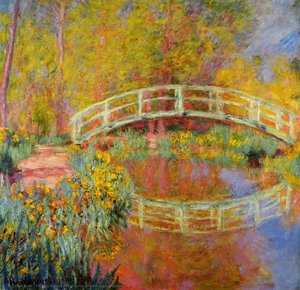
1883年、モネはパリ北西部のヴェルニーに定住し、家と庭を彼の聖域であり、最大のインスピレーション源となるように変貌させました。彼は注意深く敷地を整備し、異国の花々、垂れ柳、そして最も有名な水仙池に架かる日本式の橋などを配置しました。これは単なる装飾的な庭ではなく、光が水、葉、反射に及ぼす影響を制御された条件下で研究できる生きた実験室でした。
彼の人生の最後の数十年はほぼ完全に水仙池の絵画に捧げられました。睡蓮シリーズという壮大な作品に取り組み、水面の絶え間なく変化する色彩と光のタペストリーを描写した広大なキャンバスを制作しました。これらは単なる花々を描いた絵ではなく、鑑賞者を穏やかな美しさと瞑想的な静けさの世界に包み込む没入型の体験でした。これらの作品の規模は息を呑むほどで、伝統的な絵画の境界線を押し広げ、抽象表現主義を予感させます。
遺産:美術史への永続的な影響
クロード・モネの影響力は計り知れません。彼は印象派の創始者であるだけでなく、芸術家たちが世界を取り囲むものをどのように認識し、表現したかを根本的に変えました。主観的経験への重点、En plein airでの絵画の採用、そして革新的な技術は、現代美術における抽象化と非描写形態の探求への道を開きました。
モネは彼の時代のアバンギャルドな芸術家にとってまれなことですが、生涯にわたってかなりの商業的成功を収めました。彼の作品は今日でも世界中の観客を魅了し、畏敬の念を起こさせ、西洋美術における最も重要な人物の一人としての地位を確固たるものにしています。彼は1926年12月5日に亡くなり、世代を超えて芸術家や美術愛好家の心に響き渡る遺産を残しました。彼の傑作の重要なコレクションは、パリのオルセー美術館やモネ美術館などの著名な機関で保管されており、彼のビジョンが世界を照らし続けています。
主要な芸術的技法
- En plein airでの絵画: 彼の発展の中心であり、光と大気の状態を直接観察することを可能にしました。
- 分割色彩: 光学的なブレンドのために、小さな筆致で純粋な色を隣接して適用します。
- シリーズ絵画: 同じ主題を異なる照明条件や天候条件下で描くことで、時間と光の変革力を示します。
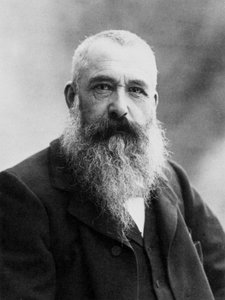
クロード・モネ
1840 - 1926 , フランス
基本情報
- フルネーム: クロード・モネ
- 主な作品:
- 印象、日の出
- 睡蓮
- 干し草
- ルーアン大聖堂
- 出生地: パリ、フランス
- 国籍: フランス人
- 影響を与えたアーティストまたは運動: ['近代美術']
- 影響を受けたアーティスト:
- ユージェン・ブーダン
- J.M.W.ターナー
- 死亡年月日: 1926年12月5日
- 生年月日: 1840年11月14日
- 芸術運動またはスタイル: 印象派
関連記事

クロード・モネ傑作25選:光と色彩の印象派を彩る名画の世界 | ArtsDot
クロード・モネの傑作25選。印象派を代表する光の画家、モネの世界を旅しませんか?睡蓮や風景画など、名画の背景にある物語と芸術技法をご紹介。ArtsDotで高品質な複製画とインテリアアートを見つけましょう。全コレクションはこちら。

Impressionistic Landscapes: 10 Masterpieces That Changed Art & Decor
Journey into the heart of Impressionism! Explore 10 masterpieces by Monet, Renoir & Degas that revolutionized landscape art. Discover their stories, techniques & find museum-quality reproductions to elevate your home decor on ArtsDot.com.

印象派風景を彩った至宝:アート史に名を刻む10選
印象派風景の革新を彩った10選。モネ、ルノワールら巨匠の名作を紐解き、色彩と光が生み出す感動の世界へ。アートの歴史とインテリアのインスピレーションをArtsDot.comで。高品質な複製画で、あなただけの空間を創造しましょう。
Cultivating Paradise: A Historical & Artistic Exploration of Gardens in Painting
Explore the rich history of gardens in painting! Discover masterpieces from Renaissance to Impressionism & beyond. Learn about symbolism, artists like Monet & Klimt, and find your perfect artwork at ArtsDot.

ポール・セザンヌ:至高の25選 - 傑作と革新の軌跡 | ArtsDot
ポール・セザンヌの至高の25選。ポスト印象派を代表する画家、セザンヌの傑作と革新的な技法を紐解きます。ArtsDotで高品質な複製画やインテリアアートを見つけ、芸術の世界をご自宅に。今すぐコレクションをご覧ください。