

 プレビュー
プレビュー
 シェアする
シェアする シェアする
シェアする
 詳細を見る
詳細を見る

 ダウンロード
 似ている作品
 X線調査
X線調査 スライドショー
 Stats
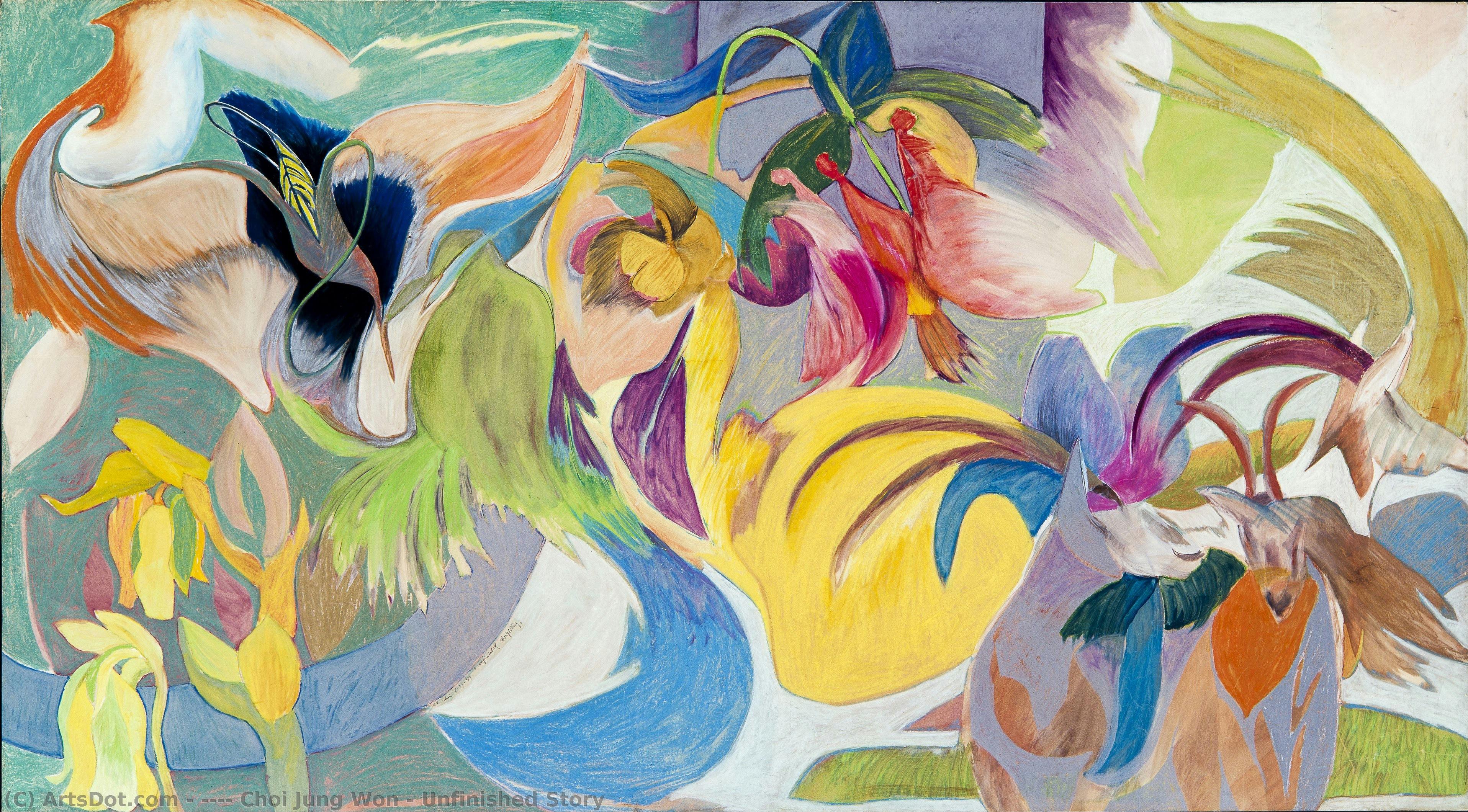
StatsUnfinished Story
 266.0 x 147.0 cm
 詳細を見る
詳細を見る
手描き油彩複製画
当社のアーティストが、お客様のご希望のサイズと額縁に合わせて、キャンバスに手描きで制作する油彩画です。 ( Switch to Print Switch to Digital Image)




































標準サイズ
オーダーメイド
CM
INCH
作品のオリジナル比率に合わせた、当店の規定サイズからお選びください。
Loading sizes...

幅
高さ
特定のフレームやスペースに合わせて、ご希望のサイズをご入力いただけます。選択されたサイズが元の画像の比率と異なる場合、アートワークをトリミングするか、手描きで要素を追加して絵画を拡張いたします。デジタルモックアップ を制作し、制作開始前にご確認(承認)をいただきます。
画面上のプレビューは、実際のトリミングや拡張を正確に反映しているものではありません。最終的な構図は、モックアップによってのみ正確にご確認いただけます。
カスタムサイズもご利用いただけますが、元の比率を維持するためには、あらかじめ用意されたリストからサイズを選択することをお勧めいたします。
カスタマイズの例:顔をお客様の写真に置き換える、ペットを追加する(例:猫を犬に変更)、背景に隠れたメッセージを入れる、背景の風景や要素を変更するなど。
ご注文後、ArtsDot.com チームより詳細な指示をお送りするとともに、仕上がりイメージ(モックアップ)をご提供いたします。
ご注文後、ArtsDot.com チームより詳細な指示をお送りするとともに、仕上がりイメージ(モックアップ)をご提供いたします。


 ガラスオプションは、110cm未満のサイズでのみご利用いただけます。

Unfinished Story
複製技法
複製画のサイズ
-


合計金額
$ 263
In Unfinished Story (1977) and Ecstasy (1977) by CHOI Wook-kyung (1940-1985), the striking contrast among primary colors in her previous works is replaced by the palette of pastel shades including pink, purple, and yellowish green. Here color, form, and composition devote themselves to the declaration of Choi’s poetic inward mind. The forms gently vibrate and slowly move to meet, collide, and mingle with one another. Choi’s ultimate concern lies “not in what is explanatory or readily readable but in arming the audience to fly freely in the sky like birds by reducing the natural and true qualities of emotions to visual idioms and thereby engendering something like the abstractness of music.”
関連作品
アーティストの略歴
The Enduring Spirit of Choi Jung Won: A Life Woven in Ink and Brush
Choi Jung Won, a contemporary Korean master, stands as a vital link to the rich traditions of East Asian painting while simultaneously forging a uniquely personal artistic voice. Though biographical details remain somewhat elusive – a deliberate choice perhaps, reflecting his focus on the work itself rather than celebrity – it is understood that Choi was born in Korea and continues to live and create there. This intentional privacy allows for an unburdened appreciation of his art, free from the distractions of personality cults or sensational narratives. His journey has been one of deep immersion in classical techniques, followed by a subtle yet profound evolution towards a style that is both deeply rooted in history and strikingly modern in its sensibility.A Foundation in Tradition: Calligraphy, Landscape, and the Scholar’s Brush
Choi Jung Won's artistic lineage traces back through centuries of Korean painting, heavily influenced by the scholar-artist tradition. This is immediately apparent in his masterful calligraphy, which isn’t merely decorative but integral to the composition of his works. He doesn’t simply *add* text; he allows the energy and form of the characters to interact with the imagery, creating a harmonious balance between word and visual representation. His early training focused on the “Four Gentlemen” – plum blossom, orchid, bamboo, and chrysanthemum – symbolic plants representing virtues like perseverance, refinement, resilience, and integrity. These motifs recur throughout his oeuvre, not as tired tropes but as vehicles for exploring deeper philosophical themes. Equally central to his development was a rigorous study of landscape painting, specifically in the traditions of ink wash (sumukhwa or suibokuga). He absorbed the techniques of creating atmospheric depth through varying shades of ink, employing both bold washes and delicate brushstrokes to evoke the spirit of nature. The influence of earlier masters like Jeong Seon and Kim Hongdo is discernible, but Choi never simply replicates; he internalizes these lessons and transforms them into something distinctly his own.Evolving a Personal Language: Minimalism, Abstraction, and Emotional Resonance
While deeply respectful of tradition, Choi Jung Won’s work isn't defined by strict adherence to it. Over time, his paintings have moved towards increasing abstraction, stripping away unnecessary detail in favor of capturing the *essence* of a subject. This is not an abandonment of representation but rather a refinement – a distillation of form and energy. His landscapes, for example, often feature simplified mountains, trees reduced to their skeletal structures, and vast expanses of empty space. These aren’t depictions of specific places; they are meditations on the power and tranquility of nature, inviting viewers to project their own emotions and experiences onto the canvas. The use of negative space is particularly significant, creating a sense of stillness and contemplation. He often works in monochromatic palettes – shades of black ink on white paper or silk – further emphasizing the importance of line, texture, and tonal variation. This minimalist approach isn’t cold or sterile; it's imbued with a profound emotional resonance, conveying a sense of quietude, solitude, and spiritual awakening.Themes and Symbolism: Nature, Zen Buddhism, and the Search for Harmony
Recurring themes in Choi Jung Won’s work reveal his deep engagement with philosophical concepts, particularly those found within Zen Buddhism. Nature is not simply a subject to be depicted but a pathway to enlightenment – a mirror reflecting the impermanence of all things. The mountains he paints often symbolize strength and stability, while flowing water represents change and adaptability. Bamboo, in particular, holds special significance, embodying resilience, humility, and moral integrity. His paintings frequently evoke a sense of harmony between humanity and nature, suggesting that true peace can only be found through aligning oneself with the natural order. The deliberate simplicity of his compositions encourages viewers to slow down, quiet their minds, and connect with the present moment – a core tenet of Zen practice. He doesn’t offer explicit narratives or moral lessons; instead, he creates visual poems that invite contemplation and self-discovery.Historical Significance and Contemporary Relevance
Choi Jung Won occupies a unique position within contemporary Korean art. He is not part of any particular avant-garde movement, yet his work has garnered significant critical acclaim both domestically and internationally.- His paintings represent a powerful counterpoint to the often frenetic pace of modern life.
- He demonstrates that tradition doesn’t have to be static or irrelevant; it can be a source of inspiration and renewal.
- His minimalist aesthetic resonates with contemporary sensibilities, appealing to viewers seeking quietude and contemplation in an increasingly chaotic world.
基本情報
- Artistic Movement Or Style: Korean Painting
- Date Of Death: Living
- Full Name: Choi Jung Won
- Nationality: Korean