作品解説
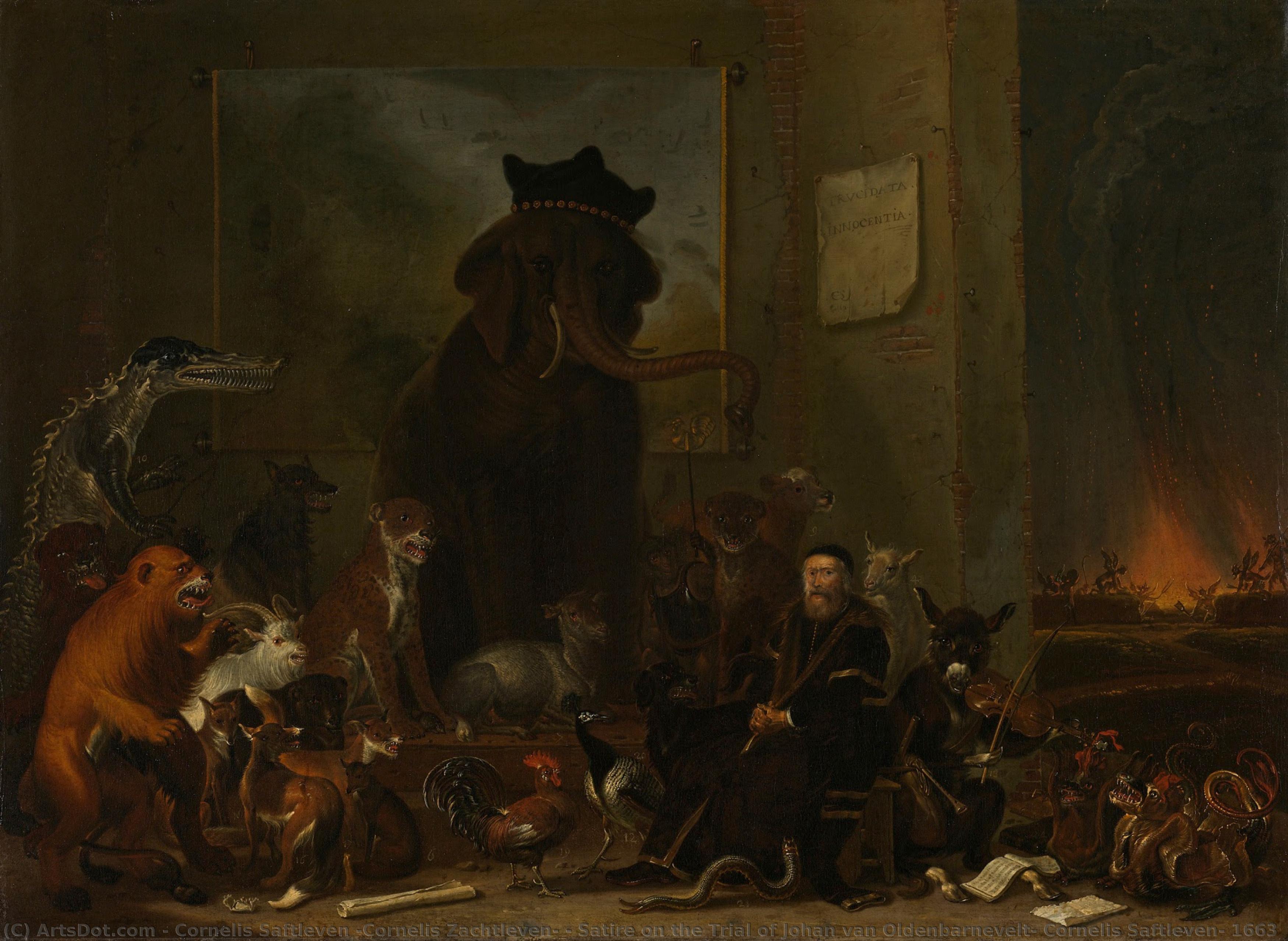
Cornelis Saftleven is known for his allegories in which animals play the part of people. The earliest examples, now in Rotterdam and Prague, are dated 1629.12 The present painting, which is from 1663, is devoted to a crucial event in Dutch history: the trial of Johan van Oldenbarnevelt. The Grand Pensionary of the province of Holland was a prominent statesman during the Eighty Years’ War (1568-1648).13 In the course of the Twelve Years’ Truce of 1609-21 he clashed with Stadholder Prince Maurits on religious and political issues. When Van Oldenbarnevelt decided to give the towns the freedom to appoint their own civic guards, the prince staged a coup and had the nearly 71-year-old arrested on 29 August 1618 on a charge of high treason. On 12 May 1619 he was sentenced to death by a 24-member court headed by Reijnier Pauw, and was executed the following day. Saftleven depicted Van Oldenbarnevelt as an old man seated in a chair, surrounded by animals playing his judges. On the far right is a view of Hell. Hanging on the wall is a map of the Dutch Republic and next to it a large sheet of paper with the words ‘TRUCIDATA INNOCENTIA’ (Murdered innocence), as well as the artist’s signature ‘SCL’ and ‘1663’. Each of the 24 animals is accompanied by a number added in light-coloured paint.14 The Rijksmuseum has a copy of what is probably an eighteenth-century manuscript clarifying who these opponents of Van Oldenbarnevelt are.15 The peacock (pauw in Dutch), is very fittingly playing the part of Reijnier Pauw, the elephant is Nicolaes Cromhout, counsellor of the provincial Court of Holland, while the ass playing the violin is Pieter Jansz Schagen, town councillor of Alkmaar.16 It is not certain that this is the original identification, because the numbers on the picture were altered at an unknown date. For instance, there are different, older versions beneath the ones for the calf and the sheep behind Van Oldenbarnevelt, and for the monster in the bottom right corner. There is a long iconographic tradition of using animals to ape people.17 Raupp argued persuasively in 1984 that Saftleven’s scene was inspired by Joost van den Vondel’s stage play Palamedes oft Vermoorde onnooselheyd of 1625, in which the poet gave the controversy involving Van Oldenbarnevelt and Prince Maurits a mythological slant.18 Not only is the hero in the title page engraving by Salomon Savery being menaced by a horde of wild animals,19 as in Saftleven’s allegory, but moreover, the Trucidata innocentia legend given to the painting is the Latin translation of the Dutch subtitle (‘Vermoorde onnooselheyd’). Vondel’s Palamedes was originally banned due to its controversial subject and was not performed in Amsterdam until 1665. Raupp noted that it could be seen in Rotterdam in 1663, which makes a relationship between Vondel’s play and Saftleven’s picture very probable indeed.20 The allegory in the Rijksmuseum has a very unusual adjunct: a small rounded, convex silver plate with the painted likeness of Van Oldenbarnevelt, known from contemporary prints, that can be mounted on his head in the canvas (fig. a).21 The miniature must have been made especially for this purpose, and was probably ordered by the picture’s first owner. It is mentioned in the earliest record of the painting in a 1799 Amsterdam sale catalogue,22 so the roundel must date from the seventeenth or eighteenth century. In fact, it is very possible that it was produced by Saftleven himself, for the little portrait is in his manner. There are two documented drawings which may be preliminary studies for the present work;23 the winged devils on the right were inspired by Jacques Callot’s 1635 print The Temptation of St Anthony.24 It is not clear on whose initiative the scene was made, but in view of the highly unusual subject it was presumably a commission.25 According to the Rijksmuseum’s aforementioned copy identifying the animals,26 Saftleven produced the picture for the Teding van Berkhout family because they were descendants of Johan van Oldenbarnevelt. As far as is known, the latter was not in fact a relative but a friend of Adriaan Teding van Berkhout (1571-1620), justice at the Court of Holland, who warned the Grand Pensionary of his impending arrest. It is conceivable that Saftleven, having built up a reputation as a satirist, added the Trucidata innocentia text at the request of Adriaan’s next of kin.27 It is odd, though, that the picture was put up for auction several times around 1800 before eventually ending up mid-nineteenth century with a member of the family again,28 Jonkheer Willem Pieter Adriaan Teding van Berkhout, who was a direct descendant of Adriaan Teding van Berkhout.29 In 1892 the Rijksmuseum was unable to buy this work, which was so important for the nation’s history, but it then received it as a gift from Gijsbert de Clercq.30 It is clear that Saftleven’s Satire on the Trial of Johan van Oldenbarnevelt appealed to the popular imagination from the existence of severa../..


 プレビュー
プレビュー
 プリントを購入
 シェアする
シェアする シェアする
シェアする
 詳細を見る
詳細を見る

 ダウンロード
 似ている作品
 X線調査
X線調査 スライドショー


 詳細を見る
詳細を見る






































 ガラスオプションは、110cm未満のサイズでのみご利用いただけます。