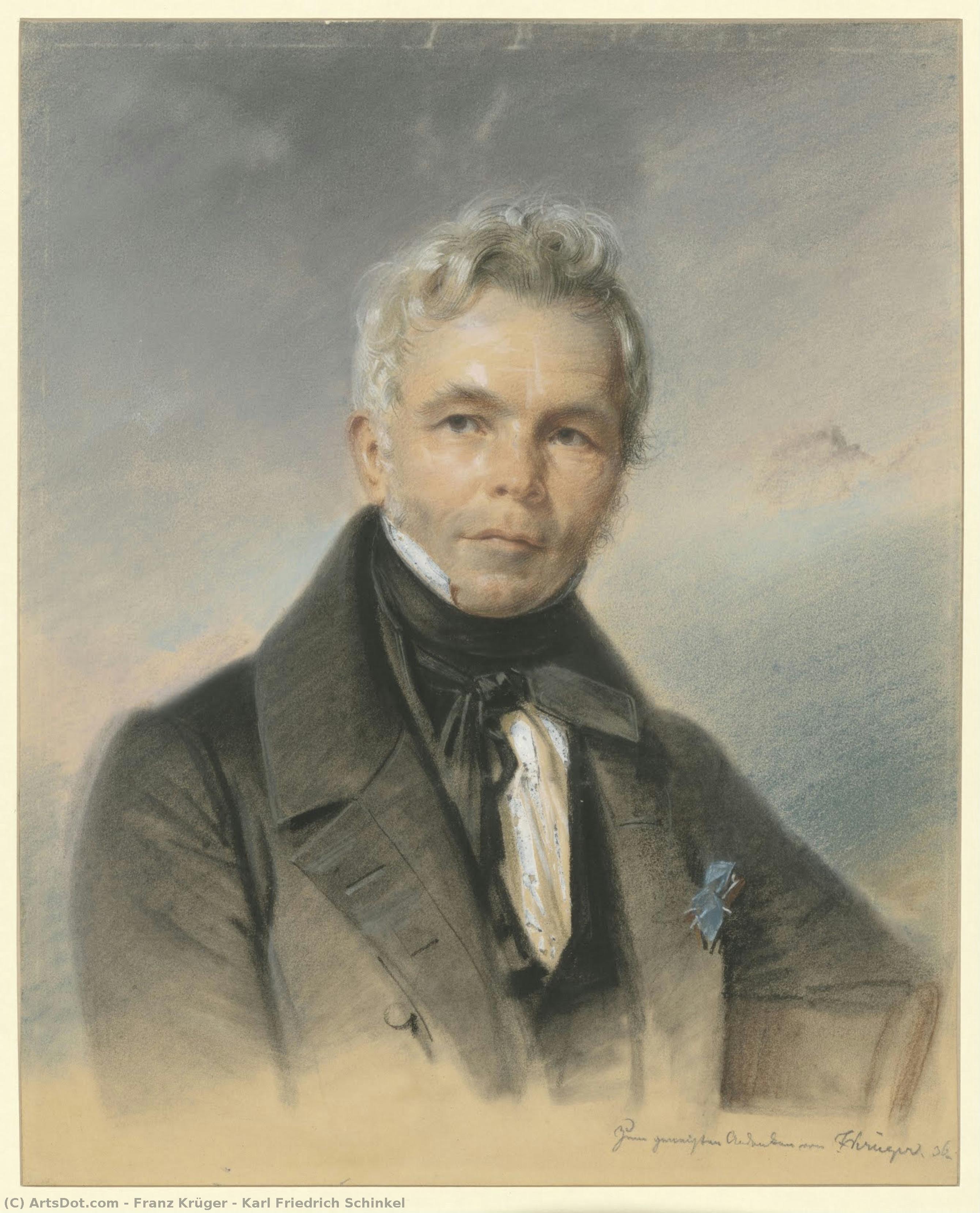
A Glimpse into Prussian Grandeur: Franz Krüger's Portrait of Karl Friedrich Schinkel
This striking black and white drawing offers an intimate portrait of Karl Friedrich Schinkel, the visionary architect and designer who indelibly shaped Berlin’s landscape in the 19th century. Created by the skilled hand of Franz Krüger around 1836, the artwork transcends a simple likeness; it captures the essence of a man whose influence resonated throughout Prussian society and beyond. Measuring 25 x 31 cm, this piece provides a remarkable window into an era defined by Neoclassical ideals, burgeoning industrialization, and the rise of Prussia as a major European power.
The Artist and His Subject: A Meeting of Minds
Franz Krüger (1797-1857), often affectionately known as "Pferde-Krüger" ("Horse-Krüger") due to his celebrated depictions of horses, was a highly sought-after portraitist in Berlin. His ability to capture both the likeness and the character of his subjects made him a favorite among Prussian royalty and the elite. The subject of this drawing, Karl Friedrich Schinkel (1781-1841), stands as one of Germany’s most significant architects. Schinkel's legacy is woven into the fabric of Berlin; from the iconic Altes Museum to the Neue Wache, his designs embody a harmonious blend of classical principles and innovative urban planning. The fact that Krüger was commissioned to portray Schinkel speaks volumes about the esteem in which both men were held within their respective fields.
A Study in Light and Shadow: Technique and Style
The drawing itself is a testament to Krüger’s technical skill. Executed in black and white, the artist masterfully employs shading and line work to create depth and dimension. The meticulous detail evident in Schinkel's facial features—the subtle curve of his lips, the thoughtful gaze of his eyes—reveals a profound understanding of human anatomy and expression. The crisp lines defining his well-tailored suit and neatly tied cravat underscore the formality and dignity associated with Schinkel’s position. The use of light and shadow is particularly noteworthy; it sculpts the face, highlighting key features while subtly obscuring others, creating an air of quiet contemplation. This style aligns with the Romantic movement's emphasis on emotional depth and individual character, though tempered by a Neoclassical sensibility evident in the precise rendering and formal composition.
Beyond Likeness: Symbolism and Historical Context
More than just a portrait, this drawing serves as a visual document of its time. Schinkel’s attire—the suit, tie, and neatly groomed beard—reflects the prevailing fashion and social conventions of 19th-century Prussia. The very act of commissioning such a formal portrait was itself symbolic, signifying status, achievement, and belonging to a privileged class. The historical context is crucial: Prussia was undergoing significant transformation during Schinkel’s lifetime, evolving from a fragmented collection of states into a unified and powerful nation. As its chief architect, Schinkel played a pivotal role in shaping Berlin's identity as the capital of this rising power. Krüger’s portrait captures not only Schinkel’s individual character but also his embodiment of Prussian ambition and cultural refinement.
A Timeless Reflection: The Enduring Appeal
This drawing by Franz Krüger offers a compelling glimpse into the life and times of Karl Friedrich Schinkel, one of Germany's most influential figures. Its technical mastery, historical significance, and subtle emotional depth ensure its enduring appeal to art lovers, collectors, and anyone fascinated by the grandeur of 19th-century Prussia. Owning a reproduction of this artwork is not merely acquiring a decorative piece; it’s possessing a tangible connection to a pivotal moment in European history—a testament to the vision of an architect who shaped a city and the skill of an artist who captured his essence.