A Glimpse into the Renaissance Soul
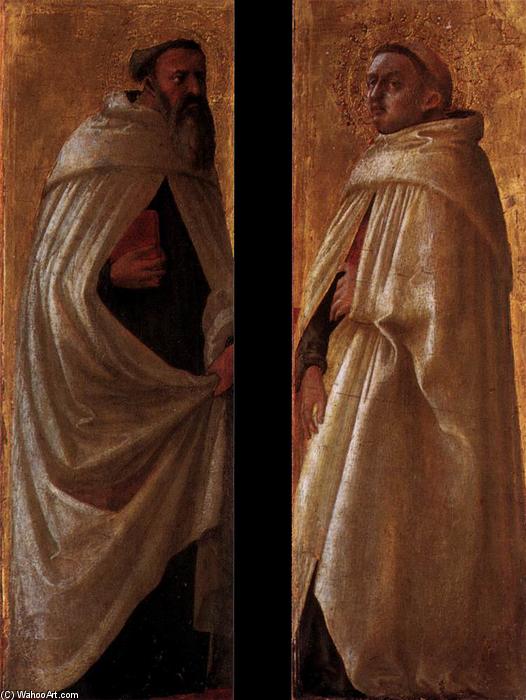
In the quiet, hallowed halls of art history, few works capture the dawn of a new era as poignantly as Masaccio’s Two Panels from the Pisa Altarpiece. Completed in 1426, these panels are far more than mere fragments of a lost polyptych; they are windows into a transformative moment when the rigid conventions of the Gothic period began to dissolve, giving way to the profound humanism of the Early Italian Renaissance. Commissioned for the church of Santa Maria del Carmine in Pisa by Ser Giuliano degli Scarsi, these figures stand as silent sentinels of faith, inviting the viewer into a space of deep, meditative stillness.
The subject matter is deceptively simple yet emotionally profound. The panels depict two figures—a man and a woman—caught in an intimate gesture of spiritual contemplation. There is a palpable sense of gravity in their postures; they do not merely exist within the frame, but seem to inhabit a sacred, shared breath. As one figure gazes toward the other, a silent dialogue unfolds, suggesting the theological interconnectedness of humanity and the divine. For the modern collector or designer, this piece offers an unparalleled sense of serenity, making it a masterful focal point for spaces intended to inspire reflection and peace.
The Mastery of Light and Form
To look upon these panels is to witness the revolutionary hand of Masaccio, a painter who redefined the boundaries of reality. Having trained under the influence of the great sculptor Donatello, Masaccio brought a sculptural weight to his figures that was unprecedented in 1426. Through the meticulous application of egg tempera, he achieved a luminous vibrancy that allows light to dance across the heavy folds of their white garments. His use of chiaroscuro—the dramatic interplay of light and shadow—creates a convincing sense of three-dimensionality, pulling the figures forward from the flat plane of the panel.
The technique is nothing short of architectural. Masaccio employed an early mastery of linear perspective to create an illusion of depth, transforming a simple backdrop into a structured space that feels tangible and real. Every crease in the drapery and every subtle shift in skin tone was executed with a commitment to naturalism that would set the standard for generations of Western artists. This dedication to anatomical accuracy and geometric precision ensures that even as a reproduction, the work retains its commanding presence and structural integrity.
A Legacy of Humanist Beauty
The historical context of this work is steeped in the intellectual ferment of the Quattrocento. As Europe began to rediscover the wisdom of classical antiquity, Masaccio was at the forefront, translating Roman sculptural principles into the language of painting. The Two Panels from the Pisa Altarpiece embody this shift toward a more naturalistic aesthetic, where the divine is found within the human experience. The symbolism embedded in their quietude—the solemnity of their gaze and the dignity of their forms—serves as a timeless reminder of the beauty found in devotion and the strength found in stillness.
For those seeking to adorn a curated collection or an elegantly designed interior, these panels offer much more than decoration. They provide a connection to the very foundations of modern art. Whether placed in a sunlit study or a sophisticated gallery setting, Masaccio’s work brings with it an aura of historical importance and an enduring emotional resonance that continues to captivate the heart of the art lover.