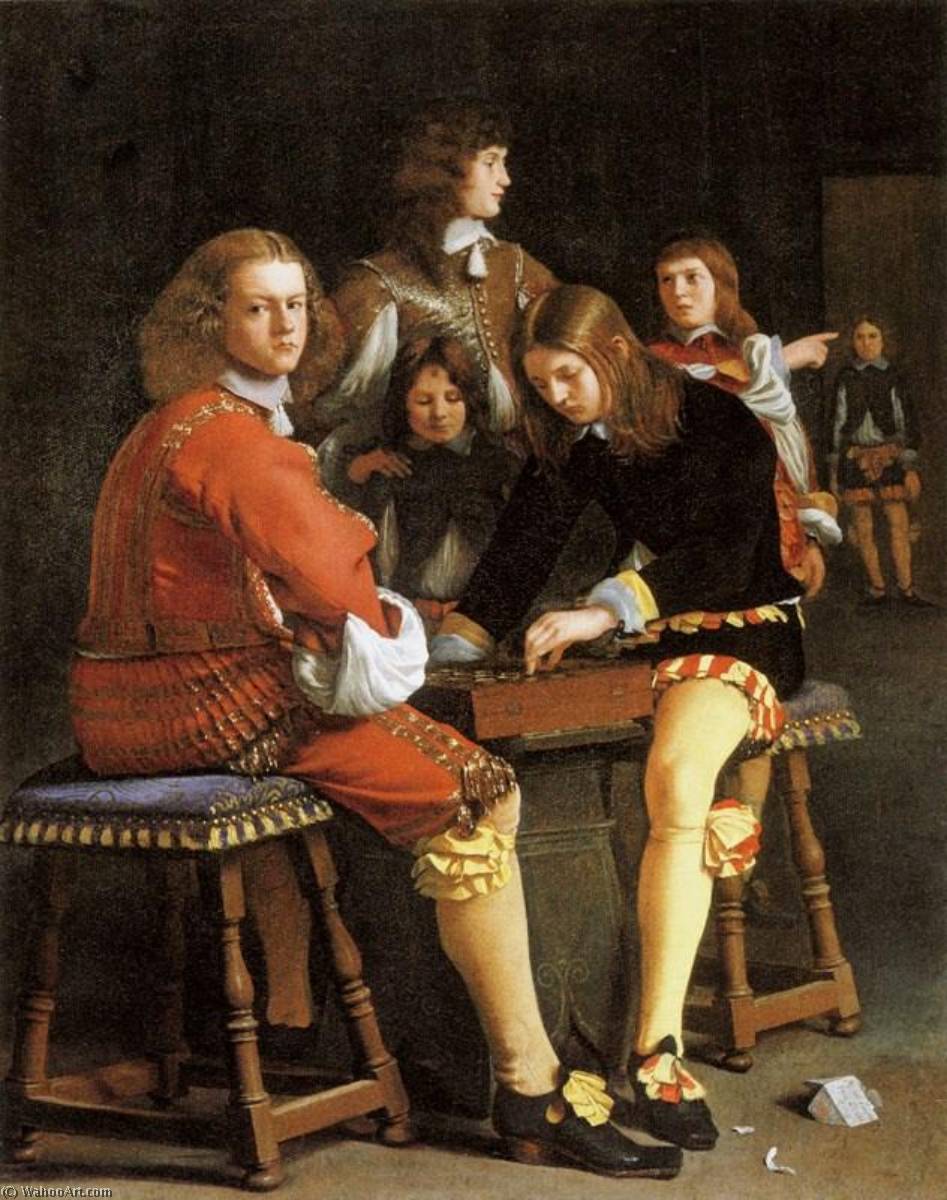
A Game of Draughts: A Window into Baroque Society by Michiel Sweerts
Michiel Sweerts’ “A Game of Draughts,” painted in 1652, is more than just a depiction of a leisurely pastime; it's a meticulously crafted snapshot of 17th-century social life and artistic innovation. This captivating work, measuring a modest 48 x 38 cm, resides within the esteemed Mauritshuis collection in The Hague, offering viewers an intimate glimpse into the world of the Dutch Golden Age. Sweerts, a remarkably itinerant artist born in Brussels and deeply influenced by both Flemish realism and Italianate grandeur, masterfully captures not just the scene itself but also the subtle nuances of human interaction and the prevailing social atmosphere.
The painting immediately draws the eye to the group gathered around the table – men and women dressed in opulent fabrics, indicative of their status and wealth. The man on the left, sporting a vibrant red jacket, is likely the host, radiating an air of confident leadership. Sweerts’ skill lies not merely in his accurate rendering of clothing and facial features but in his ability to convey personality through gesture and expression. Note the slight tilt of heads, the focused gaze, and the subtle smiles – each element contributing to a sense of lively engagement. The composition is carefully balanced, with the table acting as a central anchor, drawing the viewer into the scene.
The Bamboccianti and the Depiction of Everyday Life
Sweerts’ work firmly places him within the circle of the Bamboccianti – a group of Northern European painters who distinguished themselves by portraying scenes from everyday life in Italy. Unlike their predecessors, who often focused on religious or mythological subjects, the Bamboccianti sought to capture the realities of urban existence, depicting street vendors, artisans, and commoners with remarkable detail and social commentary. “A Game of Draughts” embodies this spirit perfectly; it’s not a grand historical narrative but a quiet observation of a domestic scene, offering insight into the leisure activities of the upper classes.
The choice of draughts (a form of chess) as the subject matter is significant. The game itself was a popular pastime among the wealthy and educated, serving as both an intellectual challenge and a social connector. Sweerts’ depiction suggests a relaxed, convivial atmosphere – a space for conversation, strategy, and perhaps even a bit of friendly rivalry. The inclusion of details like the ornate table setting, the richly colored clothing, and the carefully rendered faces all contribute to this sense of refined enjoyment.
Technique and Artistic Style
Sweerts’ technique is characterized by a masterful blend of realism and dramatic lighting. He employs a rich palette of colors – deep reds, blues, and golds – to create a visually sumptuous effect. The use of chiaroscuro (the contrast between light and dark) adds depth and drama to the scene, highlighting key figures and creating a sense of three-dimensionality. Sweerts’ brushwork is remarkably smooth and refined, reflecting his meticulous attention to detail.
The painting's style reflects the influence of both Flemish realism and Italianate grandeur. Sweerts skillfully incorporates elements of both traditions, resulting in a unique artistic voice that is both grounded in observation and imbued with a sense of theatricality. The figures are rendered with a degree of naturalism, yet they possess an almost idealized quality, suggesting a desire to elevate the scene beyond mere representation.
Symbolism and Historical Context
Beyond its immediate depiction of a game of draughts, “A Game of Draughts” offers clues about the social and cultural values of 17th-century Europe. The presence of women in the scene suggests a degree of openness and acceptance that was relatively uncommon at the time. The emphasis on leisure activities reflects the growing importance of secular pursuits during the Renaissance and Baroque periods.
Furthermore, the painting provides valuable insight into the artistic practices of the era. Sweerts’ work exemplifies the rise of portraiture as a popular genre, reflecting the increasing wealth and social mobility of the time. His association with the Bamboccianti demonstrates the growing interest in depicting everyday life and capturing the nuances of human experience. “A Game of Draughts” stands as a testament to Sweerts' artistic skill and his ability to capture the essence of a bygone era, inviting viewers to contemplate the complexities of social interaction and the enduring appeal of art’s capacity to illuminate the human condition.