

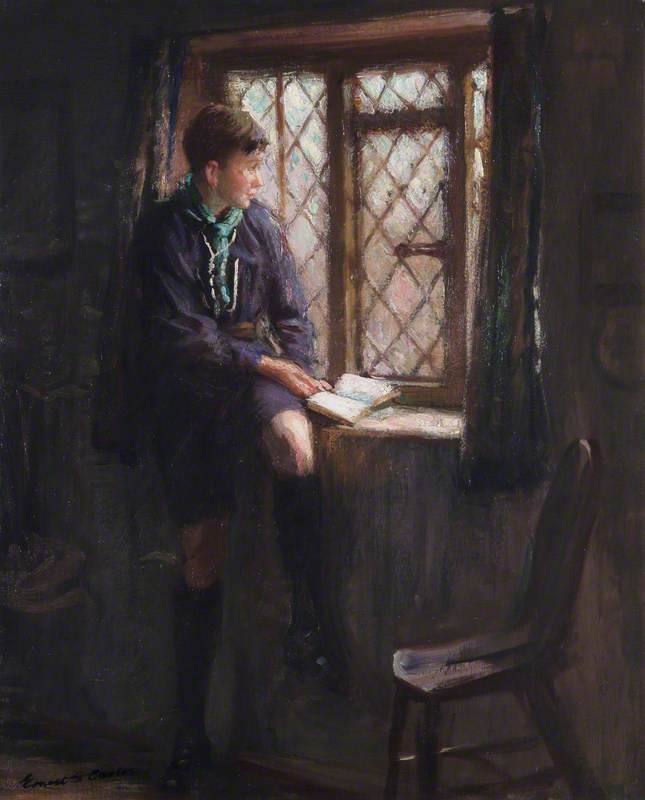
 プレビュー
プレビュー
 シェアする
シェアする シェアする
シェアする
 詳細を見る
詳細を見る

 ダウンロード
 似ている作品
 X線調査
X線調査 スライドショー
 Stats
StatsDay Dreams
 1917
1917 59.0 x 50.0 cm
 The Scout Association
 詳細を見る
詳細を見る
ジークレー/アートプリント
迅速な制作と多彩な仕上げオプションを備えた、ミュージアムクオリティのジークレーまたはキャンバスプリント。 ( 手描きの絵画を購入 Switch to Digital Image)




































作品のオリジナル比率に合わせた、当店の規定サイズからお選びください。

特定のフレームやスペースに合わせて、ご自身でサイズを指定することも可能です。選択されたサイズが元の画像の比率と一致しない場合、作品をトリミングするか、鏡面反射または単色での塗りつぶしによって画像を拡張いたします。制作を開始する前に、ご確認用のデジタルモックアップをお送りいたします。
画面上のプレビューには、実際のトリミングや拡張は反映されませんのでご注意ください。最終的な構図を正確に確認できるのは、モックアップのみとなります。
カスタムサイズも承っておりますが、元の比率を維持するためには、あらかじめ用意されたリストからサイズを選択することをお勧めいたします。


 ガラスオプションは、110cm未満のサイズでのみご利用いただけます。

Day Dreams
ジークレー/アートプリント
複製画のサイズ
-


合計金額
$ 62
関連作品








アーティストの略歴
The Visionary Chronicler of London’s Soul
Ernest Stafford Carlos, a name etched into the annals of early twentieth-century British art with both brilliance and tragedy, possessed an uncanny ability to peer beneath the surface of Victorian and Edwardian society. Born on June 4, 1883, in North Brixton, Carlos was more than a mere painter; he was a visual historian of the human spirit. His life, though cut tragically short by the ravages of the First World War at the age of thirty-four, was defined by an unwavering commitment to capturing the authentic, often overlooked, textures of existence. Educated at the Lambeth School of Art and later receiving a prestigious scholarship to the Royal Academy Schools in 1901, his formative years were steeped in the rigorous traditions of classical observation, yet his heart always beat for the stories found in the shadows of London’s streets.
The artistry of Carlos was never merely about the application of pigment to canvas; it was an exercise in profound empathy. While many of his contemporaries sought the grandiosity of high-society portraiture or the fleeting light of pure Impressionism, Carlos gravitated toward a meticulous realism that served as a vessel for social commentary. He found beauty in the grit and dignity in the struggle. His early training at the Slade School of Fine Art provided him with the technical prowess to render detail with surgical precision, but it was his fascination with the lives of the marginalized that gave his work its enduring emotional resonance. Through his eyes, the weary faces of the working class and the quiet moments of communal resilience became subjects worthy of the highest artistic devotion.
A Legacy of Light and Shadow
The development of Carlos’s style can be viewed as a journey from the observational landscapes of his youth toward a deeply narrative figurative approach. Influenced by the tonal mastery of Jules Bastien-Lepage and the classical elegance of Frederic Leighton, he mastered the use of chiaroscuro to imbue his scenes with a sense of drama and depth. This technique allowed him to guide the viewer’s eye through complex compositions, much like a director guiding an audience through a silent film. His breakthrough work, “Good Service Work in a London Slum,” completed in 1908, remains a testament to this period. In this ambitious piece, he utilized warm colors and gentle brushstrokes to find a sense of tranquility amidst the grim realities of urban poverty, proving that art could illuminate even the darkest corners of the human condition.
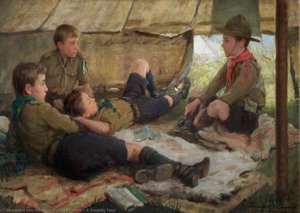
Beyond his social realism, Carlos held a unique place in history through his connection to the burgeoning Scout Movement. His works such as “A Ripping Yarn” and “The Pathfinder” capture the innocence and camaraderie of youth, often depicting young boys in uniform with a sense of warmth and nostalgia. These paintings, characterized by soft lighting and an atmosphere of friendly engagement, offer a poignant contrast to his more somber social commentaries. They reveal an artist capable of pivoting from the heavy weight of social inequality to the lightheartedness of childhood adventure, always maintaining that core thread of authentic human interaction.
The Final Chapter and Enduring Significance
The trajectory of Carlos’s career was irrevocably altered by the onset of the Great War. As a war artist and a member of the British Army, his life became inextricably linked with the global conflict that would claim so many. His death on June 14, 1917, marked the loss of one of Britain's most promising creative voices. Yet, the significance of his work transcends the tragedy of his passing. Carlos remains a vital figure for those studying the transition from Victorian sensibilities to the modern era, providing a bridge between traditional academic technique and a more modern, humanist preoccupation with social truth.
Today, the works of Ernest Stafford Carlos serve as evocative windows into a lost world. His ability to weave together the following elements ensures his place in the hearts of art historians:
- Technical Mastery: A sophisticated use of tonal gradation and light to create three-dimensional depth.
- Social Empathy: An unflinching gaze at the lives of the working class and the marginalized.
- Narrative Depth: The capacity to turn a single moment—whether a conversation around a tent or a scene in a slum—into a profound story.
- Historical Documentation: Providing essential visual records of both the social struggles and the cultural movements, such as Scouting, of his era.
Though his output was modest, the intensity of his vision remains undiminished. To look upon a Carlos painting is to encounter a man who refused to look away from the truth, finding in the most humble subjects a universal dignity that continues to resonate with viewers across the centuries.
基本情報
- Artistic Movement Or Style: Realism
- Artists Or Movements Influenced By This Artist: ['Pre-Raphaelites']
- Artists Who Influenced This Artist:
- William Holman Hunt
- John Everett Millais
- Date Of Death: 1917
- Full Name: Ernest Stafford Carlos
- Nationality: British
- Notable Artworks:
- Good Service Work in a London Slum
- Coast Watching
- Place Of Birth: London, England