


 プレビュー
プレビュー
 シェアする
シェアする シェアする
シェアする
 詳細を見る
詳細を見る

 ダウンロード
 似ている作品
 X線調査
X線調査 スライドショー
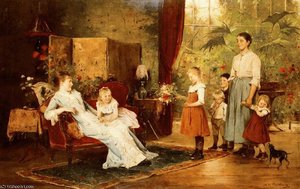
The Guidini Family
 1873
1873 139.0 x 95.0 cm
 Museo d’Arte Moderna Ca’ Pesaro
 詳細を見る
詳細を見る
ジークレー/アートプリント
迅速な制作と多彩な仕上げオプションを備えた、ミュージアムクオリティのジークレーまたはキャンバスプリント。 ( 手描きの絵画を購入 画像を購入)




































作品のオリジナル比率に合わせた、当店の規定サイズからお選びください。

特定のフレームやスペースに合わせて、ご自身でサイズを指定することも可能です。選択されたサイズが元の画像の比率と一致しない場合、作品をトリミングするか、鏡面反射または単色での塗りつぶしによって画像を拡張いたします。制作を開始する前に、ご確認用のデジタルモックアップをお送りいたします。
画面上のプレビューには、実際のトリミングや拡張は反映されませんのでご注意ください。最終的な構図を正確に確認できるのは、モックアップのみとなります。
カスタムサイズも承っておりますが、元の比率を維持するためには、あらかじめ用意されたリストからサイズを選択することをお勧めいたします。


 ガラスオプションは、110cm未満のサイズでのみご利用いただけます。

The Guidini Family
ジークレー/アートプリント
複製画のサイズ
-


合計金額
$ 62
関連作品









アーティストの略歴
The Soul of Venice: The Life and Art of Giacomo Favretto
Giacomo Favretto was not merely a painter of scenes, but a chronicler of the very heartbeat of Venice. Born on August 11, 1849, into a modest family where his father worked as a carpenter, Favretto’s early years were steeped in the tactile, industrious atmosphere of Venetian craftsmanship. This foundation of manual skill and observation would later manifest in a technique that balanced rigorous precision with a breathtaking, spontaneous energy. Before he was an acclaimed master, legend suggests he was discovered working in a stationer's shop, meticulously cutting out silhouettes to earn a living—a humble beginning that belied the immense visionary talent waiting to be unleashed upon the art world. His formal education began at the Accademia di Belle Arti di Venezia in 1864, under the watchful eye of Pompeo Marino Molmenti. It was here that Favretto began to diverge from the rigid, often heavy-handed academic traditions of his era. While many of his contemporaries sought solace in grand historical or mythological narratives, Favretto turned his gaze toward the streets, the canals, and the faces of the common people. His journey was marked by both profound inspiration and personal hardship; notably, a severe infection in 1877 cost him the sight in one eye, an experience that many believe deepened his emotional connection to the light and shadow of his subjects, forcing a new, perhaps more concentrated, way of perceiving the world around him.A Master of the Everyday
The true brilliance of Favretto lies in his ability to elevate the mundane to the level of the magnificent. He became the preeminent painter of Venetian genre scenes, capturing the rituals, customs, and daily rhythms of late nineteenth-century life with an almost cinematic sensitivity. His breakthrough at the Brera Academy Exhibition of 1873 caught the attention of the influential critic Camillo Boito, who recognized that Favretto possessed a rare gift for capturing the essence of Venetian society. Whether depicting a lively promenade in the Piazzetta or the quiet intimacy of a family gathering, his work breathes with the vitality of a living city. His stylistic approach was a sophisticated dance between detail and impression. He often employed a technique that alternated between meticulously finished, luminous areas and loose, expressive brushstrokes that suggested movement and atmosphere. This duality allowed him to convey not just the physical reality of a scene, but its emotional temperature. Influenced by the works of Domenico Morelli, he embraced an ethos of observation over artifice, preferring the spontaneous truth of a street vendor's gesture or the play of light on a silk gown to the staged drama of historical painting.Legacy and Artistic Triumph
Favretto’s career was a series of ascending triumphs that solidified his place in the pantheon of Italian art. His travels, including a trip to Paris for the Universal Exhibition in 1878 alongside Guglielmo Ciardi, expanded his horizons and brought a cosmopolitan flair to his Venetian subjects. By 1880, he had won the prestigious Prince Umberto Prize at the Brera Academy, and his participation in national exhibitions in Turin further cemented his reputation as a master of both contemporary life and nostalgic scenes in eighteenth-century costume. Though his life was tragically short, ending in Venice in 1887, the impact of his work remains profound. He left behind a body of work that serves as a vibrant, colorful window into a vanished era of Venetian splendor. His significance lies in his role as a bridge between academic tradition and a more modern, observational style that prioritized the human experience. To look upon a Favretto painting is to step into the streets of 1880s Venice, feeling the warmth of the sun on the stone and hearing the distant echoes of a city that continues to live through his brushstrokes.- Early Life: Born in Venice (1849) to a carpenter; trained at the Accademia di Belle Arti.
- Style: Venetian genre painting characterized by spontaneity, light, and everyday subject matter.
- Key Achievements: Recognition by Camillo Boito; winner of the Prince Umberto Prize (1880).
- Historical Significance: A pivotal figure in late 19th-century Italian art, moving away from academicism toward realism and impressionistic observation.
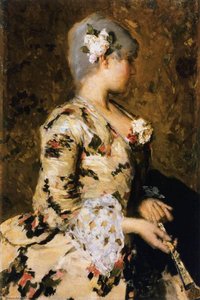
giacomo favretto
1849 - 1887
基本情報
- Artistic Movement Or Style: Venetian Genre Painting
- Artists Or Movements Influenced By This Artist: ['Michelangelo Grigoletti']
- Artists Who Influenced This Artist: ['Pompeo Marino Molmenti']
- Date Of Birth: August 11, 1849
- Date Of Death: June 12, 1887
- Full Name: Giacomo Favretto
- Nationality: Italian
- Notable Artworks:
- The Poultry Seller
- After the Bath
- Entrance to a Noble Home
- Place Of Birth: Venice, Italy