

 プレビュー
プレビュー
 シェアする
シェアする シェアする
シェアする
 詳細を見る
詳細を見る

 ダウンロード
 似ている作品
 X線調査
X線調査 スライドショー
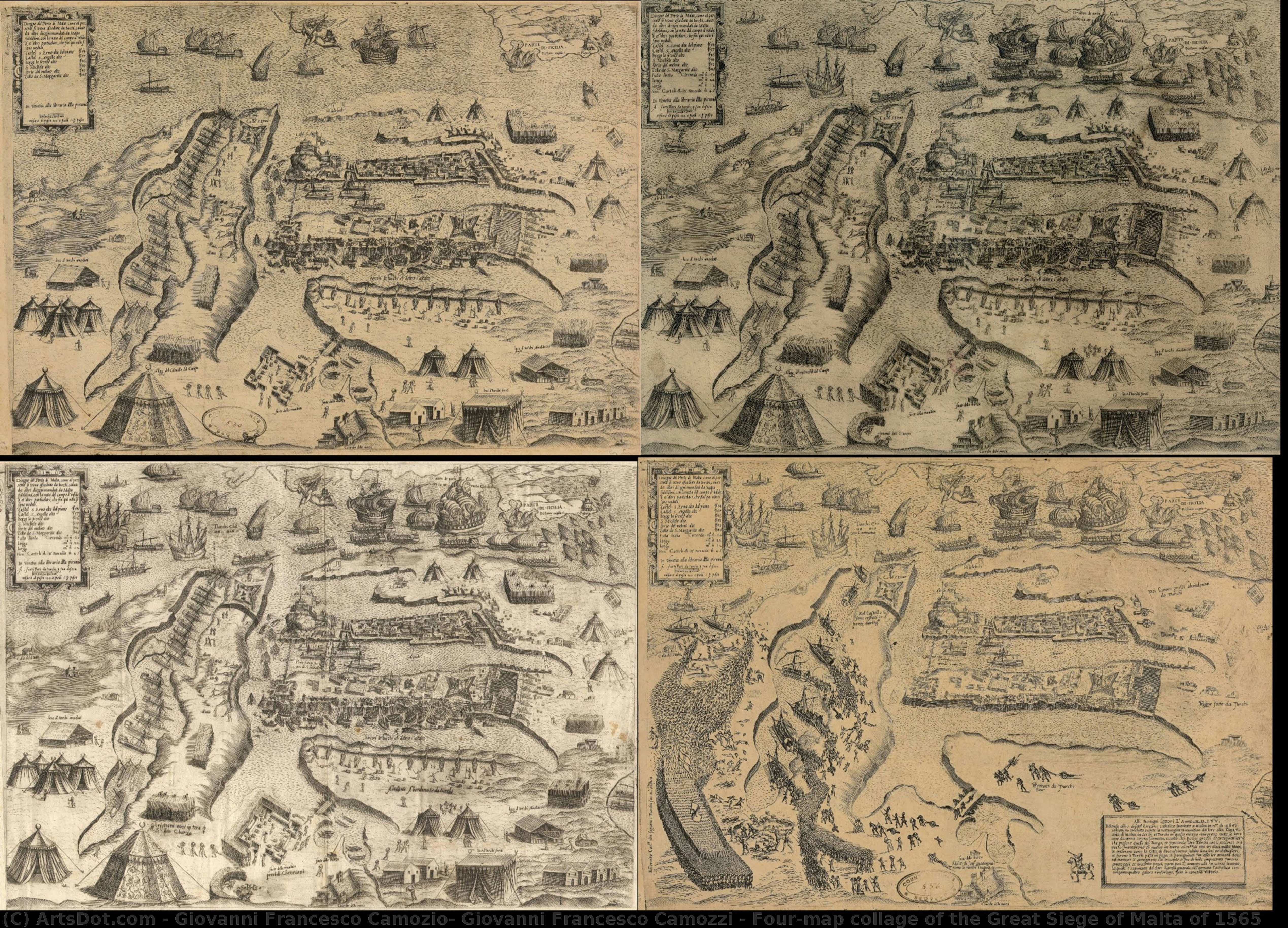
Four-map collage of the Great Siege of Malta of 1565

 詳細を見る
詳細を見る
ジークレー/アートプリント
迅速な制作と多彩な仕上げオプションを備えた、ミュージアムクオリティのジークレーまたはキャンバスプリント。 ( 手描きの絵画を購入 画像を購入)




































作品のオリジナル比率に合わせた、当店の規定サイズからお選びください。

特定のフレームやスペースに合わせて、ご自身でサイズを指定することも可能です。選択されたサイズが元の画像の比率と一致しない場合、作品をトリミングするか、鏡面反射または単色での塗りつぶしによって画像を拡張いたします。制作を開始する前に、ご確認用のデジタルモックアップをお送りいたします。
画面上のプレビューには、実際のトリミングや拡張は反映されませんのでご注意ください。最終的な構図を正確に確認できるのは、モックアップのみとなります。
カスタムサイズも承っておりますが、元の比率を維持するためには、あらかじめ用意されたリストからサイズを選択することをお勧めいたします。


 ガラスオプションは、110cm未満のサイズでのみご利用いただけます。

Four-map collage of the Great Siege of Malta of 1565
ジークレー/アートプリント
複製画のサイズ
-


合計金額
$ 62
関連作品









アーティストの略歴
The Architect of the Venetian Horizon
In the vibrant, salt-scented atmosphere of sixteenth-century Venice, where the pulse of global commerce met the height of Renaissance humanism, Giovanni Francesco Camozio emerged as a master of the printed word and the charted world. While history often reserves its highest laurels for the painters who captured the light of the lagoon, Camozio carved his legacy through the precision of the copperplate and the expansive reach of the printing press. As a prominent figure of the Lafreri school, he was far more than a mere merchant; he was a bridge between the abstract mathematical certainties of the Renaissance and the tangible, expanding frontiers of the known world. His life, though shrouded in the characteristic mists of the era, reflects the profound intellectual shift of an age where knowledge was being aggressively mapped, translated, and disseminated to the far corners of Europe.
Though the exact details of his early years remain a subject of scholarly debate—with some tracing his roots to Asolo and others suggesting a connection to the fortress of Crema—Camoziente’s presence in Venice was undeniable. By 1552, he had already established himself as a sophisticated libraro, navigating the complex legal and intellectual waters of the Venetian Republic. His early ventures were marked by a scholarly ambition that transcended simple commerce; he sought privileges from the Doge to publish translations of Greek medical texts and the profound meteorological commentaries of Aristotle. This period of his life reveals an artist-publisher deeply embedded in the humanist tradition, where the pursuit of scientific truth was inextricably linked to the beauty of the printed page.
The Precision of the Motionless Fleet
As Camozio’s career matured, his focus shifted toward the monumental task of cartography, a discipline that demanded both artistic elegance and rigorous accuracy. He became one of the most prolific contributors to the Lafreri school, a collective of mapmakers celebrated for their ability to blend topographical precision with exquisite decorative detail. His work during the period between 1560 and 1575 represents a pinnacle of Venetian cartographic achievement. Unlike the more generalized charts of previous generations, Camozio’s maps possessed an almost haunting clarity, capturing coastlines, harbors, and fortifications with such fidelity that they earned him the evocative title of "Venice's motionless fleet."
These works were not merely objects of aesthetic contemplation; they were vital instruments of power and strategy. The meticulous rendering of islands and maritime routes held immense value for the great powers of the age, including the Ottoman Empire, which utilized these detailed charts to navigate trade routes and assess potential military targets. To hold a Camozio map was to hold a piece of the world’s shifting political landscape. His ability to translate the vast, unpredictable Mediterranean into a structured, readable format allowed for a new era of maritime confidence, making his copper-plate printing shop a central node in the global flow of information.
A Legacy Etched in Copper
The breadth of Camozio’s output extended beyond the boundaries of geography. His workshop was a site of immense cultural production, where the lines of cartography met the artistry of fine engraving. He was responsible for disseminating works that included engravings of drawings and paintings by the legendary Titian, as well as various religious scenes that spoke to the spiritual heartbeat of Venice. This versatility highlights his role as a true Renaissance polymath—a man who understood that the same precision required to map a coastline could be used to capture the divine grace of a saint or the dramatic shadows of a masterwork.
The twilight of Camozio’s life was as dramatic as the maps he produced. The production of his vast catalog came to an abrupt end around 1575, coinciding with the devastating plague that swept through Venice, claiming countless lives and altering the course of Venetian history. With no further records of his existence after this period, it is widely believed by historians that he succumbed to the very pestilence that silenced his press. Yet, his influence endured long after the ink had dried on his final plates. Through his meticulous maps and his dedication to the printed word, Giovanni Francesco Camozio ensured that the vision of the sixteenth century—a world being rediscovered, measured, and mastered—would be preserved for all eternity.
giovanni francesco camozio, giovanni francesco camozzi
1501 - 1575 , Italy
基本情報
- Artistic Movement Or Style: Lafreri School
- Artists Or Movements Influenced By This Artist: ['Ottoman Cartography']
- Artists Who Influenced This Artist: ['Tintoretto']
- Date Of Birth: Venice, Italy (1501)
- Date Of Death: 1575
- Full Name: Giovanni Francesco Camozio
- Nationality: Italian
- Notable Artworks:
- India and the Silk Road
- Four-map collage of the Great Siege of Malta
- Trumpeter on horseback with cartouche
- Place Of Birth: Venice