

 プレビュー
プレビュー
 プリントを購入
 シェアする
シェアする シェアする
シェアする
 詳細を見る
詳細を見る

 ダウンロード
 似ている作品
 X線調査
X線調査 スライドショー
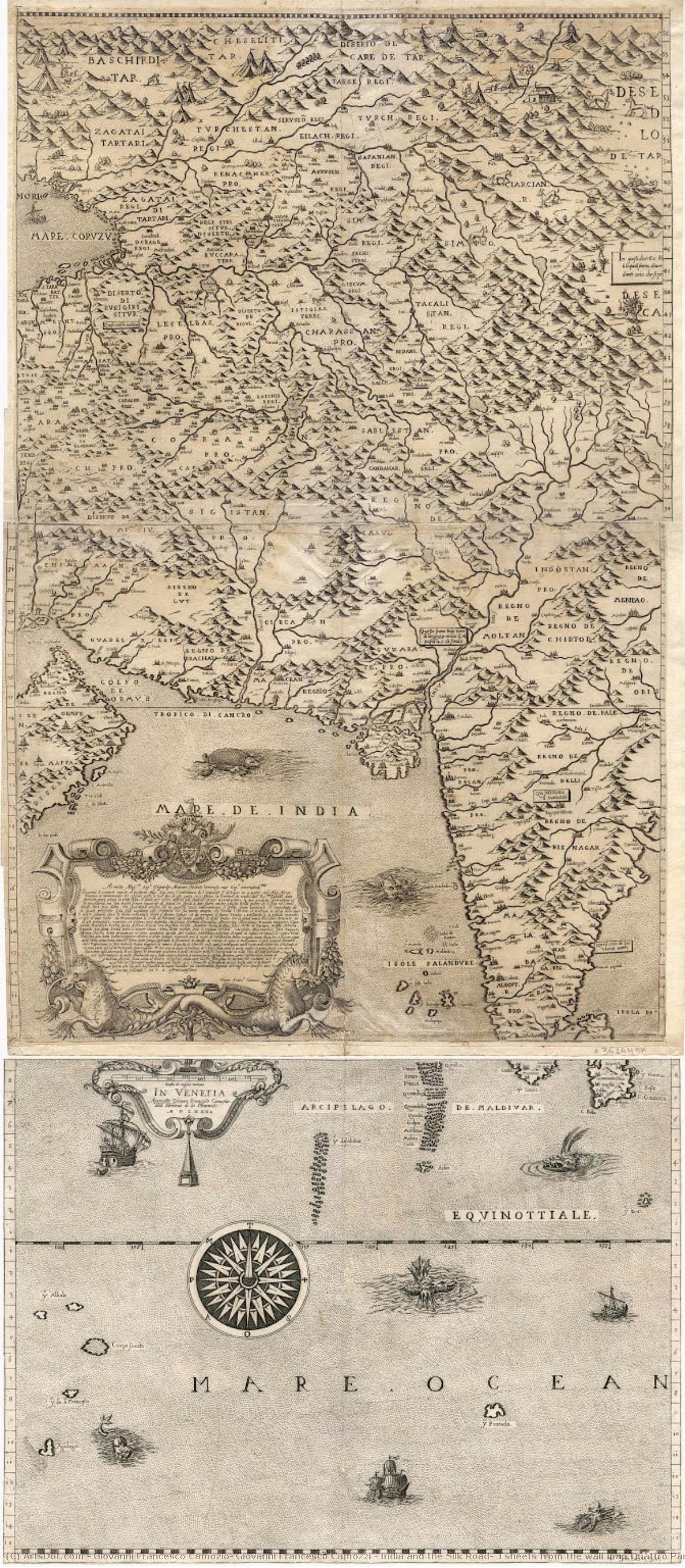
India and the Silk Road, 3 sheets from the wall map Quattro Parte Del Mondo
 100.0 x 44.0 cm
 Kalakriti Archives
 詳細を見る
詳細を見る
オンラインプレビューをはるかに凌ぐ、高解像度で鮮明なデジタル画像をご購入いただけます。
各ファイルは、社内の専門家が高度なツールと熟練した手作業によるレタッチを用いて、細心の注意を払って準備されています。すべての画像において、卓越した鮮明度、正確な色彩再現性、そして繊細なディテールを保証いたします。
最終ファイルは、プロフェッショナルな編集・印刷環境ですぐにご利用いただけるよう最適化された状態で、72時間以内にメールにてお届けいたします。これは、一流のデザインスタジオ、出版社、ギャラリーから信頼されているものと同等の品質です。
デジタル画像のご注文に付随する特典
高品質なデジタル画像配信を、確かな品質で。
ArtsDot.com を選ぶことは、単に画像を手に入れることではありません。それは、プロの手によって精密に仕上げられ、満足保証が付いた高品質なデジタルアートワークを受け取ることを意味します。ご注文いただいた際に自動的に付随する内容は、以下の通りです:

メールですぐにお届け
ご注文から72時間以内に、高解像度のデジタル画像ファイルがメールでお手元に届きます。すぐにそのままご利用いただけます。

AI技術で最適化されたデジタルファイル
お客様の作品は、高度なAIツールと専門家による手作業の編集を組み合わせてプロフェッショナルに最適化されており、細部のディテール、鮮明さ、そして正確な色再現性を最大限に引き出しています。

一生涯無料の再送サービス
ファイルを誤って削除したり、紛失してしまったりしましたか?ご安心ください。いつでも無料で再送いたします。

輸入手数料は一切かかりません
関税や手数料、配送料を気にすることなく、お気に入りのアートワークをすぐにお楽しみいただけます。デジタルダウンロードは常に免税です。

色彩再現の保証
プロ仕様のツールとカラーマネジメント技術を用いることで、デジタル画像が元の色を最大限に忠実に再現することを保証いたします。

100日間満足保証
ご購入いただいたデジタル画像にご満足いただけない場合は、100日以内であれば、理由を問わず修正または100%の返金対応をさせていただきます。

100% 返金保証
ご満足いただけない場合は、デジタルファイルを受け取ってから100日以内であれば、理由を問わず全額返金いたします。

まとめ買い割引
3枚購入で10%OFF - 5枚購入で15%OFF - 10枚以上購入で20%OFF。クリエイティブなプロジェクト、ギャラリー、エージェンシーに最適です。
関連作品









作家の略歴
The Architect of the Venetian Horizon
In the vibrant, salt-scented atmosphere of sixteenth-century Venice, where the pulse of global commerce met the height of Renaissance humanism, Giovanni Francesco Camozio emerged as a master of the printed word and the charted world. While history often reserves its highest laurels for the painters who captured the light of the lagoon, Camozio carved his legacy through the precision of the copperplate and the expansive reach of the printing press. As a prominent figure of the Lafreri school, he was far more than a mere merchant; he was a bridge between the abstract mathematical certainties of the Renaissance and the tangible, expanding frontiers of the known world. His life, though shrouded in the characteristic mists of the era, reflects the profound intellectual shift of an age where knowledge was being aggressively mapped, translated, and disseminated to the far corners of Europe.
Though the exact details of his early years remain a subject of scholarly debate—with some tracing his roots to Asolo and others suggesting a connection to the fortress of Crema—Camoziente’s presence in Venice was undeniable. By 1552, he had already established himself as a sophisticated libraro, navigating the complex legal and intellectual waters of the Venetian Republic. His early ventures were marked by a scholarly ambition that transcended simple commerce; he sought privileges from the Doge to publish translations of Greek medical texts and the profound meteorological commentaries of Aristotle. This period of his life reveals an artist-publisher deeply embedded in the humanist tradition, where the pursuit of scientific truth was inextricably linked to the beauty of the printed page.
The Precision of the Motionless Fleet
As Camozio’s career matured, his focus shifted toward the monumental task of cartography, a discipline that demanded both artistic elegance and rigorous accuracy. He became one of the most prolific contributors to the Lafreri school, a collective of mapmakers celebrated for their ability to blend topographical precision with exquisite decorative detail. His work during the period between 1560 and 1575 represents a pinnacle of Venetian cartographic achievement. Unlike the more generalized charts of previous generations, Camozio’s maps possessed an almost haunting clarity, capturing coastlines, harbors, and fortifications with such fidelity that they earned him the evocative title of "Venice's motionless fleet."
These works were not merely objects of aesthetic contemplation; they were vital instruments of power and strategy. The meticulous rendering of islands and maritime routes held immense value for the great powers of the age, including the Ottoman Empire, which utilized these detailed charts to navigate trade routes and assess potential military targets. To hold a Camozio map was to hold a piece of the world’s shifting political landscape. His ability to translate the vast, unpredictable Mediterranean into a structured, readable format allowed for a new era of maritime confidence, making his copper-plate printing shop a central node in the global flow of information.
A Legacy Etched in Copper
The breadth of Camozio’s output extended beyond the boundaries of geography. His workshop was a site of immense cultural production, where the lines of cartography met the artistry of fine engraving. He was responsible for disseminating works that included engravings of drawings and paintings by the legendary Titian, as well as various religious scenes that spoke to the spiritual heartbeat of Venice. This versatility highlights his role as a true Renaissance polymath—a man who understood that the same precision required to map a coastline could be used to capture the divine grace of a saint or the dramatic shadows of a masterwork.
The twilight of Camozio’s life was as dramatic as the maps he produced. The production of his vast catalog came to an abrupt end around 1575, coinciding with the devastating plague that swept through Venice, claiming countless lives and altering the course of Venetian history. With no further records of his existence after this period, it is widely believed by historians that he succumbed to the very pestilence that silenced his press. Yet, his influence endured long after the ink had dried on his final plates. Through his meticulous maps and his dedication to the printed word, Giovanni Francesco Camozio ensured that the vision of the sixteenth century—a world being rediscovered, measured, and mastered—would be preserved for all eternity.
giovanni francesco camozio, giovanni francesco camozzi
1501 - 1575 , Italy
プロフィール概要
- Artistic Movement Or Style: Lafreri School
- Artists Or Movements Influenced By This Artist: ['Ottoman Cartography']
- Artists Who Influenced This Artist: ['Tintoretto']
- Date Of Birth: Venice, Italy (1501)
- Date Of Death: 1575
- Full Name: Giovanni Francesco Camozio
- Nationality: Italian
- Notable Artworks:
- India and the Silk Road
- Four-map collage of the Great Siege of Malta
- Trumpeter on horseback with cartouche
- Place Of Birth: Venice