

 プレビュー
プレビュー
 シェアする
シェアする シェアする
シェアする
 詳細を見る
詳細を見る

 ダウンロード
 似ている作品
 X線調査
X線調査 スライドショー
Proof – Leaflet for the Mercur Bank and Foreign Exchange Office


 詳細を見る
詳細を見る
ジークレー/アートプリント
迅速な制作と多彩な仕上げオプションを備えた、ミュージアムクオリティのジークレーまたはキャンバスプリント。 ( 手描きの絵画を購入 画像を購入)




P118B $10

P118H $10

P118W $10

P438Z $10

P508JH $12

P508YH $12

P805H $10

P805Z $10

P919BZ $10

P919G $10

P919XJ $10

P959ZH $10

P968JZ $12

W106C $8

W218G $10

W218JH $8

W218Y $10

W307PJ $10

W316G $10

W316PJ $8

W316Y $10

W398PJ $8

W4111J $10

W500HY $15

W500JH $15

W692G $12

W849H $8

W940BG $15

W953PJ $8




作品のオリジナル比率に合わせた、当店の規定サイズからお選びください。

特定のフレームやスペースに合わせて、ご自身でサイズを指定することも可能です。選択されたサイズが元の画像の比率と一致しない場合、作品をトリミングするか、鏡面反射または単色での塗りつぶしによって画像を拡張いたします。制作を開始する前に、ご確認用のデジタルモックアップをお送りいたします。
画面上のプレビューには、実際のトリミングや拡張は反映されませんのでご注意ください。最終的な構図を正確に確認できるのは、モックアップのみとなります。
カスタムサイズも承っておりますが、元の比率を維持するためには、あらかじめ用意されたリストからサイズを選択することをお勧めいたします。


 ガラスオプションは、110cm未満のサイズでのみご利用いただけます。

Proof – Leaflet for the Mercur Bank and Foreign Exchange Office
ジークレー/アートプリント
複製画のサイズ
-


合計金額
$ 62
A Vision of Stability: The Divine Commerce of Ferenc Helbing
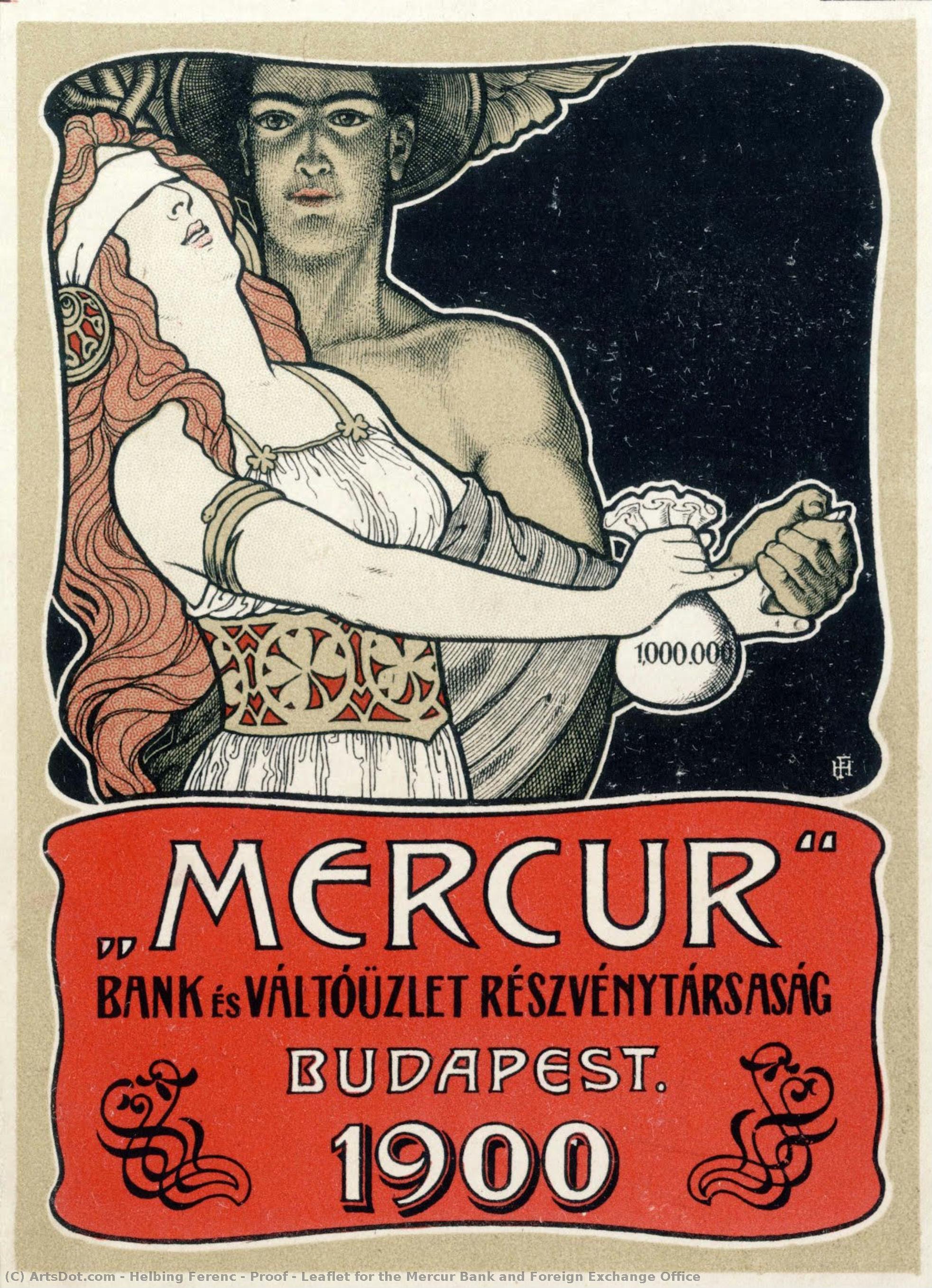
In the delicate intersection of commerce and classical mythology lies Proof – Leaflet for the Mercur Bank and Foreign Exchange Office, a mesmerizing masterwork by the Hungarian graphic pioneer Ferenc Helbing. Created around 1900, this piece serves as more than a mere advertisement; it is a profound visual allegory designed to instill confidence in an era of shifting economic tides. At its heart, the composition presents a striking duality: the god Mercury, the messenger of the gods and patron of commerce, stands alongside Fortuna, the blindfolded goddess of luck. Set against a deep, velvety black background that lends an air of eternal mystery, the figures emerge with a sculptural presence that commands the viewer's attention.
The artistry of Helbing is deeply rooted in the aesthetic currents of his time, specifically drawing inspiration from the Munich Secession and the evocative depths of German Symbolism. There is a palpable tension in the way Mercury supports the red-haired, blindfolded Fortuna as she clutches a bag of wealth. This deliberate arrangement serves a sophisticated psychological purpose: it suggests that while fortune may be unpredictable and sightless, the steadfastness of the banking institution—embodied by the resolute Mercury—provides the necessary foundation to anchor that luck into tangible stability. The influence of Franz von Stuck’s provocative works, such as The Kiss of the Sphinx, is subtly felt in the dramatic lighting and the heavy, symbolic weight of the figures.
Technically, the leaflet showcases Helbing's extraordinary command over lithographic design and graphic composition. The lower portion of the work transitions into a bold, crimson section containing the essential advertising text, creating a striking color contrast that directs the eye upward toward the divine drama. This structural balance between informative text and high art was a hallmark of Helbing’s career, as he revolutionized Hungarian commercial graphics through his work on banknotes, posters, and stamps. The meticulous detail in the drapery of the Roman attire and the expressive anatomy of the deities demonstrates a level of craftsmanship that elevates a simple promotional tool into a lasting piece of fine art.
For the discerning collector or interior designer, a high-quality reproduction of this work offers a unique opportunity to introduce a sense of historical grandeur and intellectual depth into a space. The dramatic interplay of light and shadow, combined with the rich palette of gold, crimson, and midnight black, makes it an ideal centerpiece for a study, a sophisticated gallery wall, or a classic library setting. Owning this piece is not merely about possessing a beautiful image; it is about inviting a conversation on the timeless relationship between human ambition, the whims of fate, and the enduring pursuit of security.
関連作品
アーティストの略歴
The Visionary Architect of Hungarian Graphics
Born in 1870 in the historic town of Nový Zámek, Slovakia, Ferenc Helbing emerged as a transformative force in the landscape of European commercial art. His life’s work represents a seamless bridge between the meticulous precision of technical lithography and the expressive freedom of fine art. As a pioneer of Hungarian commercial graphics, Helbing did not merely create images; he shaped the visual identity of an era. His journey began with rigorous training in applied graphics and applied arts, a foundation that instilled in him a profound respect for the marriage of form and function. This early mastery of lithography served as the bedrock for a career that would eventually redefine how art could permeate the everyday lives of the public through stamps, banknotes, and posters.
The evolution of Helbing’s style was deeply intertwined with his role as an educator and administrator. From 1906, his presence at the College of Applied Graphics, and later at the College of Embellishment and Applied Arts, allowed him to cultivate a pedagogical legacy that would influence generations of Hungarian designers. He believed that technical skill should never be divorced from artistic soul, a philosophy that manifested in his diverse portfolio. Whether he was working on the delicate intricacies of a postage stamp or the grand scale of a mural, Helbing maintained a signature elegance characterized by innovative typography and a sophisticated use of graphic weight. His ability to navigate the demands of commercial utility while maintaining high aesthetic standards made him a titan of the applied arts.
A Legacy Carved in Ink and Paper
The true significance of Ferenc Helbing lies in his ability to elevate the "applied" to the level of the "monumental." His contributions to the Hungarian National Gallery serve as a testament to a man who saw beauty in the most functional of objects. To look upon his designs for banknotes and stamps is to witness a masterclass in composition, where every line and letterform serves a narrative purpose. His work in book illustrations and glass paintings further demonstrates a versatility that few of his contemporaries could match, proving that his creative impulse was as much about storytelling as it was about design.
Beyond the physical artifacts of his career, Helbing’s impact is felt in the very structure of art education in Hungary. By managing major institutions until 1936, he ensured that the rigorous standards of lithography and graphic design were passed down through a disciplined lineage of artists. His life remains a profound example of how an artist can influence the cultural fabric of a nation by finding inspiration in the intersection of commerce and creativity. Today, his work continues to be celebrated as a cornerstone of Hungarian visual heritage, reminding us that the most enduring art is often that which we hold in our hands every single day.
helbing ferenc
1870 - 1958 , Slovakia
基本情報
- Artistic Movement Or Style: Commercial Graphics
- Date Of Birth: Dec 25, 1870
- Date Of Death: Jan 28, 1958
- Full Name: Ferenc Helbing
- Nationality: Hungarian
- Notable Artworks: ['Hungarian National Gallery']
- Place Of Birth: Nové Zámky, Slovakia
関連記事
German Expressionism's 10 Defining Masterpieces | Art for Your Home
Explore 10 defining German Expressionism masterpieces – from Munch's 'The Scream' to Kandinsky’s abstracts. Discover the artists, stories & bold colors behind this powerful art movement. Find museum-quality reproductions at ArtsDot.com.

Károly Ferenczy: Pioneering Hungarian Modernism & the Soul of a Nation
Explore the life & art of Károly Ferenczy, a pivotal figure in Hungarian Modernism. Discover his landscapes, portraits, and role in founding the Nagybánya colony. Expert insights for collectors & enthusiasts.
Fritz von Uhde: Bridging Realism & Symbolism in Late 19th-Century German Painting
Explore the captivating world of Fritz von Uhde, a pivotal German painter bridging Realism & Symbolism. Discover his plein-air techniques, religious themes, and influence on modern art. Learn about this fascinating artist at ArtsDot.

Anton von Werner: Imperial Painter, Historical Witness & Shifting German Identity
Explore the life & work of Anton von Werner, Imperial Germany's leading painter. Discover his dramatic depictions of war, unification, and court life – a fascinating insight into 19th-century German history & art.
The Northern Awakening: Artistic Innovation & Cultural Transformation in the German Renaissance
Explore the artistic innovation of the German Renaissance! Discover Dürer, the Danube School & Reformation art. Learn about techniques, materials & lasting influence. Find museum-quality reproductions at ArtsDot.

