作家の略歴
A Legacy Forged in Porcelain: The Imperial Porcelain Factory, Saint Petersburg
The story of the Imperial Porcelain Factory is inextricably linked to the ambition and aesthetic vision of Russia’s ruling Romanov dynasty. Founded in 1744 by Empress Elizabeth Petrovna, daughter of Peter the Great, the factory wasn't merely intended as a producer of luxury goods; it was conceived as a symbol of Russia’s burgeoning power and its aspiration to rival the artistic achievements of Western Europe. Elizabeth, deeply impressed by the porcelain she encountered during state visits, recognized the potential for establishing a domestic industry that would eliminate reliance on imports from Meissen, Sèvres, and other renowned European workshops. The initial years were fraught with challenges – finding suitable raw materials proved difficult, and early experiments yielded disappointing results. However, Elizabeth’s unwavering commitment, coupled with the discovery of kaolin deposits near St. Petersburg in 1747, laid the foundation for future success. The factory's earliest productions consciously emulated the Rococo styles prevalent in France and Germany, employing skilled artisans recruited from abroad to impart their expertise. This initial phase was about mastering technique; learning to control the delicate process of firing and glazing, and replicating the forms favored by European aristocracy.
From Imitation to Innovation: Defining a Russian Aesthetic
Under Catherine the Great, the factory entered a period of remarkable artistic growth. Catherine herself was a passionate collector and actively involved in shaping the factory’s direction. She commissioned elaborate services depicting scenes from Russian history, mythology, and everyday life, moving beyond simple imitation to forge a distinctly Russian aesthetic. The influence of classicism became increasingly pronounced during this era, reflected in the elegant forms and refined ornamentation of the porcelain wares. Artists like Johann-Peter Schöpper and Dimitri Levitsky contributed designs that celebrated Russia’s imperial grandeur and its expanding territories. Catherine's patronage extended beyond decorative arts; she encouraged the creation of monumental sculptural works in porcelain, showcasing the factory’s technical prowess and artistic ambition on a grand scale. This period saw the development of unique painting styles, incorporating vibrant colors and intricate details that distinguished Imperial Porcelain from its European counterparts. The factory also began to explore new techniques, such as *en plein air* painting on porcelain plaques, further demonstrating its innovative spirit. The emphasis shifted towards narratives – telling stories through meticulously rendered scenes adorning plates, vases, and other objects.
The 19th Century: Romanticism, Realism, and Imperial Patronage
The 19th century witnessed a continuation of imperial patronage, with each successive ruler leaving their mark on the factory’s output. Under Nicholas I, the factory embraced Romanticism, producing porcelain depicting scenes from Russian folklore, military victories, and idealized landscapes. The reign of Alexander II saw a growing interest in Realism, reflected in more naturalistic depictions of peasant life and contemporary events. Throughout this period, the factory continued to refine its technical skills, experimenting with new glazes, colors, and firing techniques. The development of cobalt net porcelain – a delicate technique involving intricate openwork designs – became a signature style of the Imperial Porcelain Factory. The factory also played a significant role in creating commemorative wares celebrating important events in Russian history, such as the emancipation of the serfs and the construction of railways. Artists like Alexander Lebedkin and Fyodor Solntsev contributed significantly to the factory’s artistic reputation during this era, pushing the boundaries of porcelain painting and sculpture. The factory's products were increasingly sought after by collectors both within Russia and abroad, solidifying its position as a leading center for porcelain production.
Revolution and Renewal: Adapting to a Changing World
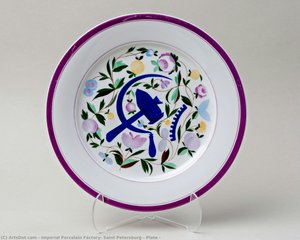
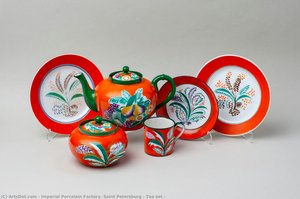
The Russian Revolution of 1917 brought profound changes to the Imperial Porcelain Factory. The Romanov dynasty was overthrown, and the factory was nationalized, becoming known as the State Porcelain Factory. Initially, production slowed as the country grappled with political upheaval and economic hardship. However, under the Soviet regime, the factory underwent a period of reinvention, embracing new artistic styles aligned with socialist ideals. Constructivism and Suprematism influenced the designs of porcelain wares during the 1920s and 1930s, resulting in bold geometric forms and abstract patterns. Despite these stylistic shifts, the factory continued to maintain its high standards of craftsmanship and technical excellence. During World War II, production was temporarily halted as the factory focused on manufacturing essential goods for the war effort. After the war, the factory resumed porcelain production, incorporating elements of socialist realism into its designs. Throughout the Soviet era, the factory remained a significant cultural institution, producing both utilitarian wares and decorative objects for domestic consumption and export.
The Modern Era: Preserving Tradition and Embracing Innovation
Following the collapse of the Soviet Union in 1991, the factory underwent further transformation, regaining its historical name – the Imperial Porcelain Factory. Today, it continues to produce both reproductions of classic designs and contemporary works by leading Russian artists. The factory remains committed to preserving traditional techniques while embracing innovation, attracting a new generation of skilled artisans and designers. Its legacy as a symbol of Russian artistry and imperial grandeur endures. The factory’s products are highly prized by collectors worldwide, representing not only exceptional craftsmanship but also a rich cultural heritage. The Imperial Porcelain Factory stands as a testament to the enduring power of art and its ability to transcend political boundaries and historical upheavals. It continues to be a vital center for porcelain production in Russia, shaping the future of this timeless art form while honoring its illustrious past.


 プレビュー
プレビュー
 プリントを購入
 シェアする
シェアする シェアする
シェアする
 詳細を見る
詳細を見る

 ダウンロード
 似ている作品
 X線調査
X線調査 スライドショー

 詳細を見る
詳細を見る