

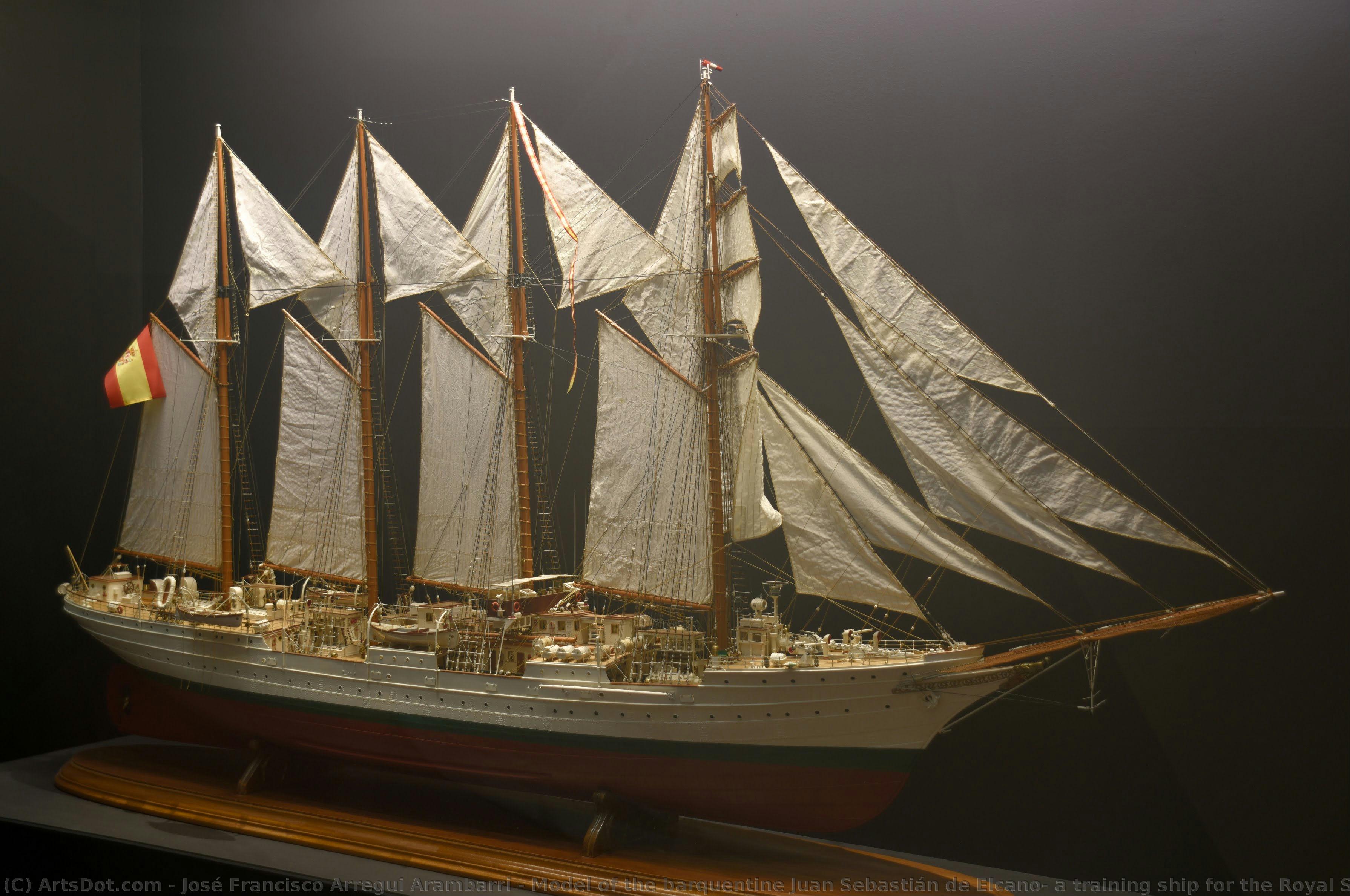
 プレビュー
プレビュー
 シェアする
シェアする シェアする
シェアする
 詳細を見る
詳細を見る

 ダウンロード
 似ている作品
 X線調査
X線調査 スライドショー
 Stats
StatsModel of the barquentine Juan Sebastián de Elcano, a training ship for the Royal Spanish Navy (1927–active service)
 2.0 x 230.0 cm
 海軍博物館
海軍博物館
 詳細を見る
詳細を見る
手描き油彩複製画
当社のアーティストが、お客様のご希望のサイズと額縁に合わせて、キャンバスに手描きで制作する油彩画です。 ( Switch to Print Switch to Digital Image)




































作品のオリジナル比率に合わせた、当店の規定サイズからお選びください。

特定のフレームやスペースに合わせて、ご希望のサイズをご入力いただけます。選択されたサイズが元の画像の比率と異なる場合、アートワークをトリミングするか、手描きで要素を追加して絵画を拡張いたします。デジタルモックアップ を制作し、制作開始前にご確認(承認)をいただきます。
画面上のプレビューは、実際のトリミングや拡張を正確に反映しているものではありません。最終的な構図は、モックアップによってのみ正確にご確認いただけます。
カスタムサイズもご利用いただけますが、元の比率を維持するためには、あらかじめ用意されたリストからサイズを選択することをお勧めいたします。
ご注文後、ArtsDot.com チームより詳細な指示をお送りするとともに、仕上がりイメージ(モックアップ)をご提供いたします。


 ガラスオプションは、110cm未満のサイズでのみご利用いただけます。

Model of the barquentine Juan Sebastián de Elcano, a training ship for the Royal Spanish Navy (1927–active service)
複製技法
複製画のサイズ
-


合計金額
$ 263
関連作品







アーティストの略歴
The Essence of Form: The Life and Legacy of José Francisco Arregui Arambarri
In the quiet, storied landscapes of Oñati, Spain, a profound artistic journey began in 1935, marking the birth of a visionary who would eventually redefine the boundaries of Spanish abstraction. José Francisco Arregui Arambarri did not merely paint or sculpt; he interrogated the very fabric of perception. His early years were steeped in the rich cultural heritage of his homeland, yet his gaze was always fixed upon the horizon of modernity. Through his formative studies at the Escrabia Superior de Diseño Cristóbal Goya in Bilbao, Arregui developed a rigorous technical foundation. This period was crucial, as it instilled in him a deep respect for the tactile nature of materials—a reverence for stone, metal, and clay that would later breathe life into his three-dimensional works and inform the structural integrity of his canvases.
As his career matured, Arregui’s artistic language underwent a transformative evolution, moving away from traditional representation toward a sophisticated synthesis of Cubism and Minimalism. He possessed a rare ability to strip an object down to its skeletal essence, finding beauty in the geometric purity of a line or the weight of a shadow. His work became a dialogue between presence and absence, where the space between forms was just as vital as the forms themselves. This mastery of spatial relationships allowed him to create compositions that felt both monumental and intimate. When viewing his paintings, one does not simply see color; one experiences a rhythmic pulse of light and energy, orchestrated through a deliberate and masterful use of palette.
A Symphony of Color and Geometry
The true magic of Arregui’s oeuvre lies in his fearless deployment of color. He treated hues not merely as decorative elements but as emotional protagonists capable of altering the viewer's psychological state. In works such as "Woman in a Blue Hat," the artist demonstrates his signature ability to distill complex human narratives into striking, simplified motifs. The vibrant blues and bold contrasts serve to anchor the eye, guiding it through a labyrinth of geometric shapes that evoke a sense of structured harmony. This approach—blending the fragmented perspective of Cubism with the restrained elegance of Minimalism—created a tension that is both intellectually stimulating and visually arresting.
Beyond the borders of Spain, Arregui’s influence expanded through his dedication to pedagogy and international exchange. His tenure teaching at the Universidad Nacional de Educación Superior Autónoma Metropolitana (UNESAM) in Mexico City allowed him to share his profound understanding of form with a new generation of creators. This cross-pollination of Spanish tradition and Mexican modernism enriched his own perspective, infusing his later works with an even greater sense of global connectivity and structural complexity. His ability to translate the language of sculpture into the two-dimensional realm of painting ensured that his art remained a cohesive exploration of volume and light.
Historical Significance and Lasting Impact
The passing of José Francisco Arregui Arambarri in 2021 marked the end of an era, yet his contribution to contemporary art remains an enduring legacy. He stands as a bridge between the classical traditions of Spanish craftsmanship and the avant-garde movements of the late 20th century. His work continues to challenge collectors and historians to reconsider the relationship between simplicity and depth. To engage with an Arregui piece is to participate in a timeless meditation on the fundamental elements of our visual world:
- The Power of Abstraction: His ability to communicate profound truths through non-representational forms.
- Materiality and Space: The seamless integration of sculptural thought into the medium of painting.
- Chromatic Emotion: The use of bold, strategic color to evoke visceral human responses.
- Geometric Precision: A lifelong commitment to finding order and beauty within simplified structures.
Today, Arregui’s name is synonymous with a particular brand of Spanish modernism—one that is both intellectually rigorous and deeply soulful. His canvases remain vibrant testaments to a life spent chasing the thresholds of light and the hidden geometries of the human experience.
josé francisco arregui arambarri
1935 - 2021 , Spain
基本情報
- Artistic Movement Or Style: Abstract & Minimalist
- Artists Or Movements Influenced By This Artist: ['American Art']
- Artists Who Influenced This Artist: ['Cubism']
- Date Of Birth: 1935
- Date Of Death: 2021
- Full Name: José Francisco Arregui Arambarri
- Nationality: Spanish
- Notable Artworks: ['Woman in a blue hat']
- Place Of Birth: Oñati, Spain