

 プレビュー
プレビュー
 プリントを購入
 シェアする
シェアする シェアする
シェアする
 詳細を見る
詳細を見る

 ダウンロード
 似ている作品
 X線調査
X線調査 スライドショー
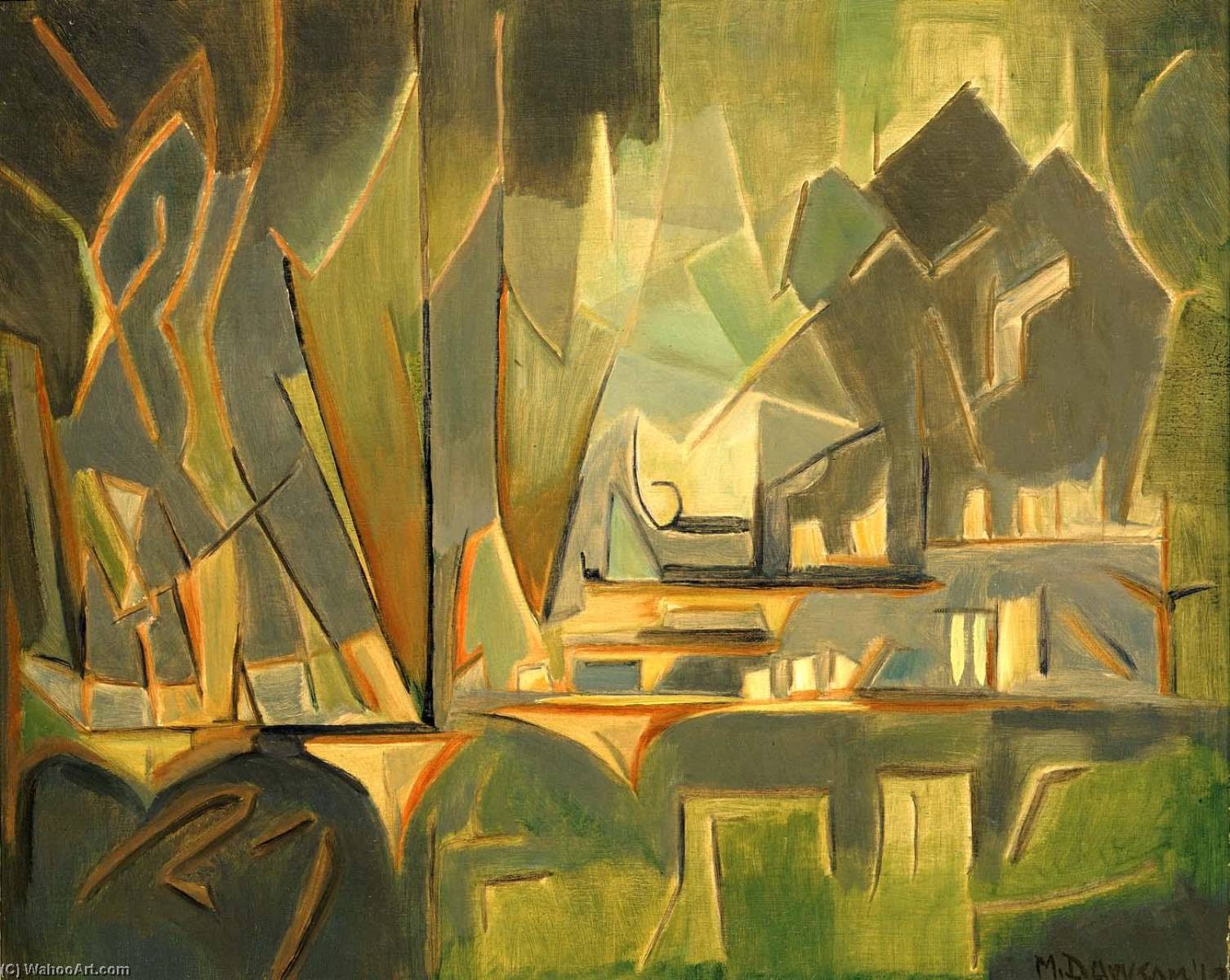
Blue Complex
 1912
1912 46.0 x 55.0 cm
 詳細を見る
詳細を見る




































作品のオリジナル比率に合わせた、当店の規定サイズからお選びください。

特定のフレームやスペースに合わせて、ご希望のサイズをご入力いただけます。選択されたサイズが元の画像の比率と異なる場合、アートワークをトリミングするか、手描きで要素を追加して絵画を拡張いたします。デジタルモックアップ を制作し、制作開始前にご確認(承認)をいただきます。
画面上のプレビューは、実際のトリミングや拡張を正確に反映しているものではありません。最終的な構図は、モックアップによってのみ正確にご確認いただけます。
カスタムサイズもご利用いただけますが、元の比率を維持するためには、あらかじめ用意されたリストからサイズを選択することをお勧めいたします。
ご注文後、ArtsDot.com チームより詳細な指示をお送りするとともに、仕上がりイメージ(モックアップ)をご提供いたします。


 ガラスオプションは、110cm未満のサイズでのみご利用いただけます。

Blue Complex
複製技法
複製画のサイズ
-


合計金額
$ 263
関連作品

アーティストの略歴
The Architect of Abstraction: The Visionary Life of Manierre Dawson
In the bustling, industrial heart of Chicago at the dawn of the twentieth century, a quiet revolution was being drafted in paint and geometry. Manierre Dawson, born on December 22, 1887, emerged not merely as a painter, but as a pioneer who dared to dismantle the boundaries of representational art long before the movement gained widespread momentum in the United States. While history often reserves its brightest spotlights for European masters like Kandinsky or Picasso, Dawson’s contribution remains a profound and singular achievement, marking him as one of the earliest architects of American abstraction.
Dawson’s journey was shaped by a unique tension between technical precision and artistic intuition. Raised in a household where art was cherished as a refined pastime rather than a professional calling, he faced the quiet expectations of a family rooted in the legal profession. His father, George E. Dawson, was a respected lawyer, yet it was his mother, Eva Manierre Dawson, who provided the subtle artistic spark that would eventually ignite his career. This duality of influence—the structured world of law and the expressive world of aesthetics—would later manifest in his ability to marry mathematical rigor with boundless imagination.
Engineering the Canvas: Technique and Evolution
Perhaps the most defining characteristic of Dawson’s artistic DNA was his education at the Armour Institute of Technology. Enrolling in a civil engineering program in 1905, he gained a profound understanding of structural integrity, geometric principles, and spatial relationships. This technical foundation became the very scaffolding upon which his abstract visions were built. Rather than viewing engineering and art as opposing forces, Dawson utilized the logic of the engineer to explore the limitless possibilities of the canvas.
By 1908, a radical shift began to occur in his work. Moving away from traditional realism, he started experimenting with forms that predated many established modernist movements. His style became a sophisticated tapestry woven from various avant-garde threads:
- Cubist Structure: The fragmentation of objects into geometric planes to explore multiple perspectives simultaneously.
- Futurist Energy: A fascination with movement, dynamism, and the rhythmic pulse of modern life.
- Mathematical Precision: The application of geometric shapes—triangles, circles, and angular lines—to create a sense of organized complexity.
In masterpieces such as At Bath (1911), one can witness this breathtaking synthesis. Through the use of vibrant oranges, yellows, and bold brushstrokes, Dawson achieved a sense of kinetic energy that felt both grounded in structure and liberated by color.
A Legacy of Visionary Spirit
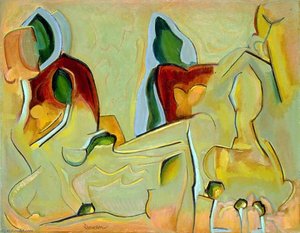
The historical significance of Manierre Dawson lies in his role as a precursor to the modern era. He was an artist who looked into the void of the unknown and saw not emptiness, but a new way of seeing. His work often bridged the gap between the tangible world and a more symbolic, dreamlike reality. In pieces like his 1920 Untitled composition, he utilized vibrant colors and enigmatic arrangements to invite viewers into a space of deep contemplation and mystery.
Though much of his later life was spent in Michigan, far from the urban epicenter of Chicago, his impact on the trajectory of American modernism remains indelible. He stood as a bridge between the nineteenth-century traditions of landscape and portraiture and the twentieth-century explosion of non-objective art. To study Dawson is to witness the moment when the American eye first began to look past the surface of things, seeking instead the underlying rhythms, structures, and truths that define our existence.
manierre dawson
1887 - 1969
基本情報
- Artistic Movement Or Style: Abstract Art
- Artists Or Movements Influenced By This Artist:
- Wassily Kandinsky
- Marcel Duchamp
- Artists Who Influenced This Artist:
- James Abbott McNeil Whistler
- Arthur Wesley Dow
- Date Of Birth: December 22, 1887
- Date Of Death: August 15, 1969
- Full Name: Manierre Dawson
- Nationality: American
- Notable Artworks:
- At Bath
- Untitled
- Blue Complex
- Place Of Birth: Chicago, Illinois