

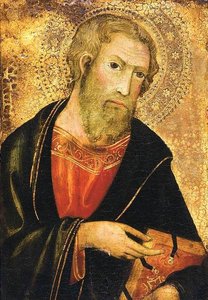
![Saint Peter, With Saint James Major [left Panel] — Martino Di Bartolomeo](/media/artworks/images-full/a8/bf/a8bf8a5306bd7d4e47cb8ced34b8d829.jpg)
 プレビュー
プレビュー
 シェアする
シェアする シェアする
シェアする
 詳細を見る
詳細を見る

 ダウンロード
 似ている作品
 X線調査
X線調査 スライドショー
 Stats
StatsSaint Peter, with Saint James Major [left panel]
 Early Renaissance
 1420
1420 102.0 x 45.0 cm
 詳細を見る
詳細を見る
手描き油彩複製画
当社のアーティストが、お客様のご希望のサイズと額縁に合わせて、キャンバスに手描きで制作する油彩画です。 ( Switch to Print Switch to Digital Image)




P118B $10

P118H $10

P118W $10

P438Z $10

P508JH $12

P508YH $12

P805H $10

P805Z $10

P919BZ $10

P919G $10

P919XJ $10

P959ZH $10

P968JZ $12

W106C $8

W218G $10

W218JH $8

W218Y $10

W307PJ $10

W316G $10

W316PJ $8

W316Y $10

W398PJ $8

W4111J $10

W500HY $15

W500JH $15

W692G $12

W849H $8

W940BG $15

W953PJ $8




作品のオリジナル比率に合わせた、当店の規定サイズからお選びください。

特定のフレームやスペースに合わせて、ご希望のサイズをご入力いただけます。選択されたサイズが元の画像の比率と異なる場合、アートワークをトリミングするか、手描きで要素を追加して絵画を拡張いたします。デジタルモックアップ を制作し、制作開始前にご確認(承認)をいただきます。
画面上のプレビューは、実際のトリミングや拡張を正確に反映しているものではありません。最終的な構図は、モックアップによってのみ正確にご確認いただけます。
カスタムサイズもご利用いただけますが、元の比率を維持するためには、あらかじめ用意されたリストからサイズを選択することをお勧めいたします。
ご注文後、ArtsDot.com チームより詳細な指示をお送りするとともに、仕上がりイメージ(モックアップ)をご提供いたします。


 ガラスオプションは、110cm未満のサイズでのみご利用いただけます。

Saint Peter, with Saint James Major [left panel]
複製技法
複製画のサイズ
-


合計金額
$ 263
関連作品

アーティストの略歴
The Bridge Between Eras: The Life and Legacy of Martino Di Bartolomeo
In the transformative twilight of the Trecento and the luminous dawn of the Quattrocento, few artists embodied the profound cultural metamorphosis of the Italian peninsula as gracefully as Martino di Bartolomeo. Often revered by historians as the last great master of the Sienese Trecento, Martino served as a vital aesthetic bridge, connecting the decorative, rhythmic elegance of the medieval tradition with the burgeoning humanism and spatial depth of the early Renaissance. His brush did not merely apply pigment to panel; it captured the very essence of an era caught between the spiritual intensity of a storied past and the perspectival promise of a new, more structured future.
The foundations of Martino’s artistry were laid within the prestigious workshops of his homeland, Siena. While the precise details of his earliest years remain shrouded in the soft mists of historical uncertainty, scholars widely believe he received his formative training under the tutored guidance of Taddeo di Bartolo. From this master, Martino inherited a meticulous devotion to detail and an extraordinary ability to imbue sacred subjects with a palpable, expressive dynamism. This early immersion into the visual language of spiritual intensity provided him with a technical rigor that would define his later, more complex compositions.
A Journey Through the Tuscan Landscape
Martino’s career was marked by a remarkable geographical and stylistic fluidity, as he moved beyond the walls of Siena to engage with a broader Mediterranean aesthetic. As a young man, his presence was felt in Pisa, where he collaborated with artists such as Giovanni di Pietro da Napoli. This period of exploration allowed him to absorb the burgeoning influences of Florentine painting, particularly the more structured and spatial approaches that were beginning to redefine the Tuscan landscape. His ability to synthesize the lyrical grace of Sienese tradition with these newer, more anatomical and perspectival elements made his work uniquely compelling.
His versatility was perhaps his greatest strength, allowing him to command various mediums with equal mastery. His reach extended from the delicate, intimate world of manuscript illumination—notably seen in his hand within the choirbooks commissioned for the cathedral of Lucca—to the monumental scale of fresco cycles. The frescoes in the church of San Giovanni Battista di Cascina, bearing his signature and the date 1398, stand as enduring testaments to his burgeoning talent and his capacity to lead large-scale narratives with both grace and authority.
Mastery of Form and Sacred Narrative
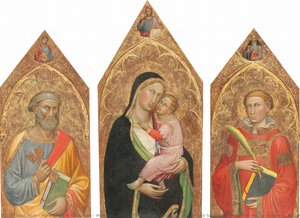
The works of Martino di Bartolomeo are characterized by a profound emotional depth and a sophisticated use of color. Whether working in tempera on panel or executing complex polychromy for sculptures, he possessed an uncanny ability to breathe life into the divine. His altarpieces, such as the magnificent triptych featuring the Madonna and Child with the Blessing Christ alongside Saints Peter and James Major, showcase a masterful command of composition. In these works, the figures are not merely icons but are imbued with a human presence that invites the viewer into a state of contemplation.
His significance in the history of art is cemented by his role as an official artist of Siena, contributing to the most prestigious civic and religious sites, including the Duomo and the Palazzo Pubblico. His legacy is defined by several key artistic contributions:
- Stylistic Synthesis: The seamless integration of medieval decorative elegance with early Renaissance humanism.
- Technical Versatility: Mastery across diverse media, including fresco, tempera panel painting, manuscript illumination, and sculptural polychromy.
- Cultural Impact: Acting as a pivotal figure in the transition of the Sienese School during one of the most significant shifts in Western art history.
Ultimately, Martino di Bartolomeo remains an artist of profound importance—a painter who stood at the crossroads of history, capturing the movement of a soul and a civilization transitioning from the shadows of the Middle Ages into the light of the Renaissance.
関連記事
Discover the Divine: Inspiring Saint Anthony Artworks to Elevate Your Home Decor
Transform your home with the profound beauty of Saint Anthony artworks. Explore exquisite Baroque reproductions by Murillo and Zurbarán, hand-painted on 100% cotton canvas to bring divine serenity and timeless elegance to your interior design.
Illuminating Surfaces: A Comprehensive Exploration of Tempera on Panel Painting Techniques & Historical Significance
Explore the rich history & techniques of tempera painting! Discover Renaissance masters like Botticelli & Fra Angelico, conservation insights, and the enduring legacy of this captivating art form. Learn more now!
Illuminating History: A Comprehensive Exploration of Tempera Painting Techniques & Artistic Legacy
Explore the rich history & techniques of tempera painting! Discover Renaissance masters like Botticelli & Fra Angelico, conservation insights, and the enduring legacy of this captivating art form.

ジョット・ディ・ボンドーネ:至高の25選 - ルネサンスの夜明けを彩る傑作たち | ArtsDot
ジョット・ディ・ボンドーネの至高の25選。ルネサンス美術を牽引した巨匠の傑作と、その感動的な物語を紐解きます。高品質な絵画複製やインテリアアートで、名画の世界をあなたの空間に。ArtsDot.com でコレクションをご覧ください。
ヴェネツィア・ビエンナーレ厳選25作品:芸術と歴史が織りなす至高のコレクション | ArtsDot
ヴェネツィア・ビエンナーレの至宝25選。印象派から現代アートまで、名画の背景にある物語と芸術家の情熱を紐解きます。ArtsDotで、キャンバスアートや油絵複製をお楽しみください。今すぐコレクションをご覧ください。