 プレビュー
プレビュー
 シェアする
シェアする シェアする
シェアする
 詳細を見る
詳細を見る

 ダウンロード
 似ている作品
 X線調査
X線調査 スライドショー
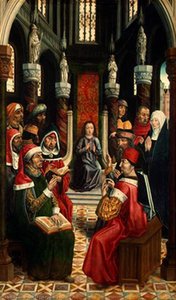
イエスと医師たち
 パネルに油彩
- Spanish Renaissance
 1495
1495 136.0 x 93.0 cm
 ナショナル・ギャラリー・オブ・アート
 詳細を見る
詳細を見る
ジークレー/アートプリント
迅速な制作と多彩な仕上げオプションを備えた、ミュージアムクオリティのジークレーまたはキャンバスプリント。 ( 手描きの絵画を購入 画像を購入)




P118B $10

P118H $10

P118W $10

P438Z $10

P508JH $12

P508YH $12

P805H $10

P805Z $10

P919BZ $10

P919G $10

P919XJ $10

P959ZH $10

P968JZ $12

W106C $8

W218G $10

W218JH $8

W218Y $10

W307PJ $10

W316G $10

W316PJ $8

W316Y $10

W398PJ $8

W4111J $10

W500HY $15

W500JH $15

W692G $12

W849H $8

W940BG $15

W953PJ $8




作品のオリジナル比率に合わせた、当店の規定サイズからお選びください。

特定のフレームやスペースに合わせて、ご自身でサイズを指定することも可能です。選択されたサイズが元の画像の比率と一致しない場合、作品をトリミングするか、鏡面反射または単色での塗りつぶしによって画像を拡張いたします。制作を開始する前に、ご確認用のデジタルモックアップをお送りいたします。
画面上のプレビューには、実際のトリミングや拡張は反映されませんのでご注意ください。最終的な構図を正確に確認できるのは、モックアップのみとなります。
カスタムサイズも承っておりますが、元の比率を維持するためには、あらかじめ用意されたリストからサイズを選択することをお勧めいたします。


 ガラスオプションは、110cm未満のサイズでのみご利用いただけます。

イエスと医師たち
ジークレー/アートプリント
複製画のサイズ
-


合計金額
$ 62
作品詳細説明
A Masterpiece of Faith and Patronage: Exploring Christ Among the Doctors
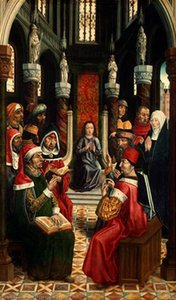
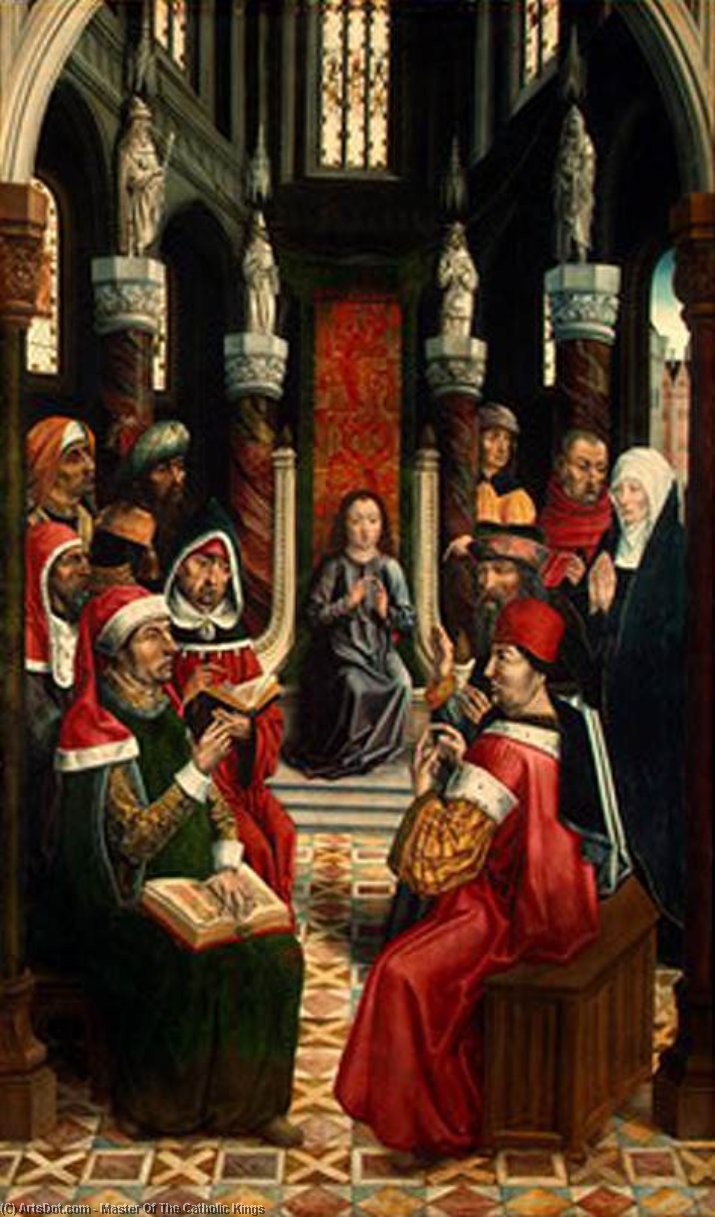
The painting “Christ Among the Doctors,” attributed to Master Of The Catholic Kings, stands as a testament to the artistic fervor of Spain’s Golden Age—specifically, 1495-1497. Commissioned by Ferdinand II of Aragon and Isabella I of Castile, rulers who championed Catholicism with unwavering conviction, this monumental oil on panel transcends mere visual representation; it embodies the spiritual aspirations of an era defined by religious piety and royal ambition.
Composition and Symbolism: At its core lies a dramatic depiction of Jesus Christ surrounded by a cohort of scholars—the “doctors”—engaged in animated debate. Set within an interior space reminiscent of a church or scholarly gathering, the artist skillfully employs light and shadow to sculpt depth and dimensionality, creating a palpable sense of realism. The positioning of Jesus at the center, elevated on a dais, underscores his authority and wisdom, while the doctors’ gestures convey intellectual engagement and earnest inquiry. Beyond this central tableau, subtle architectural details—stained glass windows bearing heraldic emblems—further enrich the scene's narrative context.
Artistic Style and Influences: Master Of The Catholic Kings’ style reflects the prevailing artistic currents of northern Castile during the reign of the Catholic Monarchs. Drawing inspiration from Gothic traditions, notably pointed arches and ribbed vaults, he achieves a grandeur that speaks to the majesty of God and the prestige of royal patronage. However, unlike purely Gothic art, this painting incorporates elements characteristic of Florentine Renaissance ideals—particularly in its humanist perspective—demonstrating the artist’s willingness to synthesize disparate stylistic influences.
Historical Context: The creation of “Christ Among the Doctors” coincided with a pivotal moment in Spanish history: the marriage alliance between Ferdinand II and Isabella I and Maximilian I of the Holy Roman Empire. This union symbolized Christendom's unity and reaffirmed the monarchs’ commitment to upholding Catholic dogma. Consequently, the painting served as a visual proclamation of royal piety and diplomatic success—a reflection of the broader cultural landscape of the time.
Provenance and Reproduction: Originally housed at the National Gallery of Art in Washington, D.C., “Christ Among the Doctors” has captivated audiences for centuries with its intricate detail and profound symbolism. Today, art enthusiasts can experience this iconic artwork through high-quality reproductions offered by ArtsDot.com, allowing them to appreciate the enduring beauty of a masterpiece from Spain’s Golden Age.
Further Exploration: To delve deeper into the artistic style and influences that shaped Master Of The Catholic Kings' oeuvre, visit /art/list/?Filter=8XZLWT-Master-Of-The-Catholic-Kings-Christ-among-the-Doctors. Discover more about the Nationality Rooms and their significance in art and culture on Wikipedia: https://en.wikipedia.org/wiki/Nationality_Rooms.
Related Artwork: Explore another remarkable painting by Master Of The Catholic Kings at https://ArtsDot.com,/media/artworks/images/thumbnails/c9/44/c944d7e8fab84c85959539fcbe3044ce.Jpg – “The Marriage at Cana”.
関連作品
アーティストの略歴
A Shadow in the Golden Age
The identity of the Master of the Catholic Kings remains one of the most captivating enigmas in the annals of Spanish art history. Operating during the twilight of the 15th century, specifically between approximately 1485 and 1500, this painter existed more as a stylistic force than a documented individual. While his birthdate and death remain lost to time, his presence is felt through the monumental scale of his contributions to Spain’s Golden Age. He earned his moniker from his profound connection to the most powerful figures of his era: Queen Isabella I of Castile and King Ferdinand II of Aragon. Through his brush, the political ambitions of the Catholic Monarchs were transformed into sacred visual narratives, weaving together the divine right of kings with the fervent piety of a unifying nation.
To study his work is to witness a pivotal moment in European art, where the medieval world began to yield to the burgeoning light of the Renaissance. His oeuvre is characterized by a remarkable ability to bridge disparate worlds, blending the meticulous, almost tactile realism of the Flemish masters with the emerging structural ideals of the Italian Renaissance. This synthesis created a unique aesthetic—a style that felt both intimately human and cosmically significant, capturing the spiritual gravity required for the great altarpieces of the period.
The Art of the Retablo: Faith and Majesty
At the heart of this artist's legacy lies the retablo, the grand, multi-paneled altarpieces that served as the spiritual and visual focal points of Spanish churches. These were not merely decorations but complex theological instruments designed to instruct the faithful and glorify the crown. The Master’s mastery of this format allowed him to execute sprawling, dramatic compositions that commanded the attention of all who entered a cathedral. His work on the Retablo of the Reyes Católicos stands as a testament to his ability to handle large-scale narratives with both technical precision and emotional depth.
His technique often utilized oil and tempera on panel, a medium that permitted an extraordinary level of detail. One can observe the delicate interplay of light upon heavy drapery, the luminous quality of skin tones, and the intricate textures of royal garments. In masterpieces such as Christ Among the Doctors, commissioned between 1495 and 1497, the artist demonstrates a profound command over composition, using the arrangement of figures to guide the viewer’s eye through a landscape of religious devotion. His ability to imbue sacred scenes with a sense of courtly dignity helped establish a visual language for the Spanish monarchy that would influence generations of painters.
Legacy and Artistic Influence
Though his personal biography is fragmentary, the stylistic footprint of the Master of the Catholic Kings is indelible. He was a pioneer of what historians often identify as the Hispano-Flemish style, a movement that defined the visual identity of Spain during its most transformative century. By integrating the Northern European obsession with naturalism—seen in the expressive folds of fabric and meticulous botanical details—with the burgeoning Renaissance interest in volume and space, he helped create an art form that was uniquely Spanish.
The significance of his work extends far beyond the altarpieces themselves. He contributed to a cultural era where art served as the primary medium for political legitimacy and religious unification. His influence can be traced through the evolution of Spanish painting, paving the way for later masters who would further refine the balance between realism and spiritual symbolism. Today, his surviving works, housed in prestigious institutions like the Museo del Prado, continue to serve as windows into a vanished world—a time when the stroke of a brush could help forge the very soul of a kingdom.
基本情報
- Artistic Movement Or Style: Spanish Renaissance
- Nationality: Spanish
- Notable Artworks:
- The Marriage at Cana
- Christ among the Doctors
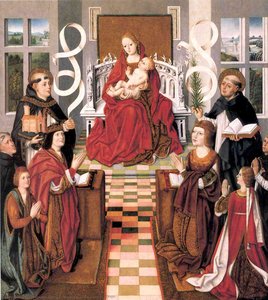
- The Virgin of the Catholic Monarchs
- Place Of Birth: Spain
関連記事
High Medieval Art: 10 Masterpieces That Shaped an Era | ArtsDot
Journey through High Medieval Art! Explore 10 iconic masterpieces – from Giotto's frescoes to stunning Gothic cathedrals. Discover the stories behind these timeless paintings, sculptures & illuminated manuscripts. Find museum-quality art reproductions at ArtsDot.com.
The Golden Age Reforged: Dramatic Realism & Religious Zeal in Spanish Baroque Art
Explore the dramatic world of Spanish Baroque art! Discover masters like Zurbarán & the powerful influence of religious zeal on painting techniques – a guide for collectors and enthusiasts.
Sacred Narratives Embodied: A Comprehensive Exploration of Religious Iconography in Art History
Explore the rich history of religious iconography in art! Discover symbolism, movements & masterpieces from Byzantine to Renaissance periods. Expert insights for collectors and enthusiasts at ArtsDot.
Late Medieval Masterpieces: 10 Artworks That Defined an Era | ArtsDot
Journey through 10 defining Late Medieval masterpieces – from Giotto's frescoes to Jan van Eyck’s realism. Explore the stories, techniques & vibrant colors of Gothic art. Find museum-quality reproductions and elevate your home decor with ArtsDot.com! Discover all masterpieces on ArtsDot.com
Sacred Narratives on Canvas: Exploring Religious Painting Through History
Explore the rich history of religious painting with ArtsDot.com! Discover iconic artworks, symbolism & techniques from antiquity to the Renaissance. Enhance your art appreciation today.