

 プレビュー
プレビュー
 シェアする
シェアする シェアする
シェアする
 詳細を見る
詳細を見る

 ダウンロード
 似ている作品
 X線調査
X線調査 スライドショー
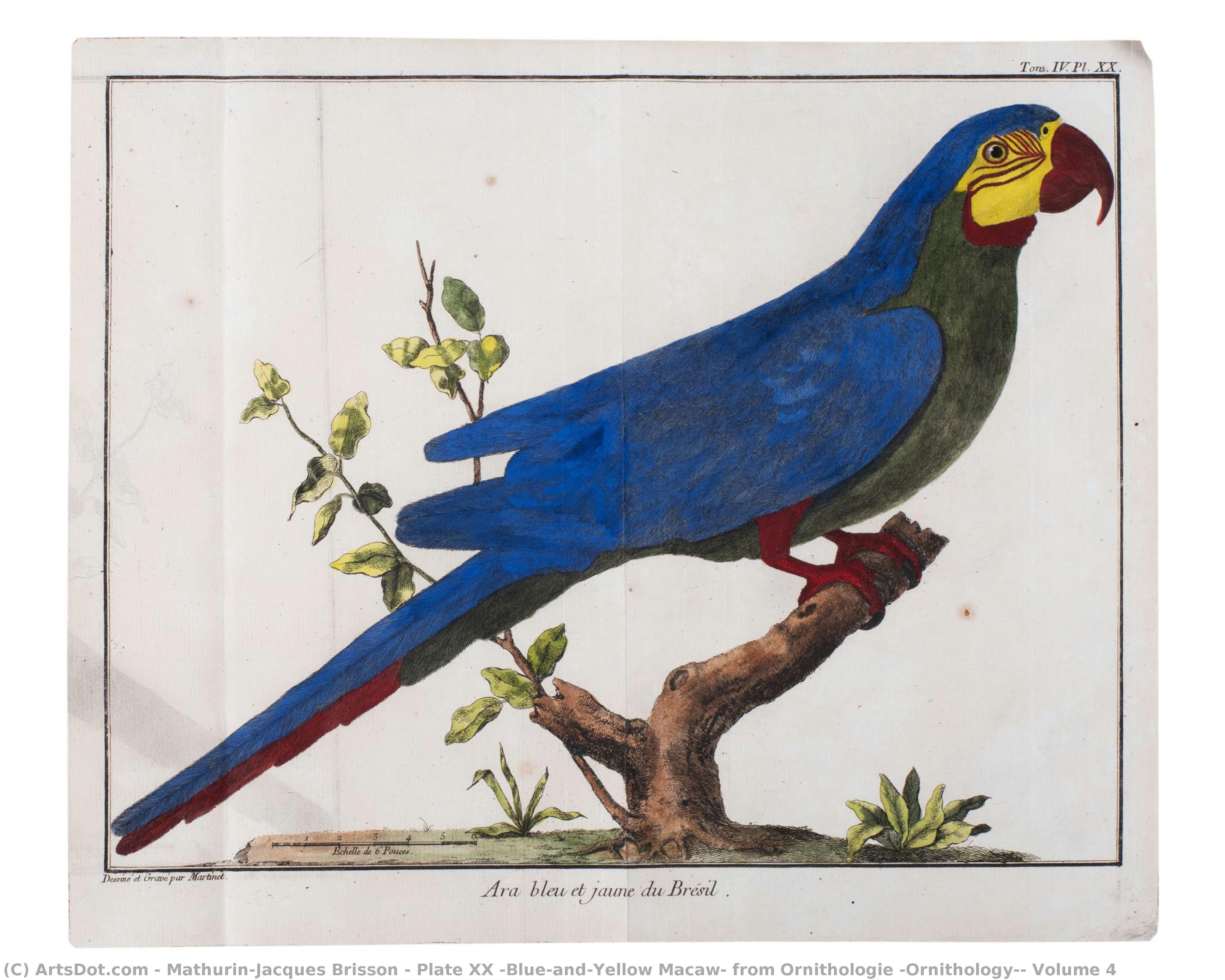
Plate XX (Blue-and-Yellow Macaw) from Ornithologie (Ornithology), Volume 4
 Acrylic
- WallArt
- Rococo
 1760
1760 25.0 x 19.0 cm
 Toledo Museum of Art
 詳細を見る
詳細を見る
ジークレー/アートプリント
迅速な制作と多彩な仕上げオプションを備えた、ミュージアムクオリティのジークレーまたはキャンバスプリント。 ( 手描きの絵画を購入 画像を購入)




P118B $10

P118H $10

P118W $10

P438Z $10

P508JH $12

P508YH $12

P805H $10

P805Z $10

P919BZ $10

P919G $10

P919XJ $10

P959ZH $10

P968JZ $12

W106C $8

W218G $10

W218JH $8

W218Y $10

W307PJ $10

W316G $10

W316PJ $8

W316Y $10

W398PJ $8

W4111J $10

W500HY $15

W500JH $15

W692G $12

W849H $8

W940BG $15

W953PJ $8




作品のオリジナル比率に合わせた、当店の規定サイズからお選びください。

特定のフレームやスペースに合わせて、ご自身でサイズを指定することも可能です。選択されたサイズが元の画像の比率と一致しない場合、作品をトリミングするか、鏡面反射または単色での塗りつぶしによって画像を拡張いたします。制作を開始する前に、ご確認用のデジタルモックアップをお送りいたします。
画面上のプレビューには、実際のトリミングや拡張は反映されませんのでご注意ください。最終的な構図を正確に確認できるのは、モックアップのみとなります。
カスタムサイズも承っておりますが、元の比率を維持するためには、あらかじめ用意されたリストからサイズを選択することをお勧めいたします。


 ガラスオプションは、110cm未満のサイズでのみご利用いただけます。

Plate XX (Blue-and-Yellow Macaw) from Ornithologie (Ornithology), Volume 4
ジークレー/アートプリント
複製画のサイズ
-


合計金額
$ 62
A Window into Enlightenment Ornithology: Mathurin Jacques Brisson’s Plate XX
Mathurin Jacques Brisson's “Plate XX” from his monumental ornithological work, *Ornithologie*, Volume 4 represents more than just a depiction of a vibrant blue-and-yellow macaw; it embodies the spirit of scientific inquiry and artistic innovation that characterized the Enlightenment era. Executed in 1760, this meticulously crafted watercolor illustration stands as a testament to Brisson’s pioneering efforts in zoological classification and his unwavering commitment to capturing the beauty of the natural world with unprecedented accuracy.
The Artist's Vision: Ferchault de Réaumur’s Influence
Brisson’s artistic journey began under the mentorship of René Antoine Ferchault de Réaumur, a wealthy naturalist who recognized Brisson’s talent and fostered his burgeoning passion for scientific observation. Their collaboration established a cornerstone of French natural history illustration, prioritizing detailed anatomical studies alongside aesthetically pleasing compositions. Réaumur championed a humanist approach to science—one that sought not only to understand the workings of nature but also to elevate its grandeur before the eyes of educated observers.
Technique and Detail: Watercolor Precision
The artwork’s remarkable realism stems from Brisson's masterful application of watercolor technique. Layers of translucent washes build up to create a luminous surface that captures the iridescent sheen of the macaw’s feathers—a feat achieved through careful blending and precise color mixing. The artist’s meticulous attention to detail extends beyond the bird itself, encompassing subtle nuances in the texture of the tree branch and the scattered leaves, contributing to an immersive portrayal of its habitat.
Symbolism Within Observation: Representing Biodiversity
Beyond mere visual representation, “Plate XX” carries symbolic weight. As a product of the Enlightenment’s fascination with taxonomy—the systematic categorization of organisms—it reflects the burgeoning scientific understanding of biodiversity and interconnectedness. The macaw, native to Central America and South America, served as an emblem of exotic beauty and intellectual curiosity during Brisson's time, symbolizing the expanding horizons of knowledge.
Emotional Resonance: Capturing Nature’s Majesty
Ultimately, Brisson’s “Plate XX” transcends its technical merits to evoke a profound emotional response. The painting’s serene composition—coupled with the vibrant colors and exquisite detail—captures the majesty of the natural world, inviting viewers to contemplate the wonders of ornithology and appreciating the transformative power of artistic observation.
関連作品

アーティストの略歴
The Visionary of the Natural World: The Life of Mathurin Jacques Brisson
In the heart of the Enlightenment, a period defined by an insatiable hunger for knowledge and the systematic categorization of the universe, Mathurin Jacques Brisson emerged as a luminous figure. Born on April 30, 1723, in the tranquil French town of Fontenay-le-Comte, Brisson’s early years were marked by a tension between tradition and discovery. Though his path was initially directed toward the solemnity of ecclesiastical studies, the call of the natural world proved far more compelling. In 1747, he made the courageous decision to abandon the clergy, choosing instead to dedicate his intellect to the boundless complexities of life itself. This pivot from the spiritual to the empirical would eventually lead him to become one of the most significant contributors to zoological science and scientific illustration in history.
The trajectory of Brisson’s career was irrevocably altered through his profound association with René Antoine Ferchault de Réaumur. Joining the service of this esteemed French naturalist in 1749, Brisson found himself immersed in an environment of unparalleled scientific rigor. Under Réaumur’s mentorship, he gained access to a vast and diverse collection of specimens, which served as both his laboratory and his inspiration. This period of apprenticeship instilled in him a deep reverence for anatomical precision and the necessity of direct observation. It was here that Brisson began to refine the meticulous eye that would later define his artistic and scientific legacy, learning to see beyond mere surface beauty to the structural truths of the animal kingdom.
A Masterpiece of Empirical Artistry
The pinnacle of Brisson’s life work arrived in 1760 with the publication of his monumental six-volume treatise, Ornithologie. This work was not merely a book of descriptions; it was a revolutionary manifesto of scientific accuracy. At a time when many naturalists relied on secondhand accounts or dried, unrecognizable specimens, Brisson pioneered a methodology rooted in direct engagement. He insisted upon personally examining each bird before committing its likeness and characteristics to paper. This commitment to empirical truth transformed the nature of ornithological documentation, bridging the gap between fine art and rigorous science.
The illustrations within Ornithologie remain some of the most breathtaking examples of natural history art ever produced. Each plate serves as a window into a vibrant, living world, characterized by:
- Exquisite Detail: A profound focus on the texture of plumage, the curvature of beaks, and the delicate structure of talons.
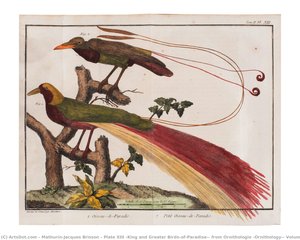
- Vibrant Coloration: The use of pigments that capture the iridescent sheen of tropical species, such as the majestic King and Greater Birds-of-Paradise.
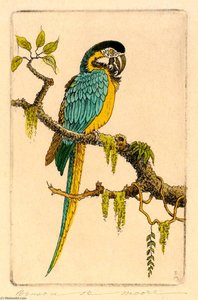
- Anatomical Integrity: A seamless blend where aesthetic beauty serves the purpose of scientific identification, seen clearly in works like his stunning depiction of the Blue-and-Yellow Macaw.
Legacy and Historical Significance
Beyond the visual splendor of his plates, Brisson’s contribution to the foundation of modern taxonomy cannot be overstated. His systematic approach to classifying animals provided a crucial framework that influenced subsequent generations of naturalists, including the likes of Carl Linnaeus. By emphasizing the importance of observable physical traits and detailed anatomical study, he helped move biology away from folklore and toward a disciplined, evidence-based science.
Mathurin Jacques Brisson passed away in 1806, leaving behind a legacy that continues to resonate in both the halls of scientific institutions and the galleries of art historians. His work remains a testament to the era's belief that through careful observation and artistic dedication, the mysteries of the natural world could be brought into the light of human understanding. Today, his illustrations are cherished not only as historical documents but as timeless masterpieces of scientific illustration, capturing the fleeting elegance of nature with an enduring, soulful precision.
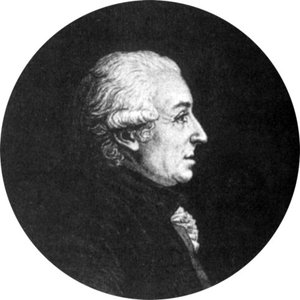
mathurin-jacques brisson
1723 - 1806 , France
基本情報
- Artistic Movement Or Style: Naturalism
- Artists Or Movements Influenced By This Artist: ['']
- Artists Who Influenced This Artist:
- Carl Linnaeus
- Jacob Theodor Klein
- Date Of Birth: April 30, 1723
- Date Of Death: June 23, 1806
- Full Name: Mathurin Jacques Brisson
- Nationality: French
- Notable Artworks: ['Plate XX (Blue-and-Yellow Macaw) from Ornithologie']
- Place Of Birth: Fontenay-le-Comte, France
関連記事

Slate Blue Masterpieces: 10 Iconic Paintings & Timeless Home Decor Ideas
Immerse yourself in the captivating world of slate blue! Explore 10 iconic paintings by Monet, Van Gogh & Renoir. Discover their stories, techniques & find museum-quality art reproductions for your home at .

Giclée Prints: Archival Quality & Aesthetic Nuances for the Discerning Collector
Explore the world of giclée prints with ArtsDot. Learn about archival quality, aesthetic nuances & investment potential. Expert guidance for discerning art collectors seeking museum-quality reproductions and lasting value.
The Allure of Azure: Exploring the Symbolic & Aesthetic Depths of Blue in Art History
Explore the rich history of blue in art! Discover its symbolism, from ancient pigments to modern masterpieces by Kandinsky & Seurat. Uncover the psychological impact and cultural meanings behind this captivating hue.

The Enduring Legacy of Fine Art Prints: Technique, History & Aesthetic Impact
Explore the rich history & techniques of fine art prints. Discover investment potential, assess authenticity, and learn how to preserve your collection with expert guidance. Trusted insights for discerning collectors.

Echoes of Time: Exploring the Enduring Appeal & Historical Context of Vintage Art Prints
Explore the captivating world of vintage art prints! Discover their history, collecting tips & enduring appeal. Expert insights on chromolithography and building a legacy collection with ArtsDot.

