

 シェアする
シェアする シェアする
シェアする
 詳細を見る
詳細を見る

 ダウンロード
 似ている作品
 スライドショー
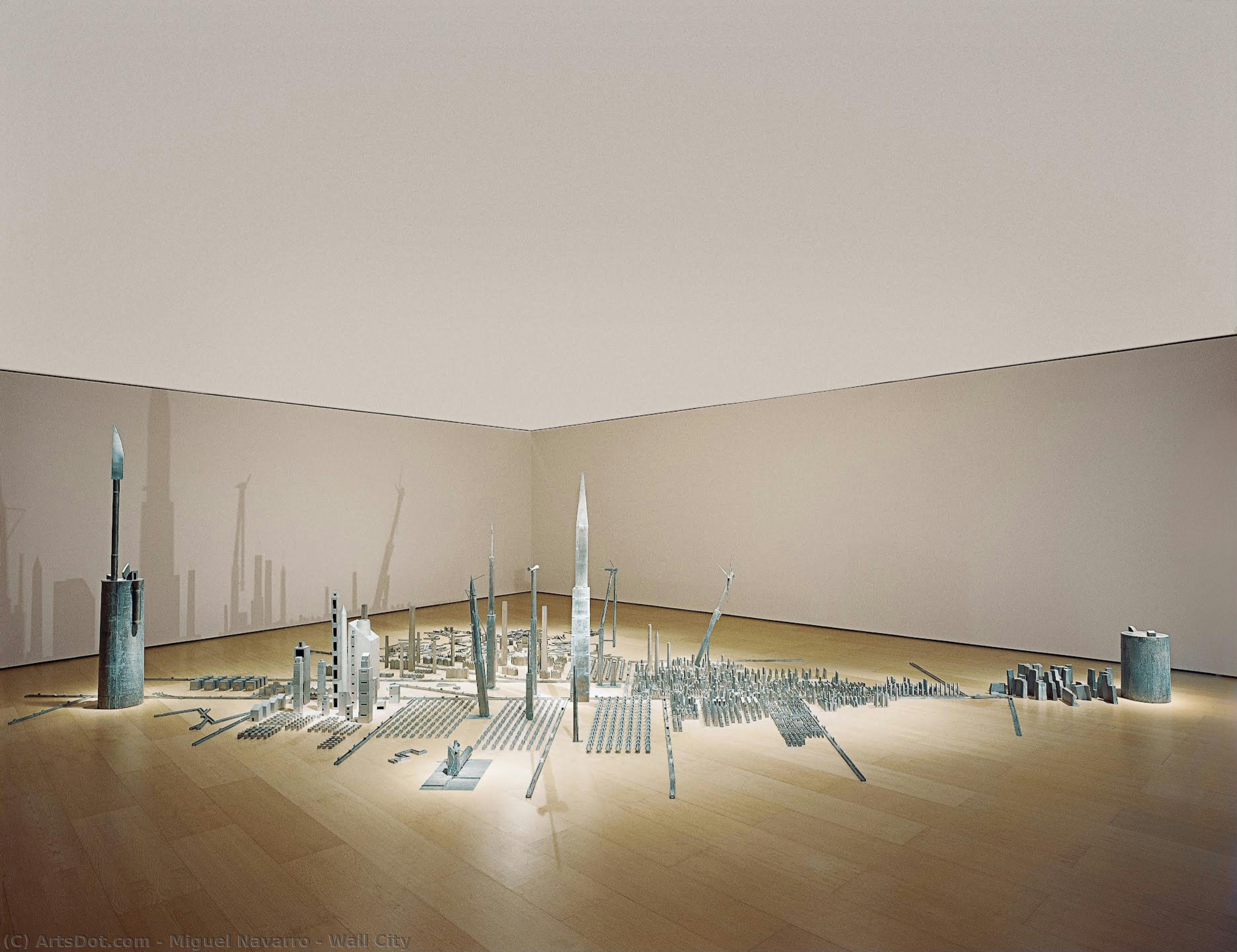
Wall City
 Installation Art
- Installation
- Minimalist Architectural Forms
 2000
2000- Modern
 450.0 x 300.0 cm
 グッゲンハイム美術館ビルバオ
 詳細を見る
詳細を見る
ジークレー/アートプリント
迅速な制作と多彩な仕上げオプションを備えた、ミュージアムクオリティのジークレーまたはキャンバスプリント。 ( 手描きの絵画を購入 画像を購入)




































作品のオリジナル比率に合わせた、当店の規定サイズからお選びください。

特定のフレームやスペースに合わせて、ご自身でサイズを指定することも可能です。選択されたサイズが元の画像の比率と一致しない場合、作品をトリミングするか、鏡面反射または単色での塗りつぶしによって画像を拡張いたします。制作を開始する前に、ご確認用のデジタルモックアップをお送りいたします。
画面上のプレビューには、実際のトリミングや拡張は反映されませんのでご注意ください。最終的な構図を正確に確認できるのは、モックアップのみとなります。
カスタムサイズも承っておりますが、元の比率を維持するためには、あらかじめ用意されたリストからサイズを選択することをお勧めいたします。


 ガラスオプションは、110cm未満のサイズでのみご利用いただけます。

Wall City
ジークレー/アートプリント
複製画のサイズ
-


合計金額
$ 62
Miguel Navarro’s “Wall City”: A Monument to Urban Anonymity
In the year 2000, Miguel Navarro presented "Wall City" (Ciudad muralla) at the Fondazione Giorgio Cini in Venice, a monumental installation that continues to resonate with its stark beauty and unsettling implications. This sprawling cityscape, initially conceived as a collection of approximately 1,000 zinc elements and subsequently expanded to over 4,000, stands as a powerful meditation on urban existence – a place where the individual dissolves into the vastness of the constructed environment. Measuring up to 500 square meters in scale, with towers reaching an imposing 4.5 meters, "Wall City" demands attention and invites contemplation about the nature of modern society.
- A Genesis in Venice: The work’s creation coincided with the seventh International Architecture Exhibition, highlighting Navarro's engagement with contemporary architectural discourse.
- Scale and Presence: Its substantial size – capable of occupying a space up to 500 square meters – immediately establishes "Wall City" as an immersive experience, forcing viewers to confront its scale directly.
Form and Materiality: Geometry and Reflection
"Wall City" is fundamentally defined by its geometric precision. Navarro meticulously assembled hundreds of rectangular and cylindrical elements from zinc (or a similar metallic material), creating a rigorously ordered cityscape. The sharp, angular lines and repetitive forms evoke the principles of minimalism while simultaneously generating a sense of controlled chaos – mirroring, perhaps, the complexities of urban life itself. The reflective surfaces of the metal contribute significantly to the artwork’s impact, capturing and distorting light in a way that adds depth and realism, almost as if the city were perpetually caught in a state of shimmering reflection.
- Zinc's Significance: The choice of zinc – valued for its durability and reflective qualities – is crucial to the artwork’s aesthetic and conceptual impact.
- Tactile Impression: The texture, described as metallic and reflective with subtle variations in surface finish, invites a tactile engagement, even through a photograph.
Symbolism and Interpretation
Beyond its formal qualities, "Wall City" is laden with symbolic weight. The absence of human figures within the vast cityscape amplifies this effect, transforming it into an imagined metropolis – deserted, anonymous, and perhaps even oppressive. The repetitive nature of the elements suggests a uniformity or lack of individuality characteristic of modern urban environments. Navarro’s work can be interpreted as a critique of societal structures, prompting questions about identity, connection, and the potential for isolation within densely populated areas. It's a powerful visual statement on the relationship between individuals and their surroundings.
Historical Context and Artistic Influences
Created in 2000, "Wall City" reflects Miguel Navarro’s broader artistic trajectory – one deeply rooted in postmodernism, minimalism, and avant-garde principles. Influenced by artists like Donald Judd and Sol LeWitt, Navarro's work shares a commitment to geometric abstraction and the exploration of spatial relationships. His earlier sculpture “fraternitat,” a prominent piece located in Barcelona’s Parc del Fòrum, further demonstrates his mastery of these techniques and his ability to create impactful public artworks. Navarro’s versatility – encompassing sculpture, painting, and poetry – underscores his commitment to pushing the boundaries of contemporary artistic expression.
関連作品

アーティストの略歴
The Versatile Vision of Miguel Navarro
Born on September 29, 1945, in the Spanish town of Mislata, Miguel Navarro stands as a profound figure in the landscape of contemporary Spanish art. His creative journey is not merely a career but a multi-faceted exploration of form, space, and language. As an artist who refuses to be confined by a single medium, Navarro has masterfully navigated the realms of sculpture, painting, and contemporary poetry. This rare versatility allows him to weave a complex narrative across different disciplines, creating a cohesive artistic universe that resonates with both the tactile weight of bronze and the ethereal rhythm of verse. His education at the prestigious San Carlos School of Fine Arts in Valencia provided the foundational rigor that would later allow him to experiment with the boundaries of modern aesthetics.
The evolution of Navarro’s practice is marked by a significant transition in the early 1970s. While he began his professional path in the 1960s as a painter, capturing the nuances of color and light on canvas, it was in 1972 that he made the pivotal decision to dedicate himself exclusively to the art of sculpture. This shift allowed him to engage more intimately with volume, mass, and the physical presence of objects in space. His stylistic language emerged from a sophisticated blend of postmodernism, minimalism, and avant-garde influences. By stripping away unnecessary ornamentation and focusing on the essential geometry of form, Navarro created works that speak to the quiet strength of minimalism while maintaining the intellectual complexity characteristic of postmodern thought.
A Legacy Carved in Stone and Memory
Navarro’s significance in the Spanish art scene is perhaps most poignantly felt through his ability to imbue physical structures with deep historical and social meaning. His work often serves as a bridge between the abstract and the commemorative. One of his most profound achievements is the sculpture Fraternitat, located in the Parc del Fòrum in Barcelona. This monumental piece acts as a solemn homage to the victims of the Camp de la Bota, those assassinated by nationalists during the Spanish Civil War. Through this work, Navarro transcends the purely aesthetic, using his sculptural mastery to ensure that collective memory is preserved within the public consciousness.
The prestige of his contributions is reflected in the esteemed institutions that house his creations. His art has been showcased in some of the world's most renowned galleries, including:
- The Guggenheim Museum in Bilbao, Spain, a testament to his standing in the global contemporary art dialogue.
- The Reina Sofía Museum in Madrid, placing him alongside the giants of modern and contemporary Spanish history.
- Museo de Arte de Orizaba in Veracruz, Mexico, demonstrating the international reach and enduring appeal of his sculptural vision.
Beyond the physical permanence of his sculptures, Navarro’s identity as a poet adds a layer of lyrical depth to his entire body of work. This intersection of the visual and the literary creates a holistic experience for the viewer, where the silence of a minimalist sculpture is echoed by the rhythmic cadence of his poetry. As a primary reference point for contemporary Valencian and Spanish art, Miguel Navarro continues to inspire, reminding us that true artistry lies in the ability to find harmony between the tangible world and the boundless reaches of human emotion.
miguel navarro
1945 - , Spain
基本情報
- Artistic Movement Or Style: Eclectic (Postmodernism, Minimalism)
- Artists Or Movements Influenced By This Artist: ['Postmodernism']
- Artists Who Influenced This Artist: ['Minimalism']
- Date Of Birth: September 29, 1945
- Full Name: Miguel Navarro
- Nationality: Spanish
- Notable Artworks:
- Fraternitat
- Wall City
- Place Of Birth: Mislata, Spain
関連記事

Bronze Sculptures That Defined Art History | ArtsDot
Journey through art history with our Top 10 bronze sculptures! Explore masterpieces by Rodin, Michelangelo & more. Discover stories behind iconic statues and find museum-quality reproductions for your home decor at ArtsDot.com.

The Enduring Form: Exploring Themes & Techniques in Sculpture Across Historical Periods
Explore the rich history of sculpture from ancient masterpieces to contemporary innovations. Discover key techniques, influential artists & investment potential for discerning art collectors.

Bronze Age to Modern Masters: 10 Sculptures That Redefined Art | ArtsDot
Journey through art history with 10 legendary bronze sculptures – from Michelangelo's David to Rodin’s Thinker. Explore the stories, techniques & timeless beauty of these masterpieces. Find museum-quality reproductions & elevate your home decor on ArtsDot.com.

The Enduring Form: Sculpture Across History, Technique & Emotional Resonance
Explore the rich history of sculpture with ArtsDot. Discover key techniques, influential artists & investment potential for discerning collectors. Expert insights into valuing and collecting timeless masterpieces.

抽象表現主義を定義する十大傑作:芸術と装飾の深遠な旅
抽象表現主義を定義する10の傑作。ポロック、ロスコら巨匠たちの情熱と色彩の世界へ。各作品に込められた物語と技法を紐解き、至高のアート体験を。ArtsDot.comで、ミュージアムクオリティの複製画や洗練されたインテリアアイデアを発見してください。