

 プレビュー
プレビュー
 プリントを購入
 シェアする
シェアする シェアする
シェアする
 詳細を見る
詳細を見る

 ダウンロード
 似ている作品
 X線調査
X線調査 スライドショー
The Geography Lesson or


 詳細を見る
詳細を見る




P118B $10

P118H $10

P118W $10

P438Z $10

P508JH $12

P508YH $12

P805H $10

P805Z $10

P919BZ $10

P919G $10

P919XJ $10

P959ZH $10

P968JZ $12

W106C $8

W218G $10

W218JH $8

W218Y $10

W307PJ $10

W316G $10

W316PJ $8

W316Y $10

W398PJ $8

W4111J $10

W500HY $15

W500JH $15

W692G $12

W849H $8

W940BG $15

W953PJ $8




作品のオリジナル比率に合わせた、当店の規定サイズからお選びください。

特定のフレームやスペースに合わせて、ご希望のサイズをご入力いただけます。選択されたサイズが元の画像の比率と異なる場合、アートワークをトリミングするか、手描きで要素を追加して絵画を拡張いたします。デジタルモックアップ を制作し、制作開始前にご確認(承認)をいただきます。
画面上のプレビューは、実際のトリミングや拡張を正確に反映しているものではありません。最終的な構図は、モックアップによってのみ正確にご確認いただけます。
カスタムサイズもご利用いただけますが、元の比率を維持するためには、あらかじめ用意されたリストからサイズを選択することをお勧めいたします。
ご注文後、ArtsDot.com チームより詳細な指示をお送りするとともに、仕上がりイメージ(モックアップ)をご提供いたします。


 ガラスオプションは、110cm未満のサイズでのみご利用いただけます。

The Geography Lesson or
複製技法
複製画のサイズ
-


合計金額
$ 263
作品解説
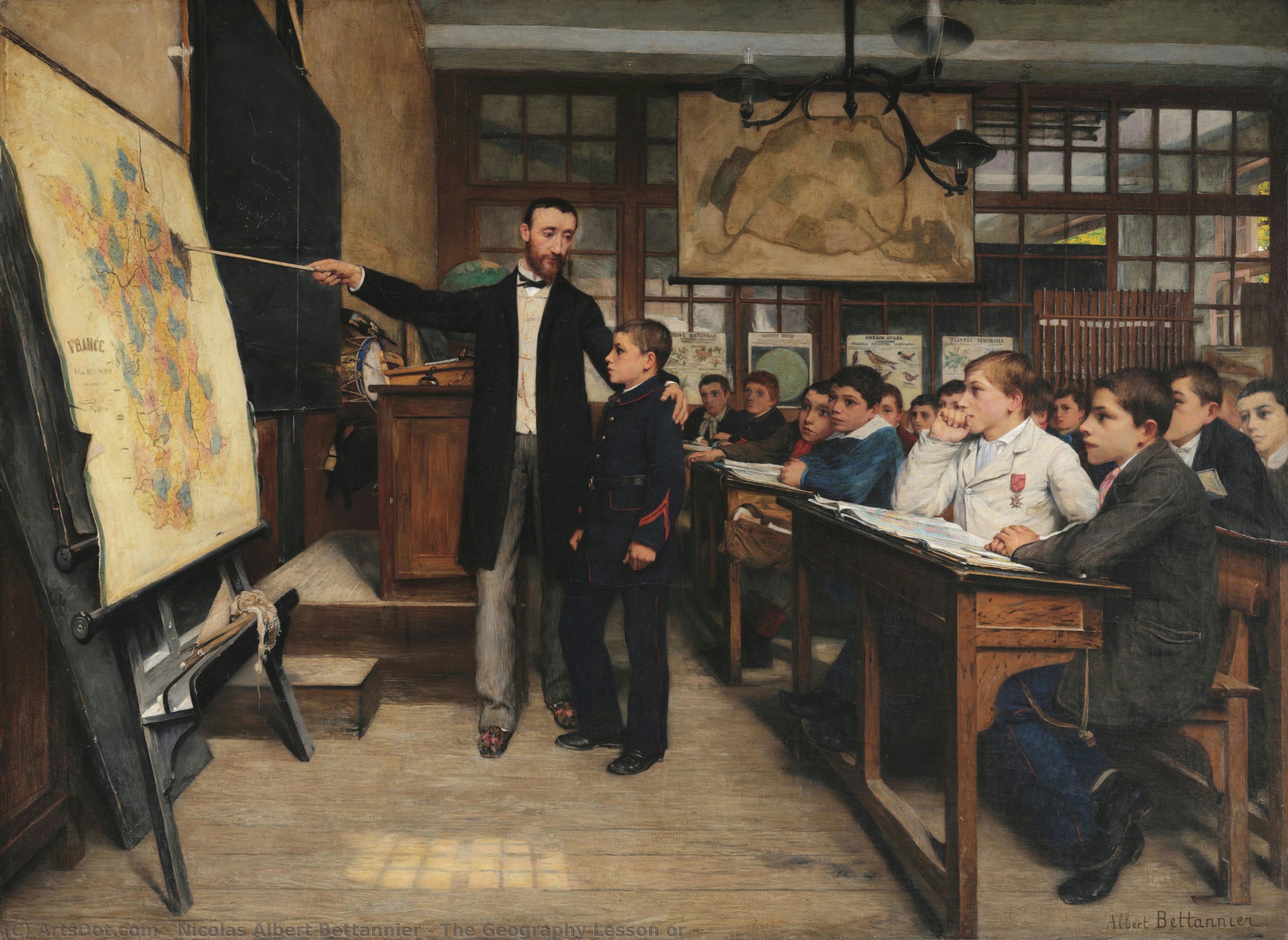
A Window into a Classroom: Bettannier's "The Geography Lesson"
Nicolas Albert Bettannier’s “The Geography Lesson,” painted in 1887, is more than just a depiction of a classroom scene; it’s a poignant reflection of a nation grappling with loss and identity. Born in Metz during the aftermath of the Franco-Prussian War, Bettannier's life was inextricably bound to the unresolved trauma of Alsace-Lorraine’s annexation. This historical context permeates every brushstroke, lending the painting an undeniable emotional weight.
- Subject Matter: The scene unfolds within a typical French classroom – a teacher instructing his students on geography.
- Composition: Bettannier masterfully employs a frontal perspective, placing the teacher at the center of attention, holding aloft a map that serves as both the focal point and the conduit for knowledge.
- Setting: The room itself is rendered with meticulous detail, capturing the everyday atmosphere of a late 19th-century educational space.
Style and Technique – A Post-Impressionist Vision
Bettannier’s style firmly resides within the Post-Impressionist movement, inheriting its emphasis on subjective perception and expressive color while forging his own distinct path. Unlike the purely optical concerns of Impressionism, Bettannier utilizes color not merely to capture light but to convey emotion and reinforce his thematic concerns. The palette is rich and earthy – browns, ochres, and muted greens – reflecting a sense of groundedness and perhaps even melancholy. His brushwork is characterized by visible strokes, adding texture and dynamism to the scene, particularly in the rendering of the students’ clothing and the map itself.
- Brushwork: Noticeable impasto creates a tactile quality, emphasizing the physicality of the painting.
- Color Palette: Earth tones dominate, contributing to the painting's somber mood.
- Perspective: A realistic yet subtly stylized perspective draws the viewer into the classroom space.
Historical Context and Symbolism – Echoes of Alsace-Lorraine
“The Geography Lesson” is deeply rooted in the historical context of its creation. The loss of Alsace-Lorraine fueled a persistent sense of national grievance within France, and Bettannier’s work reflects this sentiment. The map itself becomes a potent symbol—a representation of territory lost, a reminder of national humiliation, and perhaps even an unspoken plea for reunification. The attentive students represent the future generation, burdened with the legacy of their nation's past. The teacher embodies authority and the transmission of knowledge – a crucial role in shaping national identity.
It’s important to note that Bettannier’s artistic output was significantly shaped by his personal experiences and the prevailing political climate of the time, making this painting a powerful historical document as well as a work of art.Emotional Impact and Artistic Value
“The Geography Lesson” transcends a simple classroom scene; it evokes a profound sense of nostalgia, loss, and national pride. Bettannier’s ability to capture the quiet dignity of the educational setting combined with his deeply felt historical context creates a work that resonates with viewers on an emotional level. This hand-painted reproduction offers a unique opportunity to own a piece of art history—a testament to a nation's struggle and a poignant reminder of the enduring power of memory.
関連作品




アーティストの略歴
A Painter Haunted by Alsace-Lorraine
Nicolas Albert Bettannier, born on August 12, 1851, in the historic city of Metz, lived a life profoundly shaped by the shifting borders and political tremors of his era. His early years were spent in the Moselle department, a region that would soon become the epicenter of a great national tragedy for France. Following the devastating Franco-Prussian War of 1870-1871, the annexation of Alsace-Lorraine by Germany forced Bettannier into a pivotal moment of identity. Choosing firmly to uphold his French heritage, he relocated to Paris in 1872, carrying with him a deep-seated sense of loss and a fervent, revanchist spirit that would become the heartbeat of his artistic career.
In the vibrant, intellectual atmosphere of Paris, Bettannier sought formal mastery at the prestigious Académie des Beaux-Arts. Under the tutelage of influential masters such as Henri Lehmann and Isidore Pils, he refined a technique that balanced classical rigor with an emerging Post-Impressionist sensitivity to color and form. His training provided him with the tools to translate complex political emotions into visual narratives, allowing him to move beyond mere portraiture into the realm of profound social and national commentary.
The Canvas as a Manifesto
Bettannier’s work is most celebrated for its role as a visual manifesto of French nationalism. He did not merely paint scenes; he captured the psychological landscape of a nation mourning its lost territories. His canvases often served as poignant reminders of the tache noire—the black stain—left upon the French map by German expansion. This preoccupation with the loss of Alsace-Lorraine transformed his art into a form of cultural resistance, where every brushstroke echoed the desire for reclamation and the sorrow of displacement.
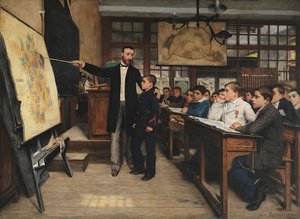
His most iconic achievement, "La Tache noire" (The Black Spot), completed in 1887, remains a haunting masterpiece housed in the Deutsches Historisches Museum in Berlin. In this evocative work, Bettannier utilizes classroom symbolism to communicate a powerful message of continuity and defiance. Through the depiction of a geography teacher pointing to the lost region, he illustrates how the memory of the territory was passed to the next generation, ensuring that the flame of French identity would never be extinguished. The painting is rich with symbolic details, from the sinister presence of a blackboard representing the German threat to the subtle nods toward the Prussian siege of Paris.
Legacy and Historical Significance
Throughout his career, Bettannier was a regular and respected presence at the Salon des artistes français. Starting in 1881, his exhibitions became significant events for those seeking art that resonated with the contemporary political zeitgeist. His ability to blend the aesthetics of the late 19th century with the raw, emotional urgency of the Third Republic ensured his place in the annals of French art history.
The significance of Bettannier’s oeuvre lies in its dual nature: it is both a technical exploration of Post-Impressionist light and shadow and a historical document of a period defined by territorial struggle. He remains a vital figure for understanding how art can function as a vessel for collective memory, capturing the heartache of a people caught in the tides of war and the enduring hope of a nation seeking to heal its fractured borders.
nicolas albert bettannier
1851 - 1932 , France
基本情報
- Artistic Movement Or Style: Post-Impressionism
- Artists Who Influenced This Artist:
- Henri Lehmann
- Isidore Pils
- Date Of Birth: August 12, 1851
- Date Of Death: November 17, 1932
- Full Name: Nicolas Albert Bettannier
- Nationality: French
- Notable Artworks:
- La Tache noire
- Le Désespoir
- Place Of Birth: Metz, France
関連記事
没後印象派を彩る至宝:時代を定義した10大名作
時代を彩る没後印象派の名作10選。ゴッホ、セザンヌら巨匠の傑作を深く掘り下げ、その物語と技法に迫ります。色彩豊かなアートで空間を演出。ArtsDot.comで至高のアートプリントを見つけませんか?
Impressionistic Realism's Finest: 10 Masterpieces for Your Home | ArtsDot
Journey through Impressionistic Realism with 10 iconic masterpieces by Monet, Renoir & Van Gogh. Explore art history, techniques & find museum-quality reproductions for your home at ArtsDot.com. Discover all masterpieces online!
印象派風景を彩った至宝:アート史に名を刻む10選
印象派風景の革新を彩った10選。モネ、ルノワールら巨匠の名作を紐解き、色彩と光が生み出す感動の世界へ。アートの歴史とインテリアのインスピレーションをArtsDot.comで。高品質な複製画で、あなただけの空間を創造しましょう。
Beyond Impressionism: Exploring the Emotional Depth of Post-Impressionist Painting
Explore the profound emotional depth & innovative techniques of Post-Impressionism with ArtsDot. Discover Cézanne, Van Gogh, Gauguin & more – and their lasting impact on modern art.
光と色彩の彼方:知的な収集家のための印象派とポスト印象派
印象派とポスト印象派の傑作を深く理解し、知的なコレクションを築くための情報を提供。ArtsDotでは、高品質な油絵複製やカスタムアートをご用意。専門家が最適な作品選びをお手伝いします。

