

 プレビュー
プレビュー
 シェアする
シェアする シェアする
シェアする
 詳細を見る
詳細を見る

 ダウンロード
 似ている作品
 X線調査
X線調査 スライドショー
 Stats
StatsMap of Asia by Nicolas Sanson\n\nMap of Asia by Nicolas Sanson


 詳細を見る
詳細を見る
手描き油彩複製画
当社のアーティストが、お客様のご希望のサイズと額縁に合わせて、キャンバスに手描きで制作する油彩画です。 ( Switch to Print Switch to Digital Image)




P118B $10

P118H $10

P118W $10

P438Z $10

P508JH $12

P508YH $12

P805H $10

P805Z $10

P919BZ $10

P919G $10

P919XJ $10

P959ZH $10

P968JZ $12

W106C $8

W218G $10

W218JH $8

W218Y $10

W307PJ $10

W316G $10

W316PJ $8

W316Y $10

W398PJ $8

W4111J $10

W500HY $15

W500JH $15

W692G $12

W849H $8

W940BG $15

W953PJ $8




作品のオリジナル比率に合わせた、当店の規定サイズからお選びください。

特定のフレームやスペースに合わせて、ご希望のサイズをご入力いただけます。選択されたサイズが元の画像の比率と異なる場合、アートワークをトリミングするか、手描きで要素を追加して絵画を拡張いたします。デジタルモックアップ を制作し、制作開始前にご確認(承認)をいただきます。
画面上のプレビューは、実際のトリミングや拡張を正確に反映しているものではありません。最終的な構図は、モックアップによってのみ正確にご確認いただけます。
カスタムサイズもご利用いただけますが、元の比率を維持するためには、あらかじめ用意されたリストからサイズを選択することをお勧めいたします。
ご注文後、ArtsDot.com チームより詳細な指示をお送りするとともに、仕上がりイメージ(モックアップ)をご提供いたします。


 ガラスオプションは、110cm未満のサイズでのみご利用いただけます。

Map of Asia by Nicolas Sanson\n\nMap of Asia by Nicolas Sanson
複製技法
複製画のサイズ
-


合計金額
$ 263
A Cartographic Masterpiece: Navigating the Silk Roads of History
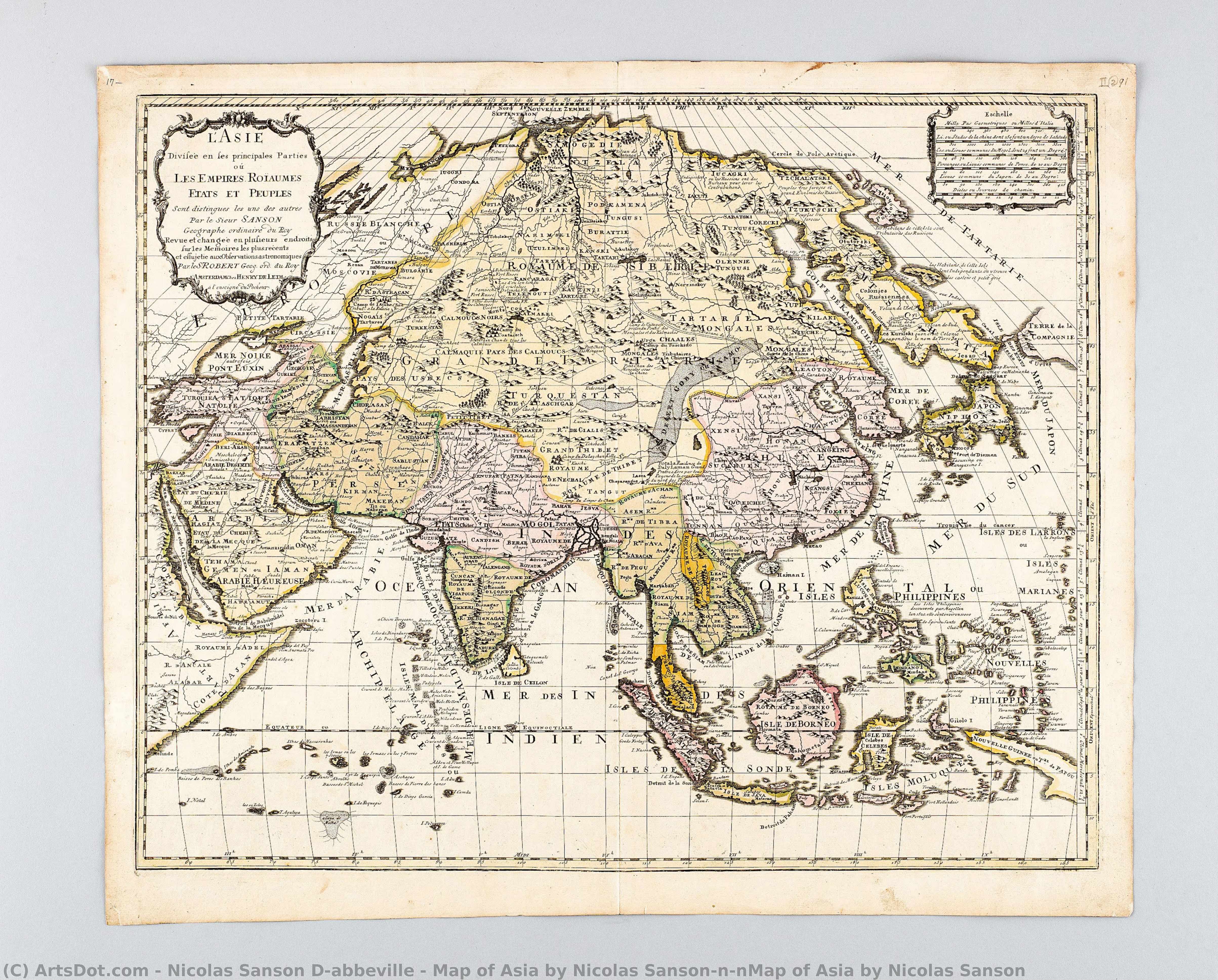
In the grand tapestry of seventeenth-century European intellect, few disciplines captured the imagination quite like cartography. The Map of Asia by Nicolas Sanson stands as a breathtaking testament to this era of discovery, offering much more than a mere geographical guide. It is a window into a world where the boundaries of the known were being redrawn with every voyage and every whispered report from distant lands. As one gazes upon this exquisite work, they are not simply looking at landmasses and coastlines, but rather witnessing the very moment when the vast mysteries of the East began to be etched into the collective consciousness of the West. The map serves as a profound intersection of science and art, where the precision of the engraver meets the boundless curiosity of the explorer.
The artistry of Nicolas Sanson d'Abbeville, a pivotal figure in French cartography, is evident in the delicate balance of detail and elegance that defines this piece. The composition is anchored by the intricate labeling of various territories, each name acting as a linguistic portal to ancient empires and legendary trade routes. A subtle yet striking feature is the inclusion of a compass in the upper right corner, a symbol of direction, purpose, and the human drive to navigate the unknown. This element does more than provide scale; it imbues the work with a sense of movement and maritime adventure, reminding the viewer of the perilous sea voyages required to compile such knowledge. The technique reflects the meticulous nature of the period, where every line was a deliberate stroke of intellectual rigor.
For the discerning collector or interior designer, this reproduction offers an unparalleled opportunity to introduce a sense of timeless sophistication and worldly wisdom into a living space. The aesthetic appeal of the map lies in its ability to evoke a feeling of nostalgia for the Age of Discovery, making it a perfect centerpiece for a library, a study, or a refined gallery wall. It possesses a quiet, commanding presence that complements both classical and contemporary decor, providing a conversation piece that transcends mere decoration. To hang this work is to invite the spirit of exploration into one's home, surrounding oneself with the echoes of history and the enduring beauty of human achievement.
Beyond its visual splendor, the emotional impact of Sanson’s work is deeply rooted in its historical context. During a time when the world was expanding through trade and conquest, such maps were symbols of power and prestige. Owning a piece that celebrates this era allows one to connect with the profound human desire to understand our place within the cosmos. Whether you are drawn to the intricate textures of the engraved lines or the scholarly weight of the geographical data, this map remains an evocative masterpiece that continues to inspire awe and wonder in all who behold it.
関連作品
アーティストの略歴
The Shadowed Genius: Caravaggio and the Dawn of Baroque
Michelangelo Merisi da Caravaggio, a name synonymous with drama, darkness, and revolutionary technique, remains one of the most compelling figures in art history. Born in Milan in 1571, his life was tragically short – he died at the young age of thirty-eight – yet within those brief years, he irrevocably altered the course of painting, ushering in the Baroque era with a style that continues to captivate and challenge viewers centuries later. Caravaggio’s legacy isn't simply about masterful brushwork; it’s about a profound shift in how artists approached light, emotion, and the very relationship between subject and viewer. Caravaggio’s early life remains shrouded in some mystery, though we know he was apprenticed to Simone Petero, a Lombard painter in Milan. He likely spent his formative years there, honing his skills before moving to Rome around 1592. It was in the Eternal City that he truly exploded onto the scene, quickly establishing himself as a sought-after portraitist and religious painter. His early commissions were largely for private clients – wealthy merchants and nobles eager to adorn their homes with striking depictions of biblical scenes and mythological subjects. However, it wasn’t until his dramatic use of *tenebrism*—a stark contrast between light and dark—that he truly distinguished himself. Caravaggio didn't simply paint a scene; he sculpted it with light, creating an intense theatricality that drew viewers directly into the heart of the narrative.- Tenebrism: The defining characteristic of his style, utilizing dramatic contrasts between illuminated areas and deep shadows to heighten emotional impact.
- Naturalism: Caravaggio rejected idealized representations in favor of portraying figures with a remarkable degree of realism – flaws, wrinkles, and imperfections were all embraced, lending an unparalleled sense of immediacy and humanity to his subjects.
- Direct Observation: He famously worked *alla prima*, directly on the canvas without preliminary sketches, capturing fleeting moments and intense emotions with astonishing speed and precision.
Key Works and Their Significance
Caravaggio’s output was relatively small but extraordinarily impactful. His paintings are not merely beautiful images; they are powerful statements about faith, humanity, and the human condition.- The Calling of St Matthew (1599-1600): This seminal work exemplifies Caravaggio's mastery of *tenebrism*, with a single beam of light illuminating the astonished apostle Matthew as Christ calls him to follow him.
- Supper at Emmaus (1601): A deeply moving depiction of the resurrected Christ sharing bread with two disciples, showcasing his ability to convey profound emotion through subtle gestures and expressions.
- David and Goliath (1609-1610): This brutal yet compelling scene captures the moment after David defeats Goliath, revealing both the victor’s triumph and the vanquished’s despair.
- The Death of the Virgin (c. 1604-1606): A profoundly moving portrayal of Mary mourning her son's death, rendered with an unprecedented level of realism and emotional intensity.
A Lasting Legacy: The Enduring Power of Darkness
Michelangelo Merisi da Caravaggio’s brief but brilliant career left an indelible mark on art history. His revolutionary use of *tenebrism*, his commitment to naturalism, and his ability to infuse his paintings with profound emotion continue to resonate with viewers today. He didn't just paint; he created experiences—intense, dramatic encounters that force us to confront the complexities of faith, humanity, and mortality. Caravaggio’s legacy is not simply one of artistic innovation but also a testament to the power of a single artist to transform an entire era. His work remains a potent reminder that even in darkness, there can be extraordinary beauty and profound truth.
nicolas sanson d'abbeville
1600 - 1667 , France
基本情報
- Artistic Movement Or Style: Baroque
- Artists Or Movements Influenced By This Artist: ['Caravaggisti']
- Artists Who Influenced This Artist:
- Michelangelo
- Leonardo da Vinci
- Date Of Death: 1610
- Full Name: Caravaggio
- Nationality: Italian
- Notable Artworks:
- The Calling of St Matthew
- David and Goliath
- Place Of Birth: Milan, Italy
関連記事

Echoes of Time: Exploring the Enduring Appeal of Vintage Artwork
Explore the captivating world of vintage art! Discover its history, enduring appeal, & how to build your own collection. Expert advice, custom reproductions & museum-quality prints at ArtsDot.
Echoes of Time: Nostalgia, Technique & Cultural Significance in Vintage Paintings
Explore the captivating world of vintage paintings! Discover key styles, cultural significance & collecting tips from art experts at ArtsDot. Find authentic reproductions and elevate your home décor.
Simon Vouet: A Baroque Master's Journey from Italian Influence to French Classicism
Explore the life & art of Simon Vouet, a pivotal French Baroque painter who introduced Italian styles to France. Discover his masterpieces and lasting influence on 17th-century art.

Echoes of Time: Exploring the Enduring Appeal & Historical Context of Vintage Art Prints
Explore the captivating world of vintage art prints! Discover their history, collecting tips & enduring appeal. Expert insights on chromolithography and building a legacy collection with ArtsDot.
Charles Le Brun: Master of French Baroque Classicism & His Enduring Legacy
Explore the life & art of Charles Le Brun, master of French Baroque Classicism. Discover his royal commissions, influence on Versailles, and enduring legacy through detailed analysis & stunning artworks.