


 プレビュー
プレビュー
 シェアする
シェアする シェアする
シェアする
 詳細を見る
詳細を見る

 ダウンロード
 似ている作品
 X線調査
X線調査 スライドショー
 統計情報
統計情報Interieur van de Sint Odulphuskerk in Assendelft


 詳細を見る
詳細を見る
ジークレー/アートプリント
迅速な制作と多彩な仕上げオプションを備えた、ミュージアムクオリティのジークレーまたはキャンバスプリント。 ( 手描きの絵画を購入 デジタル画像販売へ切り替え)




































作品のオリジナル比率に合わせた、当店の規定サイズからお選びください。

特定のフレームやスペースに合わせて、ご自身でサイズを指定することも可能です。選択されたサイズが元の画像の比率と一致しない場合、作品をトリミングするか、鏡面反射または単色での塗りつぶしによって画像を拡張いたします。制作を開始する前に、ご確認用のデジタルモックアップをお送りいたします。
画面上のプレビューには、実際のトリミングや拡張は反映されませんのでご注意ください。最終的な構図を正確に確認できるのは、モックアップのみとなります。
カスタムサイズも承っておりますが、元の比率を維持するためには、あらかじめ用意されたリストからサイズを選択することをお勧めいたします。


 ガラスオプションは、110cm未満のサイズでのみご利用いただけます。

Interieur van de Sint Odulphuskerk in Assendelft
ジークレー/アートプリント
複製画のサイズ
-


合計金額
$ 62
関連作品









アーティストの略歴
The Architect of Faith: The Life and Vision of Pieter Saenredam
In the golden light of the seventeenth-century Dutch Republic, while many of his contemporaries were captivated by the dramatic tension of portraits or the sweeping narratives of landscapes, one artist turned his gaze inward—not toward the human soul, but toward the hallowed, whitewashed bones of the church itself. Pieter Saenredam (1597–1665) was a master of architectural precision, a painter who transformed the silent, cavernous interiors of Holland’s sacred spaces into profound meditations on light, geometry, and spiritual clarity. Born in the small village of Assendelft, Saenredam was destined for a life shaped by the draftsmanship of his lineage. As the son of Jan Pietersz Saenredam, a notable Northern Mannerist engraver, the young artist was immersed from birth in the rigorous discipline of perspective and the meticulous study of structural form.
Saenredam’s journey took him to Haarlem in 1612, a move that would place him at the heart of a burgeoning artistic revolution. It was here that his unique style began to coalesce, moving away from the fanciful, often imaginary architectural fantasies of earlier masters like Hendrik van Steenwijck the Elder toward a revolutionary topographical accuracy. His training, likely influenced by the chiaroscuro techniques of Haarlem’s prominent artists, allowed him to master the interplay of shadow and illumination. Yet, Saenredam sought something more profound than mere decoration; he sought the truth of the structure. He was known to meticulously measure the very buildings he intended to paint, treating his canvas as a mathematical extension of the stone and mortar he observed.
A Symphony of Light and Geometry
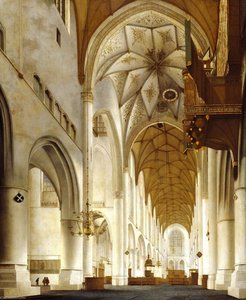
To step into a Saenredam painting is to experience a profound sense of stillness. His work is characterized by an almost ethereal clarity, achieved through a masterful command of linear perspective and a palette that often emphasized the stark, clean beauty of whitewashed walls. These interiors—ranging from the iconic St. Bavo’s Church in Haarlem to the Nieuwe Kerk—are not merely architectural records but atmospheric experiences. He captured the way light filters through stained glass, casting soft, prismatic hues upon cold stone, and how the vastness of a nave can evoke both the insignificance of man and the grandeur of the divine.
His technical brilliance lay in his ability to balance extreme detail with a sense of expansive emptiness. While he could render the intricate carvings of an altar or the delicate texture of a pillar with breathtaking realism, he never allowed detail to clutter the composition. Instead, he used architectural lines to guide the viewer’s eye upward, mimicking the spiritual ascent intended by the architects themselves. This period of his development saw him becoming a close contemporary and friend to the great architect Jacob van Campen, whose classical designs for Haarlem’s churches provided the perfect structural stage for Saenredam’s luminous explorations.
Legacy of the Silent Interior
The historical significance of Pieter Saenredam extends far beyond the borders of the Dutch Golden Age. He pioneered a genre of architectural painting that demanded a new kind of looking—a way of seeing that valued the structural essence of a space over its ornamental excess. His work serves as an invaluable historical document, preserving the vanished or altered interiors of seventeenth-century Holland with a fidelity that few other artists could match. Through his eyes, we see the transition of religious spaces from the ornate complexities of the past to the austere, light-filled sanctuaries of the Protestant era.
Though he lived a life of quiet perseverance, far from the opulent commissions of the era's most famous portraitists, Saenredam achieved a lasting immortality. His ability to find the sacred within the structural remains unparalleled. Today, his oeuvre stands as a testament to the power of observation and the belief that there is a profound, quiet majesty to be found in the precise measurement of light hitting a wall, or the long, receding shadows of a cathedral aisle. He did not just paint buildings; he painted the very atmosphere of faith.
peter saenredam
1597 - 1665
基本情報
- Artistic Movement Or Style: Dutch Golden Age
- Artists Or Movements Influenced By This Artist: ['Baroque']
- Artists Who Influenced This Artist: ['Jacob Saenredam']
- Date Of Birth: 1597
- Date Of Death: 1665
- Full Name: Peter Saenredam
- Nationality: Dutch
- Notable Artworks: ['Interior View of St. Pancras Church']
- Place Of Birth: Haarlem, Netherlands