

 プレビュー
プレビュー
 プリントを購入
 シェアする
シェアする シェアする
シェアする
 詳細を見る
詳細を見る

 ダウンロード
 似ている作品
 X線調査
X線調査 スライドショー
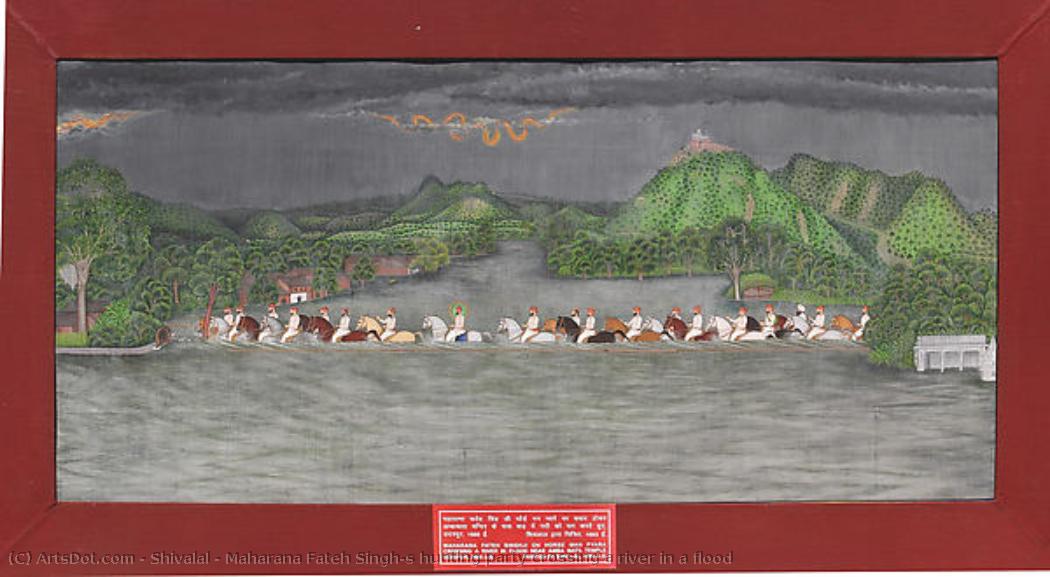
Maharana Fateh Singh’s hunting party crossing a river in a flood
 1893
1893 98.0 x 174.0 cm
 詳細を見る
詳細を見る




































標準サイズ
オーダーメイド
CM
INCH
作品のオリジナル比率に合わせた、当店の規定サイズからお選びください。
Loading sizes...

幅
高さ
特定のフレームやスペースに合わせて、ご希望のサイズをご入力いただけます。選択されたサイズが元の画像の比率と異なる場合、アートワークをトリミングするか、手描きで要素を追加して絵画を拡張いたします。デジタルモックアップ を制作し、制作開始前にご確認(承認)をいただきます。
画面上のプレビューは、実際のトリミングや拡張を正確に反映しているものではありません。最終的な構図は、モックアップによってのみ正確にご確認いただけます。
カスタムサイズもご利用いただけますが、元の比率を維持するためには、あらかじめ用意されたリストからサイズを選択することをお勧めいたします。
カスタマイズの例:顔をお客様の写真に置き換える、ペットを追加する(例:猫を犬に変更)、背景に隠れたメッセージを入れる、背景の風景や要素を変更するなど。
ご注文後、ArtsDot.com チームより詳細な指示をお送りするとともに、仕上がりイメージ(モックアップ)をご提供いたします。
ご注文後、ArtsDot.com チームより詳細な指示をお送りするとともに、仕上がりイメージ(モックアップ)をご提供いたします。


 ガラスオプションは、110cm未満のサイズでのみご利用いただけます。

Maharana Fateh Singh’s hunting party crossing a river in a flood
複製技法
複製画のサイズ
-


合計金額
$ 263
This spectacular panoramic vista, of the royal hunting party forging a flooded river, is a composition unprecedented in the history of Indian painting. Surely, it must be inspired by innovations in panoramic photography in which multiple views are composed into a single vision. Shivalal daringly filled more than half the composition with the gray waters of the swollen river, beyond which distant hills under lush vegetation are illuminated by lightning, which dances across the darkened sky. Into this setting, he placed the riders forging the river in single file. It is a surprisingly modern work, painted in the last decade of the century, which boldly asserts the validity of painting in the age of photography. About the Artist Shivalal and MohanlalActive at Udaipur, second half of the 19th century; sons of Tara A final phase of painting in Udaipur began under the rulers Sajjan Singh (r. 1874–84) and Fateh Singh (r. 1884–1930) and was influenced by both photography and examples of oil painting. In the ateliers, the brothers Shivalal and Mohanlal, sons of the painter Tara, followed different paths. A work is known that was produced by Shivalal in collaboration with his father in 1858. Shivalal specialized in hunting scenes, most of them created on location, in which the sequence of events is presented dramatically in an expansive landscape. In some of them, Shivalal himself is depicted, and in others, it is probably his brother Mohanlal (functioning as an assistant) who is shown. One of Shivalal’s greatest strengths is the realistic, topographically accurate rendering of hunting reserves and of the landscape around Udaipur. The increasing realism in such depictions also called another medium into play —photography. The rulers of Jaipur and Alwar had already established photographic studios (photokhana) for the purpose of documenting the visits of dignitaries. Shivalal also worked with the new medium, not from behind the camera but rather as a painter, coloring the albumen prints, either with traditional Indian pigments or with oils. While some photographs were completely painted over, on others, only portions were colored, the faces, for example, or the regalia. The medium of photography, with its immediacy and its accuracy, heralded the end of traditional painting. Painters at court were insufficiently prepared for the arrival of photography. Some artists tried to adopt the perspective and compositional schemes of photographs in their pictures, but with limited success. Inevitably, activities at court came to be recorded in the new medium. Even Mohanlal began to capture hunting scenes with a camera, marking the end of traditional picture making in the courts of India.
関連作品








アーティストの略歴
The Enigmatic Brush of Tara’s Son: A Life Dedicated to Miniature Painting
The late 19th century in Udaipur, Rajasthan, was a crucible of artistic tradition, and within this vibrant milieu emerged the painter known simply as the son of Tara. While biographical details remain frustratingly scarce – a common fate for artists working within established court styles – his legacy is etched vividly onto the delicate surfaces of countless miniature paintings. He wasn’t a revolutionary figure seeking to overturn convention; rather, he was a master craftsman who embodied and refined the existing aesthetic principles of the Mewar school, inheriting a lineage stretching back generations. His father, Tara, himself a respected artist, undoubtedly provided the foundational training that allowed his son to flourish. The lack of extensive personal documentation forces us to understand him through his work – a testament to the power of artistic expression to transcend the limitations of historical record. He lived and worked during a period of significant change in India, witnessing the increasing influence of British colonialism, yet his art remained steadfastly rooted in indigenous narratives and visual languages.A Legacy Forged in Tradition: Influences and Early Development
The son of Tara’s artistic development was deeply intertwined with the patronage system prevalent in Udaipur. The Mewar court, though diminished in political power compared to its zenith, continued to commission paintings for religious ceremonies, historical chronicles, and personal enjoyment. These commissions provided a crucial training ground, exposing him to a diverse range of subjects and stylistic demands. Early works reveal a strong adherence to the established conventions of Mewar painting: bold colors, flattened perspectives, intricate detailing, and an emphasis on narrative clarity.- The Bhagavata Purana: A significant portion of his early output focused on illustrating episodes from the *Bhagavata Purana*, a Hindu text recounting the life and deeds of Lord Krishna. These paintings demonstrate his skill in depicting emotive figures, lush landscapes, and dynamic compositions.
- Ragamala Paintings: He also excelled in painting *ragamalas* – visual representations of musical modes or “melodies.” Each *raga* was associated with a specific mood, time of day, and season, which the artist conveyed through symbolic imagery and color palettes.
- Courtly Life: Scenes depicting courtly life – hunting expeditions, royal processions, and intimate moments within the zenana (women’s quarters) – showcase his ability to capture the elegance and refinement of Mewar society.
Mastering the Miniature: Technique and Artistic Characteristics
The son of Tara’s technical prowess was remarkable. Miniature painting demanded an extraordinary level of precision, patience, and skill. He worked primarily on paper, using natural pigments derived from minerals, plants, and precious stones. The process involved meticulously layering colors to create depth and luminosity, often employing techniques like *kajli*, a method of outlining figures with black ink to enhance their definition.- Color Palette: His color palette was typically rich and vibrant, featuring shades of gold, crimson, indigo, emerald green, and ochre. He skillfully balanced these colors to create harmonious compositions that evoked specific moods and emotions.
- Detailed Composition: The intricate detailing in his paintings is particularly noteworthy – the delicate patterns on textiles, the elaborate jewelry adorning figures, and the lush foliage of landscapes all testify to his exceptional craftsmanship.
- Narrative Focus: Despite the small scale of his works, he managed to convey complex narratives with clarity and precision. His paintings are not merely decorative; they tell stories, evoke emotions, and offer insights into the cultural beliefs and values of Mewar society.
Historical Significance: Preserving a Tradition in a Changing World
The son of Tara’s work occupies a crucial position in the history of Mewar painting. He lived during a period when traditional art forms were facing increasing competition from Western artistic styles and mass-produced prints. His dedication to preserving the established conventions of miniature painting – while subtly refining them – helped ensure the survival of this unique artistic tradition.- Patronage Decline: The decline in royal patronage towards the end of the 19th century posed a significant challenge for artists like him. He likely relied on commissions from wealthy merchants and private collectors to sustain his livelihood.
- Cultural Preservation: His paintings serve as invaluable historical documents, providing insights into the religious beliefs, social customs, and artistic tastes of Mewar society during this period.
- Artistic Legacy: Although he did not establish a large workshop or train numerous disciples, his influence can be seen in the work of later Mewar painters who continued to uphold the traditions he embodied. His paintings are now highly sought after by collectors and museums worldwide, testament to their enduring artistic merit.
基本情報
- Artistic Movement Or Style: Rajasthan School
- Artists Or Movements Influenced By This Artist: ['(Unknown)']
- Artists Who Influenced This Artist: ['Tara (Father)']
- Date Of Birth: (Unknown)
- Date Of Death: Living
- Full Name: Shivalal
- Nationality: Indian
- Notable Artworks: ['(Unknown Titles)']
- Place Of Birth: Udaipur, India

