

 プレビュー
プレビュー
 シェアする
シェアする シェアする
シェアする
 詳細を見る
詳細を見る

 ダウンロード
 似ている作品
 X線調査
X線調査 スライドショー
 統計情報
統計情報Présentoir: les plaintifs, les bêtes, les politiques
 Mixed Media
- WallArt
- Contemporary Art
 Contemporary
 250.0 x 569.0 cm
 ボンネファンテン美術館
 詳細を見る
詳細を見る
手描き油彩複製画
当社のアーティストが、お客様のご希望のサイズと額縁に合わせて、キャンバスに手描きで制作する油彩画です。 ( プリント版に切り替え デジタル画像販売へ切り替え)




P118B $10

P118H $10

P118W $10

P438Z $10

P508JH $12

P508YH $12

P805H $10

P805Z $10

P919BZ $10

P919G $10

P919XJ $10

P959ZH $10

P968JZ $12

W106C $8

W218G $10

W218JH $8

W218Y $10

W307PJ $10

W316G $10

W316PJ $8

W316Y $10

W398PJ $8

W4111J $10

W500HY $15

W500JH $15

W692G $12

W849H $8

W940BG $15

W953PJ $8




作品のオリジナル比率に合わせた、当店の規定サイズからお選びください。

特定のフレームやスペースに合わせて、ご希望のサイズをご入力いただけます。選択されたサイズが元の画像の比率と異なる場合、アートワークをトリミングするか、手描きで要素を追加して絵画を拡張いたします。デジタルモックアップ を制作し、制作開始前にご確認(承認)をいただきます。
画面上のプレビューは、実際のトリミングや拡張を正確に反映しているものではありません。最終的な構図は、モックアップによってのみ正確にご確認いただけます。
カスタムサイズもご利用いただけますが、元の比率を維持するためには、あらかじめ用意されたリストからサイズを選択することをお勧めいたします。
ご注文後、ArtsDot.com チームより詳細な指示をお送りするとともに、仕上がりイメージ(モックアップ)をご提供いたします。


 ガラスオプションは、110cm未満のサイズでのみご利用いただけます。

Présentoir: les plaintifs, les bêtes, les politiques
複製技法
複製画のサイズ
-


合計金額
$ 263
A Symphony of Chaos and Connection
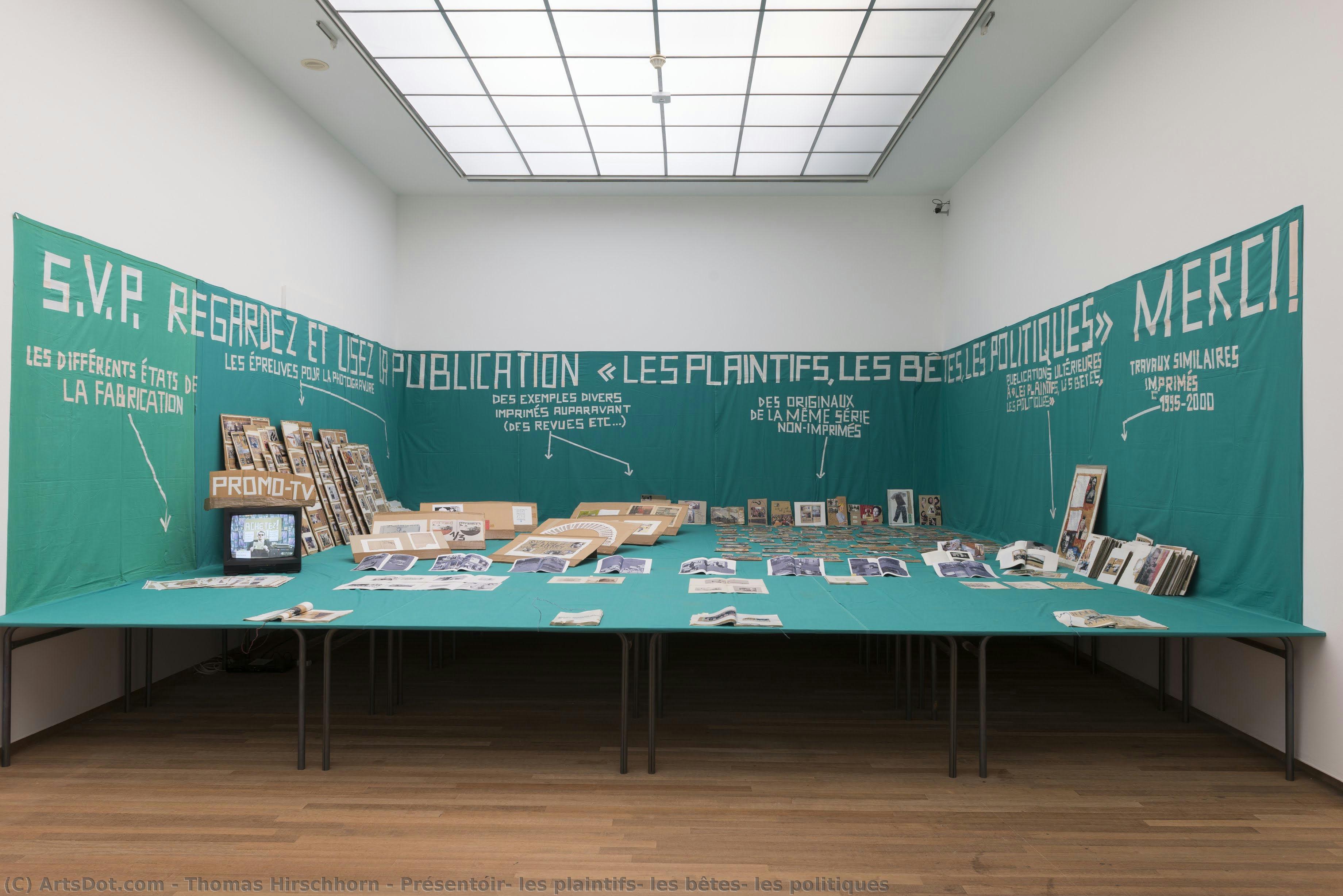
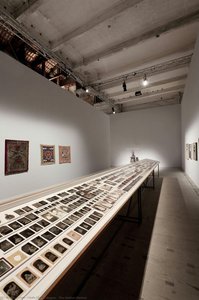
In the vast landscape of contemporary installation art, few works capture the frantic, beautiful, and often overwhelming pulse of modern existence quite like Thomas Hirschhorn’s Présentoir: les plaintifs, les bêtes, les politiques. This monumental piece serves as a historical synthesis of the artist's unique visual language, acting as a sprawling, three-dimensional collage that defies the boundaries between high art and everyday debris. At first glance, the viewer is met with an expansive scene—a large table laden with books, papers, and fragments of life—suggesting an informal gathering or a communal meeting place where ideas are tossed about as freely as the scraps of material that compose the work itself. The presence of chairs arranged around this central hub invites us to imagine a space of intense dialogue, a sanctuary for the thinkers, the dreamers, and the dissenters.
The composition is anchored by a sense of organized disorder. Hirschhorn, a master of utilizing "cheap" materials, employs cardboard, tape, plastic, and aluminum foil to construct a world that feels both fragile and incredibly potent. This technique of using disposable media creates a profound tension; while the materials themselves are ephemeral and mundane, the messages they carry are monumental. The painting captures this essence by depicting a scene where a television is mounted on a wall, perhaps broadcasting the very social critiques Hirschhorn seeks to provoke. It is a space that feels lived-in, cluttered with the intellectual residue of a society grappling with its own complexities, making it an extraordinary focal point for any collection that values depth and narrative complexity.
The Art of Social Engagement
To understand this work is to understand Hirschhorn’s profound commitment to public discourse. Emerging from a background in graphic design and influenced by the transformative legacies of Joseph Beuys and Andy Warhol, Hirschhorn uses his "assemblage" style to critique a world increasingly dominated by the cold mechanics of money and power. In Présentoir: les plaintifs, les bêtes, les politiques, the artist adopts the persona of an enthusiastic "Tele-Sales" presenter, attempting to market social engagement to a global audience. This layer of irony adds a captivating emotional dimension to the piece; there is a palpable sense of urgency and even a touch of desperation in his attempt to bring political reality into the light of public view.
For the discerning collector or interior designer, this artwork offers much more than mere decoration; it offers an intellectual atmosphere. The interplay between the domesticity of the dining setting and the radical nature of the materials creates a sophisticated aesthetic that challenges the traditional "white cube" gallery experience. It is a piece that demands conversation, making it an ideal centerpiece for modern, avant-garde interiors where art is intended to spark thought and reflection. Owning a high-quality reproduction of this work allows one to bring a fragment of this radical social experiment into a private space, surrounding oneself with the energy of a continuous, creative struggle for a more positive engagement with our shared reality.
関連作品

アーティストの略歴
Thomas Hirschhorn: Sculpting Public Discourse
Born in Bern, Switzerland, in 1957, Thomas Hirschhorn’s artistic journey is a compelling narrative of transformation – from graphic design to a profoundly engaged practice deeply rooted in public space. Initially trained in Zurich’s School of Applied Arts, his early work as a designer laid the groundwork for an approach that would later challenge conventional notions of art and its relationship with society. However, it was a pivotal shift in the 1990s, fueled by encounters with the works of Joseph Beuys and Andy Warhol, that propelled him toward a distinctly sculptural and politically-charged artistic vision.
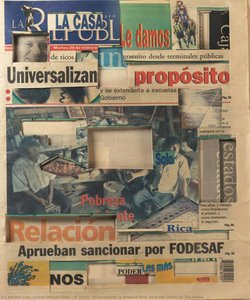
Hirschhorn’s early career saw him experimenting with materials readily available – cardboard, foil, duct tape, magazines – transforming these everyday objects into complex, often monumental structures. This deliberate choice wasn't merely aesthetic; it was a conscious rejection of the elitism traditionally associated with art and a commitment to engaging with the “non-exclusive audience.” He sought to create works that were accessible, inclusive, and spoke directly to the experiences of ordinary people, reflecting a core philosophy of democratizing artistic expression. This approach is evident in his early installations, which frequently incorporated text and found imagery, layering social commentary alongside formal considerations.
The Language of Public Space
A defining characteristic of Hirschhorn’s work is its deployment within public spaces – sidewalks, vacant lots, urban landscapes – rather than confined to traditional gallery settings. This strategic placement isn't simply about visibility; it’s a deliberate attempt to disrupt the established order and initiate dialogue. His projects, often described as “monuments” or “assemblages,” are designed to provoke interaction, questioning notions of ownership, authority, and the very definition of art. The scale of these works is frequently imposing, demanding attention and inviting viewers to confront their surroundings in a new way.
Significant examples include *Musée Précaire Albinet* in Aubervilliers, France (2004), where he presented iconic artworks from major museums alongside original pieces, fostering a critical dialogue about access to culture. Similarly, the *Bijlmer Spinoza Festival* in Amsterdam (2009) utilized a vast, abandoned airport space to explore themes of social justice and philosophical inquiry. These projects aren’t merely installations; they are carefully orchestrated events designed to engage communities and stimulate critical reflection.
Influences and Theoretical Framework
Hirschhorn's artistic trajectory is deeply informed by the philosophies of Joseph Beuys, particularly his concept of “social sculpture,” which emphasizes art as a tool for social transformation. The influence of Andy Warhol’s embrace of popular culture and mass media also plays a crucial role, shaping Hirschhorn’s use of everyday materials and his engagement with contemporary issues. He draws heavily on critical theory, particularly the work of Walter Benjamin and Michel Foucault, using these frameworks to analyze power dynamics and social structures.
His theoretical writings, such as *Critical Laboratory*, articulate a complex system of “Presence and Production,” outlining his approach to working in public space. This methodology emphasizes the importance of being physically present during the creation process, fostering a direct connection with the environment and the people involved. He believes that true impact arises from this immediate engagement, rejecting the notion of art as a detached object.
Major Achievements and Legacy
Thomas Hirschhorn’s career has been marked by numerous prestigious exhibitions and awards, solidifying his position as one of the most significant contemporary artists working today. He has represented Switzerland at the Venice Biennale (1999, 2015), Documenta 11 (2002), and other major international events. His work has been exhibited in institutions worldwide, including the Art Institute of Chicago, the Museum Ludwig in Cologne, and the Fondation MaXXI in Rome.
Beyond individual exhibitions, Hirschhorn’s sustained commitment to public art – with over seventy works now installed across Europe, North America, and South America – represents a significant contribution to the field. His projects consistently challenge conventional boundaries between art and life, prompting critical reflection on social justice, political power, and the role of art in shaping our world. His ongoing exploration of “Presence and Production” continues to inform his practice, ensuring that his work remains both deeply personal and profoundly relevant.

Thomas Hirschhorn
1957 - , Switzerland
基本情報
- Artistic Movement Or Style: Conceptual/Installation
- Artists Or Movements Influenced By This Artist:
- Beuys
- Warhol
- Artists Who Influenced This Artist:
- Beuys
- Warhol
- Date Of Birth: 1957-05-16
- Full Name: Thomas Hirschhorn
- Nationality: Swiss
- Notable Artworks:
- Spinoza Monument
- Deleuze Monument
- Bataille Monument
- Place Of Birth: Bern, Switzerland
関連記事
ArtsDot.com F.A.Q.: 油彩画の質感再現:洗練された顧客のためのテクスチャードプリント技術と美的考察
ArtsDotで、原画の質感を忠実に再現した油彩画をコレクションに。熟練アーティストによる手描き複製、カスタムポートレートも承ります。高品質なアートをお届けし、お客様の空間を豊かにします。
Joseph Cornell: Assemblage, Shadow Boxes & the Poetics of Found Objects
Explore the captivating world of Joseph Cornell's assemblage art & shadow boxes. Discover his unique process, Surrealist influences, and lasting legacy with ArtsDot.
The Magic of Collage: How to Layer Texture and Story into Your Home Decor
Elevate your interiors with the magic of collage. Discover expert tips on layering texture, 3D elements, and personal narratives through mixed media art to create a soulful, sophisticated home decor experience.
The Tactile Canvas: Exploring Texture as Subject, Materiality & Meaning in Art History
Explore the rich history of texture in art! Discover how artists from Van Gogh to contemporary masters use materiality & technique to create captivating tactile experiences. Deepen your art appreciation with ArtsDot.
マックス・エルンスト傑作25選:シュルレアリスムの深淵と装飾への誘い
マックス・エルンストの傑作25選。シュルレアリスムを代表する画家、その夢と無意識の世界を描いた絵画や版画を紐解きます。リビングやオフィスに飾るモダンアート、インテリアに最適な作品を見つけませんか?ArtsDot.comで全コレクションをオンラインで探す。