メニュー
プレビュープレビュー ARで試着ARで試着 手描きの絵画を購入 手描きの絵画を購入画像を購入 画像を購入 シェアするシェアする
詳細を見る詳細を見る お気に入りに追加 お気に入りに追加 ダウンロードダウンロード 似ている作品似ている作品 X線調査X線調査 スライドショースライドショー

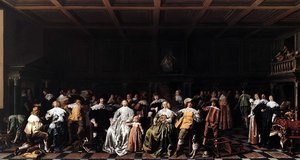
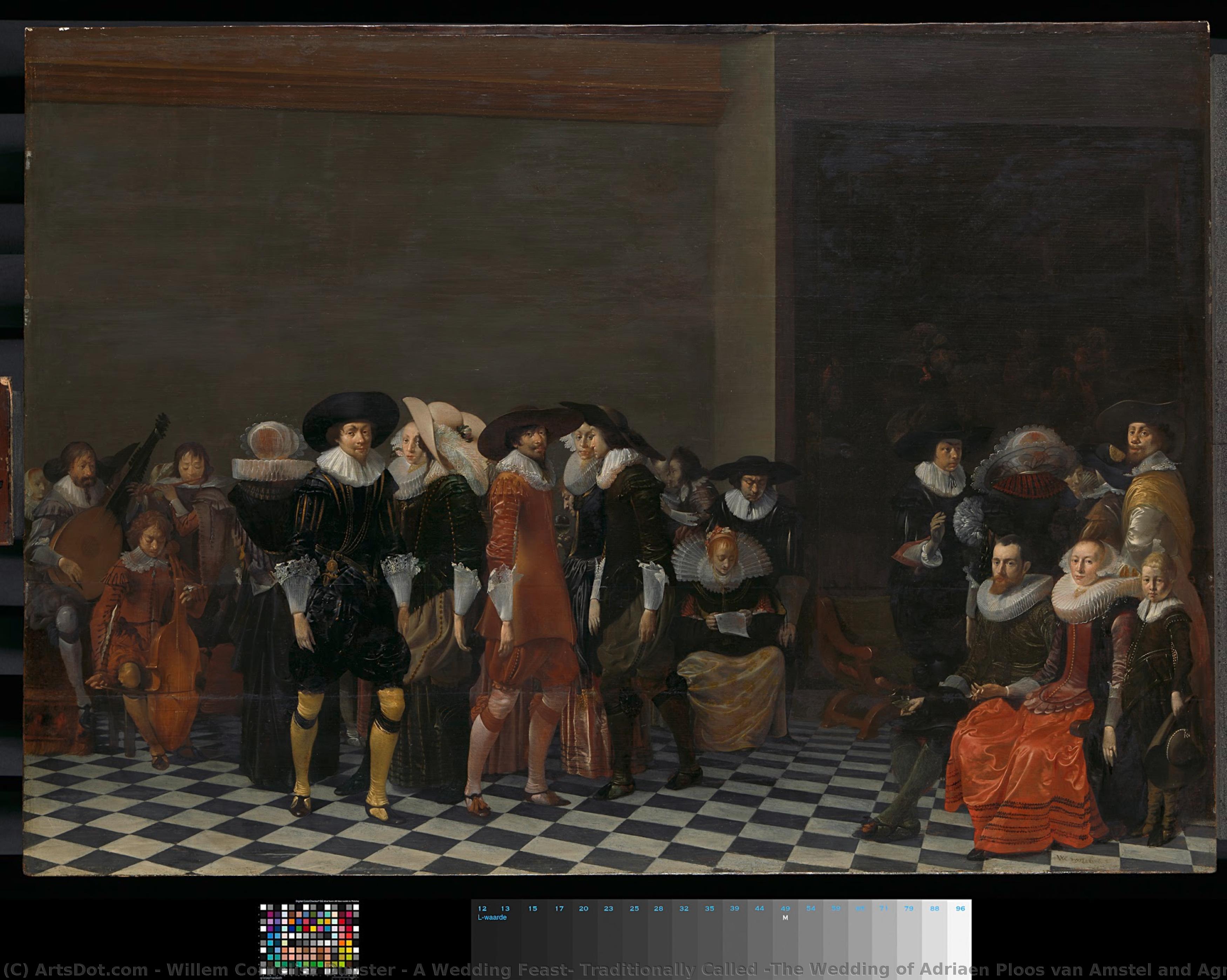
A Wedding Feast, Traditionally Called "The Wedding of Adriaen Ploos van Amstel and Agnes van Bijler", 1616, Willem Cornelisz Duyster, c. 1625

  • 制作日1625
  • 寸法76.0 x 107.0 cm

Explore Willem Cornelisz Duyster's Dutch Golden Age genre paintings! Known for 'guardroom scenes,' textile depictions & poignant military narratives, a unique artist.

ジークレー/アートプリント

迅速な制作と多彩な仕上げオプションを備えた、ミュージアムクオリティのジークレーまたはキャンバスプリント。 (手描きの絵画を購入 手描きの絵画を購入画像を購入 画像を購入)

標準サイズ
オーダーメイド
CM
INCH

作品のオリジナル比率に合わせた、当店の規定サイズからお選びください。

高さ

特定のフレームやスペースに合わせて、ご自身でサイズを指定することも可能です。選択されたサイズが元の画像の比率と一致しない場合、作品をトリミングするか、鏡面反射または単色での塗りつぶしによって画像を拡張いたします。制作を開始する前に、ご確認用のデジタルモックアップをお送りいたします。
画面上のプレビューには、実際のトリミングや拡張は反映されませんのでご注意ください。最終的な構図を正確に確認できるのは、モックアップのみとなります。
カスタムサイズも承っておりますが、元の比率を維持するためには、あらかじめ用意されたリストからサイズを選択することをお勧めいたします。

世界中への配送()は、標準の4〜5週間ではなく、2週間でお届けいたします。(7 9月)

why_choose_icon
世界中へ無料エクスプレス配送
why_choose_icon
高品質なリネンキャンバス
why_choose_icon
配送時完全保険付
why_choose_icon
関税・輸入税の払い戻し保証
why_choose_icon
忠実な色彩再現保証
why_choose_icon
100日間返品保証(製造上の欠陥のみ)
why_choose_icon
100% 全額返金保証
why_choose_icon
まとめ買い割引のご案内

合計金額

$ 62

reproduction

A Wedding Feast, Traditionally Called "The Wedding of Adriaen Ploos van Amstel and Agnes van Bijler", 1616, Willem Cornelisz Duyster, c. 1625

ジークレー/アートプリント

複製画のサイズ

-

合計金額

$ 62

When this painting was donated to the Koninklijk Oudheidkundig Genootschap in 1878, much of the paint surface, including the signature, was obscured by overpainting. It has been attributed to various artists, including Herman Berntsz van Byler,4 Johann Liss,5 Pieter Codde and Jan Miense Molenaer,6 until Bredius attributed it to Willem Cornelisz Duyster on the basis of stylistic similarities to The Tric-trac Players (SK-A-1427) in the Rijksmuseum.7 Bredius’s attribution was not confirmed until 1972, almost a century later, when the overpainting was removed during restoration, revealing the original background and the tiled floor with Duyster’s signature.8 Datings of the painting range from shortly after 16209 to c. 1630.10 Playter gives both 1623 and 1625,11 while Van Thiel placed it c. 1625-28 on the evidence of the style and the costumes.12 The lack of dated works in Duyster’s oeuvre makes it difficult to arrive at a precise date, but in view of the clothing one around the middle of the 1620s is plausible. The subject is a problem that is still unresolved. Seated on the right are a man and woman with their hands entwined, while on the left musicians are accompanying a round dance. There are several portraits in the group on the right and among the dancers. One particularly striking figure is the man in the left foreground, who is wearing a gold medal of honour on a two-stranded gold chain. The musicians and the couple kissing in the background are bit players.13 When the painting was in the collection of Cornelis Ploos van Amstel at the end of the 18th century the subject was already being identified as the wedding of Adriaen Ploos van Amstel and Agnes van Bijler. Adriaen Ploos (1585-1639), who had the word Amstel added to his surname in 1636, held a number of important political offices, including delegate from Utrecht at the States-General. On 29 July 1637 he was one of the signatories to the official ‘States Translation’ of the Bible.14 However, the marriage of Adriaen Ploos and Agnes van Bijler (d. 1661) took place on 6 August 1616, some ten years before the painting could have been made. It is also unlikely that Duyster was commemorating the couple’s tin wedding, since only one child is shown, and they had several. The suggestion by a descendant that this may be a record of another family wedding is speculative.15 The question is whether the subject of this painting by Duyster, who lived in Amsterdam, should even be sought in the history of the Ploos family of Utrecht. Cornelis Ploos van Amstel, the former owner of the group portrait, passed himself off as a descendant of Adriaen Ploos van Amstel, but he was not a direct descendant, and it is also far from certain that the painting was passed down through the family.16 It would not be the first time that Ploos van Amstel sowed confusion by over-eagerly identifying portrait sitters.17 According to Playter, the man standing behind the seated couple appears in other works by Duyster, and may be a self-portrait.18 Van Thiel, who came to the same conclusion on the evidence of the man’s pose and the direction of his gaze, suspects that the now indistinct scene of a helmeted horseman and three other figures on the tapestry in the right background might explain the reason for the celebrations.19 That hypothesis, though, is untenable, since examination of the paint layer during restoration in the early 1970s showed that the dark layer applied on top of the tapestry was painted by the artist himself. Gerdien Wuestman, 2007 See Bibliography and Rijksmuseum painting catalogues See Key to abbreviations and Acknowledgements This entry was published in J. Bikker (ed.), Dutch Paintings of the Seventeenth Century in the Rijksmuseum Amsterdam, I: Artists Born between 1570 and 1600, coll. cat. Amsterdam 2007, no. 63.

アーティストの略歴

The Quiet Observer of Dutch Military Life

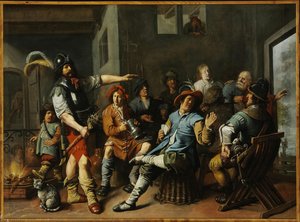
In the vibrant, bustling atmosphere of Amsterdam during the seventeenth century, a period defined by the luminous heights of the Dutch Golden Age, Willem Cornelisz Duyster (1599–1635) emerged as a master of the intimate. While many of his contemporaries sought to capture the sweeping grandeur of historical epics or the stiff formality of aristocratic portraiture, Duyster turned his gaze toward a much more grounded and human subject: the cortegaarddje, or guardroom scenes. He eschewed the thunder of battlefield glory in favor of the quiet, unvarnable realities of military life, finding profound narrative potential in the pauses between conflicts.

A Tapestry of Influence and Technical Brilliance

Duyster’s artistic evolution was a sophisticated blend of inherited tradition and personal innovation. His early training as a portraitist provided him with an essential foundation in anatomical precision, but it was his engagement with the works of contemporaries like Jacob Jansz van Velsen and Gerard ter Borch the Younger that truly refined his vision. From Van Velsen, he drew an ability to orchestrate complex social dynamics within domestic settings, while from Ter Borch, he inherited a devotion to psychological realism and an almost obsessive attention to detail. This synthesis allowed him to transform simple genre paintings into deep explorations of character and human interaction.

His technical mastery was perhaps most breathtakingly evident in his treatment of texture. Duyster possessed a singular ability to render the tactile world; under his brush, heavy velvets and shimmering silks seemed to catch the light with a convincing, palpable weight. In works such as A Wedding Feast, the fabrics do not merely serve as costume but act as luminous protagonists, their intricate weaves and lustrous surfaces demonstrating an unparalleled command over color and light that remains captivating to the modern eye.

The Human Heart within the Guardroom

What ultimately secures Duyster’s place in the pantheon of Dutch Masters is his refusal to idealize his subjects. His soldiers are not mere symbols of valorous heroism; they are flesh-and-blood individuals, imbued with palpable emotion and complex interpersonal relationships. Through subtle glances, weary postures, and the quiet intimacy of shared moments, Duyster captured the psychological depth of those living within the barracks. He did not merely paint soldiers; he painted the human condition, ensuring that his guardroom scenes remain as poignant and resonant today as they were in the seventeenth century.
Willem Cornelisz Duyster

Willem Cornelisz Duyster

1599 - 1635 , Netherlands

基本情報

  • Artistic Movement Or Style: Dutch Golden Age
  • Artists Or Movements Influenced By This Artist: ['Gerard ter Borch the Younger']
  • Artists Who Influenced This Artist: ['Jacob Jansz van Velsen']
  • Date Of Birth: Amsterdam, Netherlands (1599)
  • Date Of Death: 1635
  • Full Name: willem cornelisz duyster
  • Nationality: Dutch
  • Notable Artworks:
    • A Wedding Feast...
    • Portrait of a Woman...
    • Portrait of a Man...
  • Place Of Birth: Amsterdam