 プレビュー
プレビュー
 シェアする
シェアする シェアする
シェアする
 詳細を見る
詳細を見る

 ダウンロード
 似ている作品
 X線調査
X線調査 スライドショー
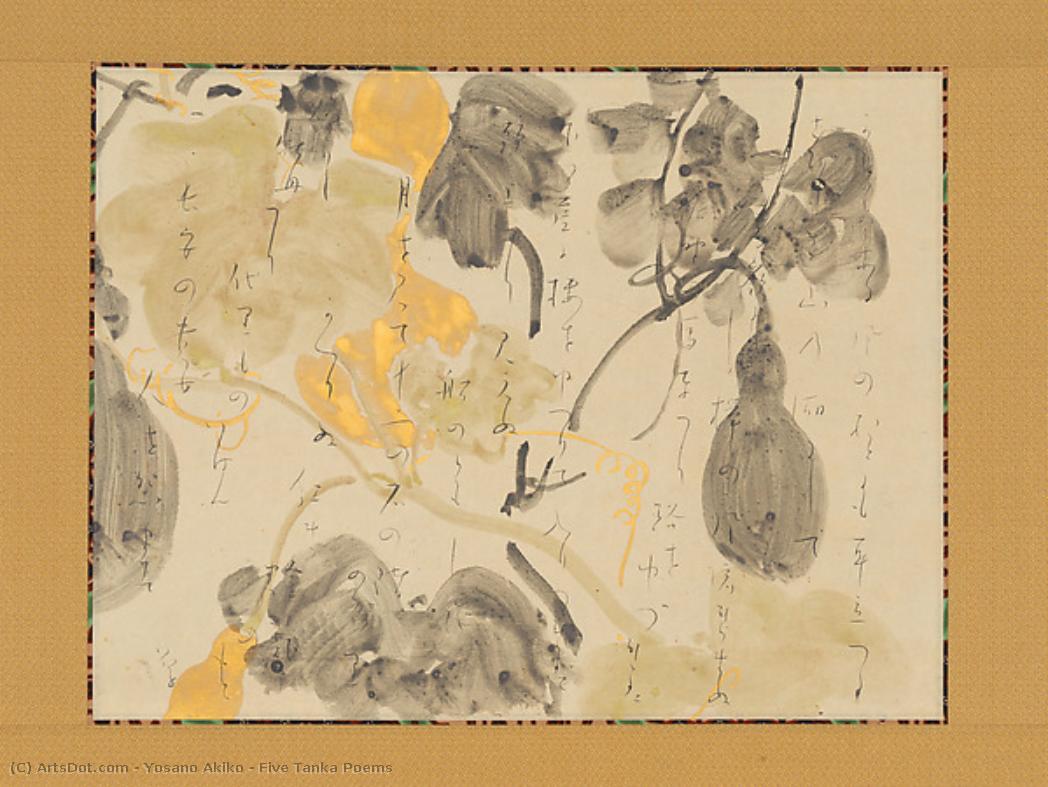
Five Tanka Poems
 1933
1933 27.0 x 35.0 cm
 詳細を見る
詳細を見る
ジークレー/アートプリント
迅速な制作と多彩な仕上げオプションを備えた、ミュージアムクオリティのジークレーまたはキャンバスプリント。 ( 手描きの絵画を購入 画像を購入)




































Standard
custom
CM
INCH
作品のオリジナル比率に合わせた、当店の規定サイズからお選びください。
Loading sizes...

幅
高さ
特定のフレームやスペースに合わせて、ご自身でサイズを指定することも可能です。選択されたサイズが元の画像の比率と一致しない場合、作品をトリミングするか、鏡面反射または単色での塗りつぶしによって画像を拡張いたします。制作を開始する前に、ご確認用のデジタルモックアップをお送りいたします。
画面上のプレビューには、実際のトリミングや拡張は反映されませんのでご注意ください。最終的な構図を正確に確認できるのは、モックアップのみとなります。
カスタムサイズも承っておりますが、元の比率を維持するためには、あらかじめ用意されたリストからサイズを選択することをお勧めいたします。


 ガラスオプションは、110cm未満のサイズでのみご利用いただけます。

Five Tanka Poems
ジークレー/アートプリント
複製画のサイズ
-


合計金額
$ 62
作品詳細説明
Yosano Akiko, who brushed the calligraphy on this elegantly decorated paper with a gold and silver gourd vine motif, is one of most highly esteemed female poets of the modern period, active until her death in 1942. The poetry sheet, perhaps part of a longer sheet, is delicately brushed with five of her own tanka (modern poems based on traditional 31-syllable waka), which recall classical poetic imagery while demonstrating how she developed her own distinctive style of calligraphy—at once elegant yet marked by sharp turns and an overall angular quality. Most striking is how she radically simplified kanji (Chinese ideographic characters) so that they are almost as light in visual weight as the kana (Japanese phonetic characters). Furthermore, the use of decorated paper with gold and silver underpainting brings to mind the aesthetic found in Tale of Genji painting and calligraphy albums of the Momoyama period.Though calligraphers of the modern age trained, as calligraphers of the past had, by studying eminent historical models, it is always interesting to observe how styles and conventions of calligraphy could be marshaled to express a modern sensibility. Akiko, not only translated The Tale of Genji into modern Japanese, but also immersed herself in the recitation and copying of the earliest manuscript recensions of the narrative and achieved recognition as a skilled calligrapher in her own right.Her poems are cherished for their relatable emotional explicitness, and sometimes even eroticism (during a time women were not supposed to express themselves freely in their literary writings). The publication of her first collection of poetry, Tangled Hair (Midaregami 1901), created a stir in Japanese literary circles for its frank depictions of female passion as well as sexual and spiritual love. At a moment when Japanese literature was opening to the influence of European Romanticism, Akiko’s poetry captured the new sense of expansiveness that marked the period’s revival of old forms of poetry and various experiments in new techniques. Along with publishing over twenty collections of poetry, and numerous tracts on social criticism (she was anti-nationalism and openly critical of government policies of foreign aggression in China and elsewhere).What makes this calligraphic composition even more interesting is that a previous owner must have also been given the original preliminary drafts of the poems that Akiko used in creating this work, and it is interesting to see how she altered things when brushing the final draft. The final version of the first poem, the first two columns on the right, reads as follows:かすかなる 風のおとにも 耳立てて さびしき山のに してKasuka naru / kaze no oto ni mo / mimi tatete / sabishiki yama no / mizuumi ni shiteEven though the sound of the wind soughs so softly, still I feel so lonely at this mountain lake.In the preliminary version, Akiko had initially started to think about the loneliness of her “lodgings” (yado 宿) while on journey to an onsen in the mountains. But clearly she was not happy with the sound of that—and circled that character, as if to single it out for revision, and switched to the image of a “mountain lake.”
関連作品
アーティストの略歴
The Enigmatic Vision of Shō Hō
Shō Hō, a contemporary artist whose work defies easy categorization, has emerged as a compelling voice in the global art landscape. Born in an undisclosed location – a deliberate choice by the artist to separate the persona from the creation – Shō Hō’s life remains shrouded in mystery, adding another layer of intrigue to their already captivating oeuvre. This intentional obscurity allows viewers to engage with the artwork purely on its aesthetic and emotional merits, unburdened by biographical preconceptions. What *is* known is that Shō Hō began formal artistic training at a young age, mastering traditional techniques before embarking on a path of radical experimentation. Early influences included classical Japanese calligraphy and Sumi-e ink painting, disciplines emphasizing minimalism, balance, and the expressive power of empty space. However, these foundations were soon interwoven with an eclectic range of inspirations – from the abstract expressionism of Mark Rothko to the philosophical underpinnings of Zen Buddhism and the raw energy of street art. This unique confluence of traditions and styles forms the bedrock of Shō Hō’s distinctive artistic language.Deconstructing Form: A Journey Through Abstraction
Shō Hō's work is characterized by a profound exploration of abstraction, often manifested in large-scale canvases dominated by sweeping brushstrokes, layered textures, and subtle gradations of color. The artist eschews representational imagery, instead focusing on the inherent qualities of paint itself – its viscosity, luminosity, and capacity to evoke emotion. Early pieces demonstrate a clear dialogue with Abstract Expressionism, particularly in their scale and gestural energy. However, Shō Hō quickly moved beyond mere imitation, developing a highly personal approach that prioritized restraint and contemplative depth.- The ‘Void’ Series (2010-2015): This pivotal body of work saw the artist explore the concept of *Ma* – the Japanese aesthetic principle of negative space – through minimalist compositions featuring vast expanses of monochrome color punctuated by delicate, almost imperceptible brushstrokes. These paintings are not about what is present but rather about what is absent, inviting viewers to project their own emotions and experiences onto the canvas.
- The ‘Chromatic Resonance’ Series (2015-2020): Shō Hō began experimenting with a wider palette of colors, creating complex layered compositions that evoke a sense of depth and movement. These works are characterized by their subtle gradations of tone and the interplay between light and shadow.
- Recent Works (2020-Present): The artist’s current work represents a further distillation of their aesthetic principles, with an increased emphasis on texture and materiality. Shō Hō often incorporates unconventional materials – such as sand, charcoal, and natural pigments – into their paintings, creating surfaces that are both visually striking and tactilely engaging.