

 プレビュー
プレビュー
 シェアする
シェアする シェアする
シェアする
 詳細を見る
詳細を見る

 ダウンロード
 似ている作品
 X線調査
X線調査 スライドショー
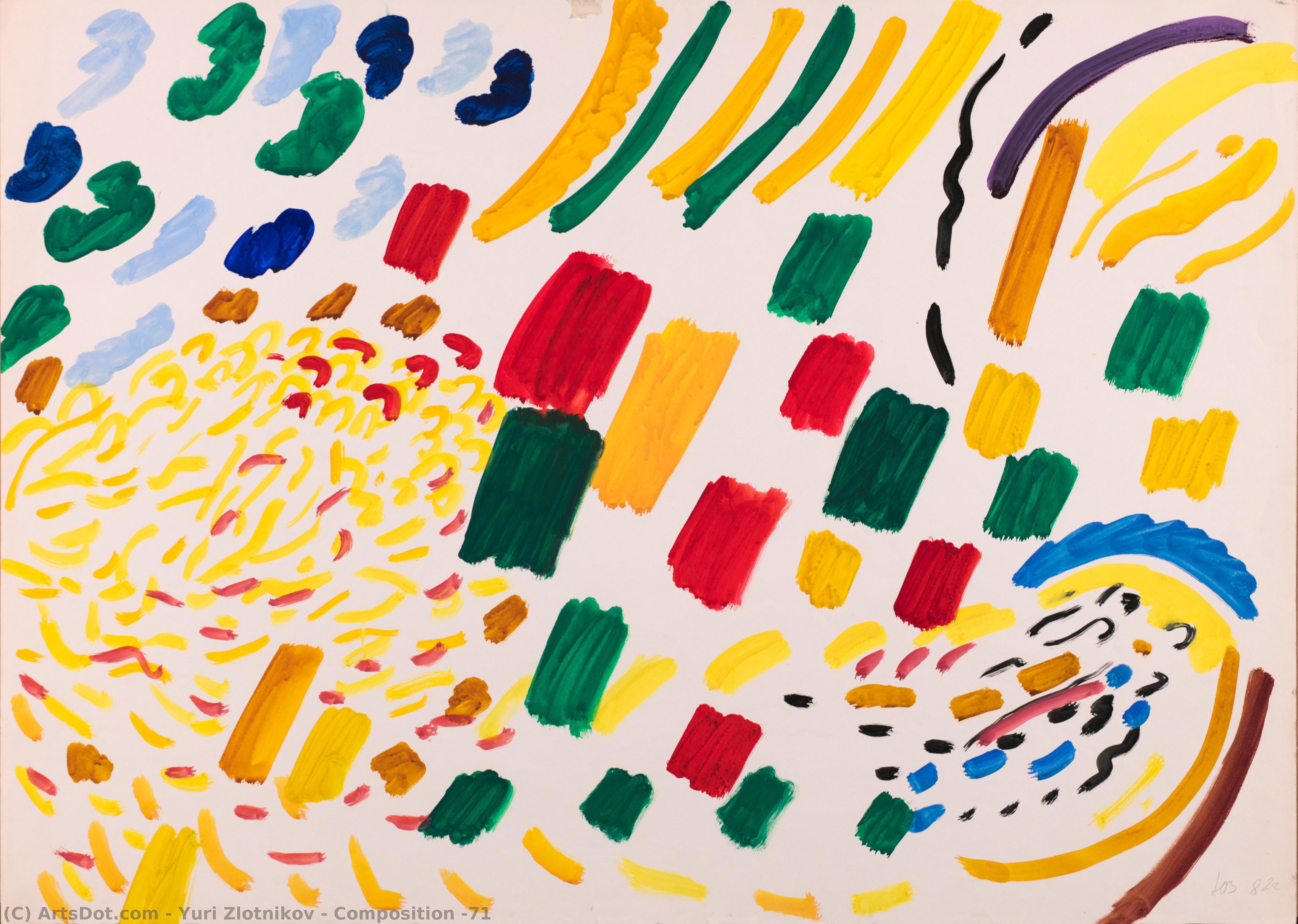
Composition #71
 Abstract Art
 1982
1982 60.0 x 85.0 cm
 詳細を見る
詳細を見る
ジークレー/アートプリント
迅速な制作と多彩な仕上げオプションを備えた、ミュージアムクオリティのジークレーまたはキャンバスプリント。 ( 手描きの絵画を購入 画像を購入)




































作品のオリジナル比率に合わせた、当店の規定サイズからお選びください。

特定のフレームやスペースに合わせて、ご自身でサイズを指定することも可能です。選択されたサイズが元の画像の比率と一致しない場合、作品をトリミングするか、鏡面反射または単色での塗りつぶしによって画像を拡張いたします。制作を開始する前に、ご確認用のデジタルモックアップをお送りいたします。
画面上のプレビューには、実際のトリミングや拡張は反映されませんのでご注意ください。最終的な構図を正確に確認できるのは、モックアップのみとなります。
カスタムサイズも承っておりますが、元の比率を維持するためには、あらかじめ用意されたリストからサイズを選択することをお勧めいたします。


 ガラスオプションは、110cm未満のサイズでのみご利用いただけます。

Composition #71
ジークレー/アートプリント
複製画のサイズ
-


合計金額
$ 62
関連作品
アーティストの略歴
Yuri Zlotnikov: Pioneer of Russian Abstract Art
Yuri Zlotnikov (1930 – 2016) stands as a singular figure in the history of Soviet art, recognized primarily for his groundbreaking contribution to abstract painting and his unwavering commitment to exploring the intersection between art and science. Born in Moscow during the tumultuous years following World War II, Zlotnikov’s artistic journey unfolded against the backdrop of Khrushchev’s Thaw—a period characterized by a cautious liberalization of cultural expression after decades of rigid ideological control—and he quickly established himself as a champion of nonconformist aesthetics within the Soviet art scene. His formative years were marked by exposure to influential figures like Ilya Kabakov and Lev Povzner, who instilled in him a critical perspective on Socialist Realism and fueled his desire to forge an independent artistic path.- Early Influences: Zlotnikov’s intellectual curiosity extended beyond painting itself; he was deeply engaged with the burgeoning field of cybernetics—a discipline pioneered by Norbert Wiener—which explored the principles of communication and control in both biological systems and machines. This fascination profoundly shaped his artistic methodology, informing his belief that art could actively contribute to reshaping societal understanding and behavior.
- The “Signal System” Series (1957-1962): Zlotnikov’s most celebrated achievement resides in the “Signal System” series—a collection of abstract paintings created during the Thaw era. These works, executed primarily in gouache and tempera on paper, represent a pivotal moment in Soviet art history. Rejecting the prevailing dogma of Socialist Realism, Zlotnikov sought to liberate painting from its constraints by investigating the psychological impact of color and form—drawing inspiration from composers like Anton Webern and mathematicians exploring geometric patterns.
- Scientific Approach: Unlike many fellow nonconformist artists who embraced emotional expression as their primary artistic impulse, Zlotnikov insisted on a rigorously scientific framework for his creative endeavors. He meticulously documented his experiments with electrocardiograms and bio-currents—collaborating closely with researchers at Botkin Hospital—demonstrating that he viewed painting not merely as an aesthetic pursuit but as a tool for probing the fundamental laws governing human perception and behavior.
- Collaboration with Technocrats: Zlotnikov’s artistic vision found resonance among young engineers working in closed military institutes, who championed independent artists and facilitated access to laboratory facilities. This partnership proved instrumental in validating his hypotheses about the transformative potential of art—particularly its capacity to influence the design of spacecraft and contribute to advancements in technological innovation.
- Legacy: Zlotnikov’s unwavering conviction that art could reshape society—echoing the utopian aspirations of Constructivist artists—remained a defining characteristic throughout his life. His work continues to inspire contemporary artists and scholars alike, serving as a testament to the enduring power of artistic experimentation and intellectual rigor in challenging conventional notions of beauty and truth.
Exploring Geometric Abstraction and Cybernetic Influences
Zlotnikov’s artistic method was characterized by an uncompromising dedication to mathematical precision—a stance that contrasted sharply with the prevailing trend among Soviet nonconformist artists who prioritized emotional subjectivity. He meticulously analyzed geometric patterns, mirroring the principles of cybernetics—the science of communication and control—which Wiener had championed in 1948. This scientific approach wasn’t merely a stylistic choice; it represented Zlotnikov's profound belief that art could illuminate underlying realities—much like the microschematics of computer engineers—and contribute to reshaping human understanding. The “Signal System” series exemplifies this conviction, presenting abstract signs rendered with crystalline clarity and reflecting both Chintz fabrics from Khrushchev’s Thaw and the cartography of Soviet settlements.The Tretyakov Gallery Exhibition: Rediscovering Zlotnikov's Vision
A recent exhibition at the State Tretyakov Gallery in Moscow—titled “Yuri Zlotnikov: Exploring Geometric Abstraction”—provided a crucial opportunity to revisit Zlotnikov’s artistic legacy and reaffirm his significance within Soviet art history. Featuring works from the Tsukanov Family Foundation and other private collections, the show underscored Zlotnikov's pioneering role in establishing abstract painting as a viable alternative to Socialist Realism—a movement that had dominated Soviet culture for decades. The exhibition highlighted Zlotnikov’s collaboration with young engineers who embraced cybernetics and championed independent artists—demonstrating that his artistic explorations were deeply intertwined with broader intellectual currents shaping the Soviet era.A Dialogue Between Art and Science: Reflections on Zlotnikov's Philosophy
Zlotnikov’s philosophical outlook—rooted in positivism and rationalism—fueled his conviction that art should engage rigorously with scientific research—a stance that distinguished him from many of his contemporaries who prioritized emotional expression. He likened the impact of Wiener’s cybernetics to “the sudden destruction of the entire world,” recognizing its potential to fundamentally alter human perception and behavior. This intellectual fervor extended beyond painting itself; Zlotnikov pursued studies in mathematics, philosophy, and psychology—reflecting a broader humanist impulse to comprehend the complexities of human experience and contribute to advancing knowledge.
yuri zlotnikov
1930 - 2016 , Russia
基本情報
- Artistic Movement Or Style: Abstract Art
- Artists Or Movements Influenced By This Artist:
- Rothko
- Pollock
- Artists Who Influenced This Artist:
- Kandinsky
- Malevich
- Date Of Birth: April 23, 1930
- Date Of Death: October 25, 2016
- Full Name: Yuri Zlotnikov
- Nationality: Russian
- Notable Artworks: ['Composition #71']
- Place Of Birth: Moscow, Russian Federation