The Genesis of Mystery: Formative Trauma and the Belgian Landscape
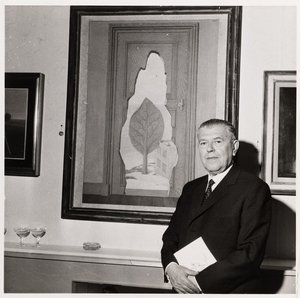 René Magritte
Early Life and the Seeds of Surrealism René Magritte, born René François Ghislain Magritte on November 21, 1898, in Lessines, Belgium, emerged into a world that would profoundly shape his enigmatic artistic vision. His early years were marked by an u...
To understand the enigmatic gaze of René Magritte, one must first wander through the somber, mist-laden landscapes of his youth in Belgium. Born in 1898 in Lessines, Magritte’s entry into the world was marked by a quiet, unsettling gravity that would later define his entire artistic vocabulary. The shadows of his formative years were cast long by a profound personal tragedy: the suicide of his mother when he was just thirteen. While historical accounts debate the exact details of her passing in the River Sambre, the haunting imagery associated with it—specifically the notion of her dress obscuring her face upon recovery—became a persistent motif in his later work. This early encounter with loss and concealment instilled within him a lifelong fascination with what remains unseen and the unsettling power of the veiled.
His artistic journey was not a sudden burst of surrealist inspiration but a deliberate evolution through the established traditions of his era. Initially exploring Impressionism, Magritte eventually moved through the structured influences of Futurism and Cubism during his studies at the Académie Royale des Beaux-Arts in Brussels. However, it was his 1922 encounter with Giorgio de Chirico’s
The Song of Love that acted as a catalyst, unlocking a new way of seeing. De Chirico’s dreamlike landscapes provided the blueprint for Magritte to move beyond mere formal experimentation and toward a realm where the ordinary could be rendered strange, imbuing everyday objects with a profound, psychological mystery.
The Paradox of Representation: Decoding 'The Treachery of Images'
The Treachery of Images - Wikipedia--- title: The Treachery of Images - Wikipedia author: Show Authority Control Databases International Viaf Gnd National France Bnf Data url: https://en.wikipedia.org/wiki/The_Treachery_of_Images hostname: wikipedia.org sitename: Wikimedia Foundation,...
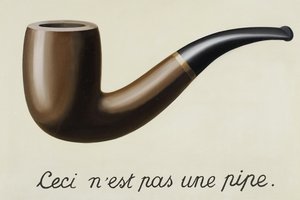
Perhaps no single work embodies the intellectual rigor of Magritte’s philosophy more than his 1929 masterpiece,
The Treachery of Images. Known colloquially as
Ceci n'est pas une pipe (This is not a pipe), this painting serves as a profound meditation on the gap between reality and representation. By painting a meticulously rendered tobacco pipe accompanied by a text that denies its identity, Magritte forces the viewer into a state of cognitive dissonance. He reminds us that the image of the object is not the object itself; one cannot stuff, light, or smoke a painted representation. This subversion of the familiar serves as a foundational pillar of his "Surritualist Realism," where the medium becomes a tool for questioning the very foundations of truth.
This linguistic and visual play extends far beyond a single canvas, challenging the viewer to recognize that our perceptions are often mediated by symbols and labels. Magritte’s work functions as a high-definition glitch in the fabric of our perceived world, utilizing hyperrealistic techniques to render illogical scenes with an unsettling clarity. For the discerning collector, this tension between the recognizable subject and the impossible context offers a continuous intellectual engagement, ensuring that the artwork remains a living question rather than a static image.
Surrealist Realism: The Precision of the Uncanny
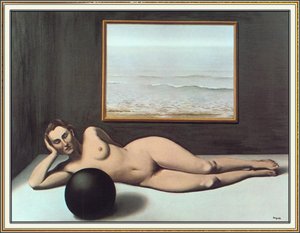 Bather between Light and Darkness
A Surrealist Meditation on Perception René Magritte’s “Bather Between Light and Darkness,” painted in 1935, stands as a quintessential example of Surrealism—a movement that sought to liberate the imagination from rational constraints and explore the ...
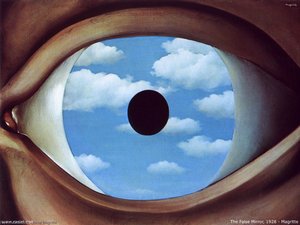
While many associate Surrealism with the spontaneous, dream-like distortions of Dalí, Magritte charted a more cerebral course through what can be described as Surrealist Realism. His approach was characterized by an almost academic precision, employing meticulous oil paint application to achieve smooth surfaces devoid of pronounced impasto. This understated technique allows for subtle tonal gradations that heighten the painting’s dramatic effect, making the impossible appear tangibly real. In works such as
Bather Between Light and Darkness, he uses stark contrasts—a luminous blue ocean merging with a muted, interior room—to create an unsettling juxtaposition that defines his core aesthetic.
This precision is vital to the success of his "mind games." By rendering familiar objects—bowler hats, green apples, clouds, and pipes—with such clarity, he creates a sense of trust in the viewer's eyes, only to systematically betray that trust through unexpected contexts. This method does not seek to depict dreams so much as to question reality through their depiction. The result is an art form that feels grounded in the physical world yet vibrates with the energy of the subconscious, making his works particularly effective in sophisticated architectural spaces where they can provoke contemplation without disrupting the environment's elegance.
Visual Metaphors: Exploring Veiled Figures and Hidden Truths
 The Lovers (Magritte)
The Lovers (French: Les Amants (French pronunciation: [lez‿amɑ̃])) is a surrealist painting by René Magritte, made in Paris in 1928. It is the first in a series of four variations, and in the painting two people can be seen kissing passionately with ...
A recurring thread throughout Magritte’s oeuvre is the use of concealment as a metaphor for the human condition. The motif of the veiled face, seen prominently in
The Lovers, transforms an act of profound intimacy—a kiss—into an act of frustration and isolation. The barrier of fabric prevents true connection, representing the inherent boundaries between individuals and the hidden realities that exist beneath surface appearances. This preoccupation with the obscured is also evident in his more recent works, where figures are often partially masked or placed within landscapes that defy physical logic.
These visual metaphors extend to his use of light and shadow, as seen in the tension of
The Triumphal March or the duality of daylight and night in his explorations of the "Empire of Light." Magritte uses these elements to create a visual metaphor for the complexity of existence, where the sunlit sky might rest atop a nocturnal streetscape. For those looking to curate collections that speak to deeper themes of introspection and mystery, Magritte’s ability to use simple, recognizable symbols to convey complex emotional truths provides an unparalleled depth of subject matter.
The Legacy of Illusion: Magritte's Influence on Modern Perception
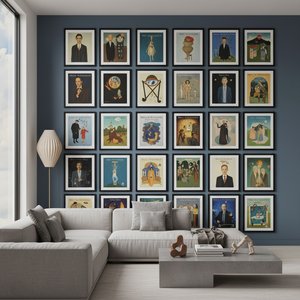 René Magritte's Masterpieces: 25 Surrealist Paintings for Art Lovers | ArtsDot
Introduction To embark on a journey through the top 25 artworks of René Magritte is to enter a realm where the familiar dissolves into the enigmatic, and reality itself becomes a question mark. These paintings are not merely images; they are portals—...
The enduring power of René Magritte lies in his ability to resonate across generations, influencing not only the Surrealist movement but also Pop Art, Minimalism, and Conceptual Art. In a modern era saturated with digital imagery and manipulated information, his warnings about the treachery of images feel more prescient than ever. His work serves as a vital reminder that seeing is not necessarily believing and that our perceptions are subjective, malleable, and often deceiving.
For the professional decorator or the serious art collector, Magritte’s legacy offers a way to introduce intellectual depth into contemporary spaces. Whether through a large-scale multi-panel arrangement for a corporate lobby or a singular, striking reproduction in a private study, his imagery provides a window into a world where reality itself becomes a question mark. His paintings are not merely decorations; they are portals that invite us to look beyond the surface and embrace the inherent mystery of our existence.
For those seeking to bring the profound mysteries of Magritte into their professional or private collections, ArtsDot.com offers museum-quality, hand-painted oil reproductions. Our master artists specialize in capturing the precise textures and tonal depths required to honor Magritte's legacy, providing bespoke sizing and custom framing solutions for large-scale architectural projects and intimate acquisitions alike.