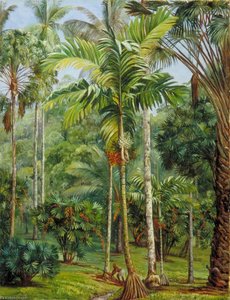

The Shift from Romanticism to Realism: A New Vision of Nature
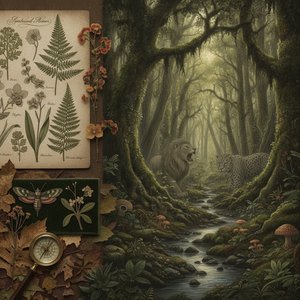 Victorian Naturalism: The Art of Capturing Botanical Precision and Raw Wilderness
The Essence of Victorian Naturalism: A Departure from Romanticism To understand the profound shift brought about by Victorian Naturalism, one must first look back at the sweeping, often idealized landscapes of the preceding Romantic era. Where the Ro...
To understand the profound metamorphosis of the nineteenth-century aesthetic, one must first look back at the sweeping, often idealized landscapes of the preceding Romantic era. In those earlier decades, artists sought to evoke the sublime—that overwhelming, sometimes terrifying power of nature that dwarfs the human spirit through dramatic storms and misty, unreachable peaks. However, as the Victorian era progressed, a subtle yet radical shift began to take hold within the European consciousness. The gaze of the artist turned away from the speculative and the supernatural, seeking instead a more intimate, grounded reality.
This transition was not an abandonment of emotion, but rather a redirection of it. Where the Romantics found divinity in the untamed tempest, the Naturalists found it in the quiet, intricate architecture of a single leaf or the precise arrangement of a petal. This movement emerged from a deep-encoded curiosity about the world, moving away from the idealization of classical traditions toward a truthful representation of subject matter without artificiality or exaggeration. It was a period where the artist’s brush became an instrument of observation, capturing the world not as we wish it to be, but exactly as it exists in its magnificent, unadorned state.
Botanical Precision: The Intersection of Scientific Inquiry and Aesthetic Grace
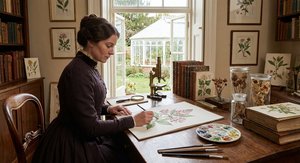 Victorian Botanical Painting: Science, Art & Aesthetic Sensibility
The Rise of Botanical Fascination: Victorian Society & the Natural World Wikipedia: Botany Botany, also called phytology or plant science, is the branch of natural science and biology that studies plants, especially their anatomy, taxonomy, and ecolo...
The Victorian era was a period defined by grand expeditions and a burgeoning fascination with botanical science. This was an age where the boundaries between the laboratory and the gallery began to dissolve, creating a unique sanctuary where scientific rigor met profound aesthetic grace. Botany, or phytology, became more than a mere academic pursuit; it became a cultural phenomenon. As explorers cataloged flora from the furthest reaches of the globe, a growing middle class, eager for intellectual stimulation, sought to bring these discoveries into their private sanctuaries.
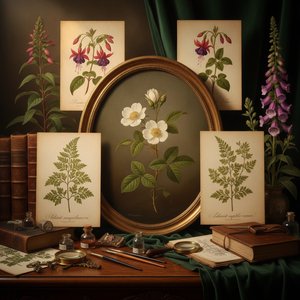
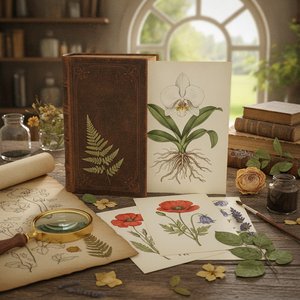
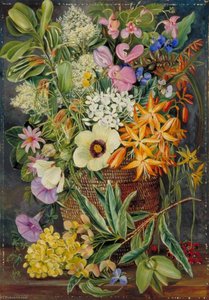
In this context, botanical painting emerged as a vital visual language. The Victorian botanical artist acted as a visual translator between the scientific community and the wider public. Accuracy was paramount, demanding meticulous observation and painstaking detail that could satisfy the most discerning botanist. Yet, these works transcended mere technical documentation. In the hands of a master, a study of a specimen became a celebration of life itself. The precision of perception allowed for an exploration of anatomy, taxonomy, and ecology, all while maintaining a level of beauty that turned scientific records into enduring masterpieces of fine art.
Pioneers of the Wild: Exploring the Legacies of Marianne North and Frederick E. Cohen
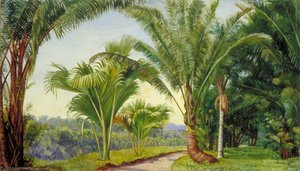 Palms in the Botanic Garden, Buitenzorg, Java
A Victorian Explorer's Ode to Tropical Beauty: Marianne North’s ‘Palms in the Botanic Garden’ Marianne North (1830–1890) wasn’t merely an artist; she was a pioneer, a woman who defied societal expectations and charted her own course toward scientific...
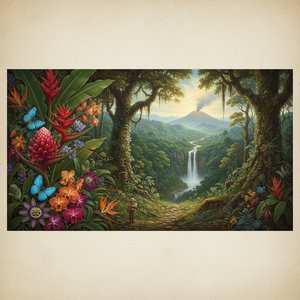
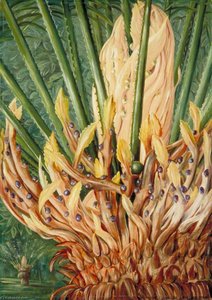
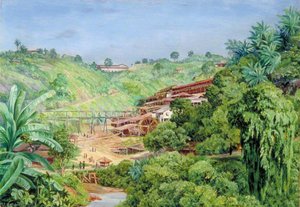
Within this movement, certain figures emerged as true pioneers, defying the societal constraints of their time to document the extraordinary. Marianne North stands as perhaps the most luminous example of this spirit. A woman who navigated the complexities of Victorian society with unparalleled courage, North was not merely an artist but a global explorer. Her journeys across Africa, Asia, and South America were driven by a personal quest to capture the vibrant energy of plants within their natural habitats. Unlike formal botanical studies that isolated specimens for scrutiny, North’s work explodes with life, using luminous watercolors to recreate the dappled sunlight of tropical gardens in Java or the humid serenity of Queensland.
In contrast to North's vibrant, expansive vistas, the work of Frederick E. Cohen offers a more introspective glimpse into the era’s fascination with detail. His meticulous botanical illustrations and scientific studies provide a shadowed, quieter vision of the natural world. Cohen’s dedication to an almost photographic precision reveals the era’s obsession with observation. While North captured the spirit of the wild, Cohen captured its essence through a profound commitment to accuracy, utilizing light and shadow to lend an air of solemnity to his subjects. Together, these artists represent the dual heartbeat of Naturalism: the outward expansion of discovery and the inward depth of scientific devotion.
The Texture of Truth: Mastering Light, Shadow, and Botanical Detail
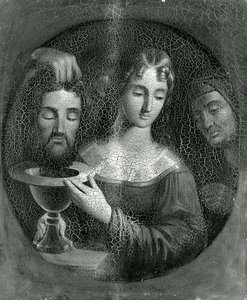 frederick e cohen
Frederick E. Cohen: A Shadowed Vision of Victorian Detail The world of 19th-century art often presents a brightly lit stage, filled with grand portraits and sweeping landscapes. Yet, within that realm existed a quieter, more introspective artist – Fr...
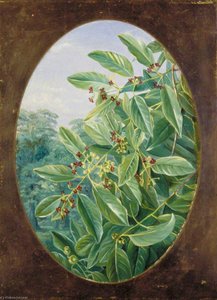
The true mastery of Victorian Naturalism lies in its technical execution—the ability to render the tactile reality of the natural world so convincingly that the viewer can almost feel the velvet of a petal or the waxy surface of a leaf. This was achieved through a sophisticated interplay of light and shadow, often reminiscent of Baroque techniques. Artists utilized layering and glazing to create a sense of depth and luminosity, particularly in watercolor, which allowed for subtle tonal variations that mimured the translucency of living tissue.
The use of impasto and textured brushstrokes in oil painting further enhanced this realism, providing a physical dimension to the subject matter. By carefully controlling the way light hits the ridges of paint, artists could simulate the moisture on a fern or the rugged bark of an ancient tree. This commitment to the texture of truth ensured that every painting was not just a depiction, but an encounter. The meticulous rendering of form and texture served to ground the viewer in the present moment, celebrating the intricate, often overlooked details that constitute the very fabric of our natural existence.
The Enduring Legacy of Victorian Naturalism in Modern Interior Curation
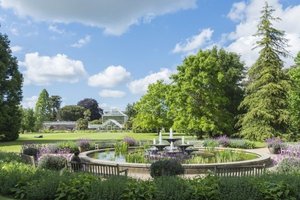 Cambridge University Botanic Garden
A Living Chronicle of Botanical Artistry Nestled within the historic heart of Cambridge, the Cambridge University Botanic Garden serves as much more than a mere horticultural display; it is a living, breathing masterpiece where scientific inquiry mee...
Today, the principles of Victorian Naturalism continue to resonate within the realm of high-end interior design and art collection. In an age of digital abstraction, there is a profound longing for the authenticity and permanence found in the natural world. The timeless elegance of botanical oil paintings offers a sense of heritage and tranquility that can transform a modern space into a sanctuary of reflected history.
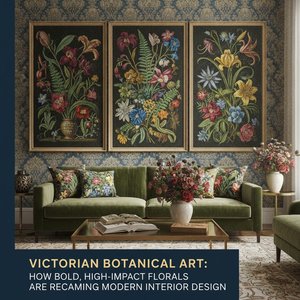
For the discerning collector or interior designer, integrating these classical elements allows for a sophisticated dialogue between the past and the present. Whether through large-scale multi-panel compositions that span a grand hallway or bespoke reproductions that bring a touch of a tropical garden to a private study, the legacy of Naturalism remains a powerful tool for creating atmosphere. It invites a slower, more mindful appreciation of beauty—a reminder that even in our most modern environments, we remain deeply connected to the enduring majesty of the natural world.
About ArtsDot.com
ArtsDot.com is the global flagship for premium art reproductions and custom commissions. Since 2004, we have been dedicated to making the Old Masters accessible to the most discerning collectors, homeowners, and professionals worldwide. Our collection of over 465,000 paintings features hand-painted oil reproductions on 100% cotton canvas, meticulously crafted by artists from prestigious Fine Arts academies. From bespoke portrait commissions to large-format architectural murals, every piece is a testament to human craftsmanship and historical reverence. We offer a seamless, luxury experience, including professional digital mockups, international shipping via DHL/FedEx, and a 100% satisfaction guarantee. Discover the art of transformation at ArtsDot.com.